
Peer review process
Revised: This Reviewed Preprint has been revised by the authors in response to the previous round of peer review; the eLife assessment and the public reviews have been updated where necessary by the editors and peer reviewers.
Read more about eLife’s peer review process.Editors
- Reviewing EditorSiming ZhaoDartmouth College, Lebanon, United States of America
- Senior EditorAlan MosesUniversity of Toronto, Toronto, Canada
Reviewer #2 (Public review):
Summary:
The authors have used 1477 sequenced trios with available gene expression data in the offsprings to discover eQTLs that act in a parent-of-origin specific manner. The classified their associated SNPs are tested for enrichment for GWAS hits, drug target genes, etc.
Strengths:
The manuscript presents an impressive analysis of a very rich data set of parent-of-origin eQTLs. To my knowledge, it is one of the largest studies of its kind and most analyses are sound and the results are of interest to many in the field and potentially beyond. The different ideas of follow-up analyses are useful and make sense.
Weaknesses:
While in general the analyses are well-conducted, I noticed a major issue with the POE eQTL classification, which puts into question most of the downstream analysis. In the light of this problem, all claims of individual discoveries (apart from those in Table 1) should be removed. The enrichment analyses remain valid and are useful.
Author response:
The following is the authors’ response to the original reviews.
Public Reviews:
Reviewer 1 (Public review):
Summary:
This study presents a systematic investigation of parent-of-origin effects on gene expression using trio-based data from the Framingham Heart Study, which is notable for its relatively large number of trios. By combining whole-genome and RNA sequencing data, the authors examined the extent to which gene expression is influenced by whether genetic variants are inherited maternally or paternally.
The authors report that parent-of-origin eQTLs are widespread, identifying 15,893 eQTLs from 14,733 variants and 1,824 genes that were significant in paternal, maternal, or joint tests but not detected by traditional eQTL approaches. They further classified these associations based on the relative strength and direction of paternal and maternal effects, highlighting a subset with opposing directions. The study also highlighted eGenes linked to known imprinted genes as well as those with opposing parent-specific effects, and observed that paternal eGenes are enriched for drug targets. Finally, the work revisits previous findings in which eQTL studies were used to interpret disease-associated loci, emphasizing that conventional eQTL analyses without testing the parent-of-origin may mislead gene prioritization efforts. The study recommends that future downstream analyses, such as Mendelian randomization, take into account the provided lists of SNPs and eGenes and exclude those with strong parent-of-origin effects when linking genetic regulation to disease risk.
Strengths:
The major strength of the study lies in the scale and quality of the dataset, the trio-based design, and the systematic application of statistical tests for parent-of-origin effects. The strengths thoughtfully employed Bayes factors rather than p-values to provide stronger evidence of association, which adds rigor to their analyses. These design choices provide compelling evidence that parent-of-origin effects are widespread and that conventional eQTL analyses miss a substantial fraction of regulatory variation. The results are clearly presented and supported by robust analyses, including the identification of opposing parental effects and the enrichment of paternal eGenes for drug targets. Notably, the two examples demonstrating how these findings can reshape disease gene prioritization highlight the broader impact of the study and encourage further work in the community to incorporate parent-of-origin effects.
Weaknesses:
The main limitations of the study are threefold.
First, there is a lack of replication in independent cohorts, which is understandable given the difficulty of identifying datasets with a comparable number of trios, but replication would help establish the generalizability of the findings.
We fully agree with the reviewer that replication in an independent cohort is a crucial step for establishing generalizability. As the reviewer notes, the Framingham Heart Study, with its 1,477 trios possessing both WGS and RNA-seq data, represents a uniquely powerful and, to our knowledge, currently unmatched resource for this specific type of parent-of-origin eQTL analysis.
In the absence of an external cohort of comparable size and data richness, we have taken several steps to ensure the internal validity and robustness of our findings within the current study, which we will clarify and expand upon in the revised manuscript:
Positive Control Validation: We explicitly used well-established, bona fide imprinted genes (e.g., MEG3, NDN, SNURF, as listed in Table 1 and Figure 1) as positive controls. The fact that our analysis correctly identifies their known parent-of-origin expression patterns (e.g., maternal eQTL for MEG3, paternal eQTL for NDN) serves as a powerful internal validation of our phasing methodology, statistical models, and significance thresholds. This demonstrates that our approach has the power to detect true POE signals.
Conservative Calling Criteria: As the reviewer suggests, we prioritized specificity. Our definition of eQTL sets (Section 4.6) uses stringent thresholds (e.g., log10 BF > 4 for primary signals and θ = log10 2 for exclusivity). We explored different θ parameters (Supplementary Table S2) and chose the one that minimized the inclusion of false positives, ensuring that our core gene sets (e.g., G1,G0,G2) are high-confidence discoveries.
Rigorous Analytical Pipeline: As we note in the revised text, our conclusions are supported by a robust analytical pipeline. This includes trio-based phasing validated by simulation (Supplementary Table S1), the use of linear mixed models to control for relatedness and population structure, and the application of Bayes factors which inherently penalize variants with low minor allele frequencies, thereby reducing spurious associations.
We believe these internal consistency checks and methodological rigor provide strong confidence in our findings. To further facilitate external replication, we will make the full list of POE eQTLs and eGenes available as a comprehensive resource (as noted in the Discussion and Supplementary Materials), enabling other researchers to validate these findings as appropriate datasets become available.
Second, while Bayes factors are thoughtfully used to assess evidence of association, the paper does not fully explore how the chosen thresholds translate to the expected rate of false positives. For example, a minor allele frequency cutoff of 1% was applied, which seems somewhat arbitrary, and without reporting the allele frequency distribution of the identified eQTLs, it is unclear whether rare variants disproportionately contribute to the signals, potentially affecting the reliability of discoveries.
We thank the reviewer for raising this important point regarding the calibration of our significance thresholds and the potential role of rare variants. We address this by clarifying the relationship between Bayes factors, prior odds, and false discovery rates, and by providing a more detailed characterization of the variants we identified.
Bayes Factors and False Discovery: The reviewer is correct that the connection between a Bayes factor threshold and a false positive rate is not direct as it has to take into account of prior odds. As we briefly noted, for a given prior odds of association (e.g., 1 in 100 or 1 in 1000 for a cis-eQTL), a log10 BF = 4 corresponds to a posterior probability of association (PPA) of 0.99 or 0.90 respectively. Consequently, 1 − PPA can be interpreted as the local false discovery rate (lfdr), as we have now explicitly stated in Section 2.2 (citing Soloff et al., 2024). Our choice of log10 BF = 4 was therefore chosen to ensure a very low or modest lfdr (depending on the prior odds) for our primary findings.
Minor Allele Frequency Threshold: The 1% MAF cutoff was indeed a pre-analysis filtering step. It was chosen based on the power afforded by our sample size of 1,477 trios. For variants rarer than 1%, our study is underpowered to detect associations, and any signals would be highly unstable. Importantly, the reviewer’s concern about rare variants disproportionately contributing to signals is further mitigated by our use of Bayes factors. As we note in Section 2.2, the prior used in our Bayes factor computation (with σ = 0.5 in the prior for effect sizes, as described in Section 4.4) inherently penalizes variants with small minor allele frequencies. This is because for a given effect size, the evidence for association is weaker for a rare variant than a common one. Thus, the combination of a pre-analysis MAF filter and the Bayesian analysis itself guards against spurious findings driven by very rare alleles.
Allele Frequency Distribution: To directly address the reviewer’s request for transparency, in the revised manuscript we include a supplementary figure (e.g., Supplementary Figure S4) showing the distribution of minor allele frequencies (1000 genomes European descents) for the SNPs identified in paternal eQTL set SP and maternal eQTL set SM. This empirically demonstrate that our findings are not disproportionately driven by low-frequency variants and provide a more complete picture of the genetic architecture underlying these POE signals. We also add a sentence to the Results section (Section 2.5) summarizing this distribution.
Third, the ancestry background of the study samples is not reported, which could be a confounding factor in the genetic analyses.
We thank the reviewer for highlighting this omission. In the revised manuscript, we explicitly report the ancestry background of the Framingham Heart Study participants analyzed. Consistent with previous reports on this cohort, the vast majority of samples are of European descent.
Crucially, as the reviewer suggests, population stratification can be a confounder in genetic studies. To mitigate this, our analysis employed a linear mixed model (Section 4.4) that includes a random effect with a covariance structure defined by the genetic relatedness matrix (GRM). This approach is specifically designed to control for spurious associations due to both subtle population structure and known relatedness among individuals, ensuring that our findings are robust to these potential confounders.
Reviewer 2 (Public review):
Summary:
The authors have used 1477 sequenced trios with available gene expression data in the offspring to discover eQTLs that act in a parent-of-origin specific manner. The classified associated SNPs are tested for enrichment for GWAS hits, drug target genes, etc.
Strengths:
The manuscript presents an impressive analysis of a very rich data set of parent-of-origin eQTLs. To my knowledge, it is one of the largest studies of its kind, most analyses are sound, and the results are of interest to many in the field and potentially beyond. The different ideas of follow-up analyses are useful and make sense.
Weaknesses:
While in general the analyses are well-conducted, I noticed a major issue with the POE eQTL classification, which puts into question most of the downstream analysis. In light of this problem, most of the analysis would need to be rerun, which represents a major revision of the paper, but is straightforward to repair.
We appreciate the reviewer’s concern and take it seriously. However, we believe the issue stems from a misunderstanding of our classification framework. We clarify our reasoning below, and we are confident that no re-analysis is necessary. In fact, our Bayesian approach was specifically chosen to avoid the very problem the reviewer raises.
The major problem with the classification of POEs is that simply having significant maternal, but insignificant paternal effect is not an indicator of POE, this happens widely for SNPs with no POE whatsoever (it can happen by chance even when both maternal and paternal effects are the same and non-zero - the authors can see it via simulations under the null [maternal=paternal effect]).
The reviewer raises a valid statistical concern: under the null hypothesis of equal maternal and paternal effects (β0 = β1≠ 0), sampling variation could occasionally produce a scenario where one effect appears significant and the other does not. This is indeed a form of Type II error (failing to detect a true non-zero effect for one of the alleles).
However, this is precisely why we chose Bayes factors over p-values. A key advantage of Bayes factors is that they are not blind to power. P-values are calculated solely under the null hypothesis and do not incorporate any information about the alternative hypothesis or the study’s power to detect it. Consequently, when power is low (e.g., due to minor allele frequency differences between paternal and maternal alleles), p-values can be misleading.
In contrast, Bayes factors are computed under both the null and alternative hypotheses. They inherently incorporate power through the prior specification. As we note in Section 2.2, “Bayes factors penalize genetic variants with small allele frequencies to reduce false positives.” This means that a SNP where, by chance, one allele appears significant and the other does not—but where power is low due to allele frequency imbalance—will not receive a high Bayes factor, because the evidence is appropriately discounted.
In order to be able to talk about POE, first, a significant difference between maternal and paternal effects needs to be claimed. Therefore, none of the 4 sets of POE eQTLs are justified. To me, the only relevant criterion to pick POE SNPs is the P-value when comparing the maternal and paternal effects.
We respectfully disagree with the reviewer’s assertion that our approach to POE eQTL classification are not justified. There are multiple biologically meaningful patterns of parent-of-origin effects, and our classification scheme was designed to capture this diversity:
(1) Paternal-specific eQTL (β0 = 0, β1 ≠ 0)
(2) Maternal-specific eQTL (β0 ≠ 0, β1 = 0)
(3) Opposing eQTL (β0 ≠ 0, β1 ≠ 0,β0 × β1 < 0)
(4) Genotype eQTL (β0= β1 ≠ 0)
The reviewer’s proposed test (H0: β0 = β1) collapses these distinct biological scenarios into a single binary outcome. For example: A purely paternal-specific eQTL (β0 = 0, β1 ≠ 0) would indeed show a significant difference, and would be captured by the reviewer’s test. However, a gene like ZNF890P in Table 1, where both effects are significant and in the same direction but of different magnitudes, would also show a significant difference. In the reviewer’s framework, this would be classified as a POE eQTL, yet biologically it behaves more like a genotype eQTL with an allelic imbalance. Our framework correctly separates these cases.
Moreover, the reviewer’s proposed test is a nested special case of our broader approach. As we note in our response, our paternal-specific test (H0: β0 = β1 = 0 vs H1: β0 = 0,β1 ≠ 0) is a more constrained hypothesis that yields a subset of the SNPs that would be identified by the reviewer’s difference test, were it to have sufficient power. Our approach is therefore more conservative for classifying paternal- or maternal-specific eQTLs, not less.
The definitions of the 4 groups are based on somewhat ad hoc priors, BF thresholds, etc. Also, in Section 4.6, the value of theta is arbitrarily chosen (along with the threshold of 4 to declare POE). In my opinion, the clean treatment of the 4 groups would start with a significant P-value (beta-maternal vs beta-paternal). Within this set, you can then use the original criteria presented in the paper, but only among these associations where there is solid evidence of different parental effects.
We take strong issue with the characterization of our prior specifications and thresholds as “ad hoc” or “arbitrary.” In Bayesian analysis, prior specification is a principled and transparent modeling choice, not an arbitrary one.
(1) Choice of log10 BF = 4 threshold: As stated in Section 2.2, this threshold was chosen based on explicit considerations of prior odds and posterior probability of association. For a prior odds of 1:1000 (a reasonable guess for cis-eQTLs), this BF corresponds to a posterior probability of association of 0.91. If one prefers a more optimistic prior odds of 1:100, the PPA becomes 0.99. The threshold is therefore grounded in decision theory, not whim.
(2) Choice of θ in Section 4.6: We explicitly state that we explored multiple values of θ(0, log10 2, log10 3) and chose θ = log10 2 because it “produced minimum G1 and G0 that contain known imprinted genes.” This is a principled, data-driven calibration step using positive controls, not an arbitrary selection. The transparency of this process is a strength, not a weakness.
(3) Comparison to p-value thresholds: The reviewer suggests that p-value thresholds are somehow less arbitrary. However, the conventional p-value threshold of 0.05 is itself a historical convention with no universal justification. Moreover, as we note, p-values do not account for power differences across SNPs. A p-value of 5 × 10⁻⁸ from a SNP with 40% MAF is not comparable to the same p-value from a SNP with 1% MAF, because the power to detect the association differs dramatically. Bayes factors automatically adjust for this through the prior, making them more comparable across variants, not less.
In revision, we added a section in supplementary to review relationships between p-values, Bayes factors, and FDR.
Recommendations for the authors:
Reviewer 1 (Recommendations for the authors):
Here are some suggestions to improve the study:
(1) Provide information about the ancestry background of participants and consider including ancestry principal components in the eQTL models, as is commonly done, to account for population structure.
We thank the reviewer for this suggestion. In the revised manuscript, we explicitly state that the participants in the Framingham Heart Study are predominantly of European descent, consistent with previous publications from this cohort. Regarding population structure, we respectfully note that our analysis already employs a linear mixed model (Section 4.4) that includes a random effect with a covariance structure defined by the genetic relatedness matrix (GRM). This approach is widely regarded as more robust than including a limited number of principal components, as it accounts for both fine-scale population stratification and known relatedness simultaneously.
(2) Conduct sensitivity analyses using different Bayes factor cutoffs to assess the robustness of the findings.
We appreciate the reviewer’s concern about threshold robustness. In fact, we already conducted a form of sensitivity analysis during the classification step. As described in Section 4.6 and shown in Supplementary Table S2, we explored multiple values of θ (0, log10 2, and log10 3) and observed how they affected the composition of our gene sets. The choice of log10 BF = 4 for significance was similarly grounded in posterior probability calculations (Section 2.2). To further address the reviewer’s point, we add a Supplementary Table S3 for counts of eQTL and eGenes under different Bayes factor threshold. This demonstrates that our most significant claim, the abundance of POE eQTL, are not overly sensitive to the specific cutoff.
(3) In the GWAS examples for KCNQ1 and CDKN1C, the assessment of whether the SNPs act as eQTLs for the two genes is based on a single BF threshold, which may be influenced by differences in gene expression levels. The authors could compare the corresponding effect sizes of these SNPs on both genes to provide a more nuanced investigation. While the limitation of missing data from other tissues is discussed in the paper, it remains possible that KCNQ1 plays a role in tissues more relevant to T2D.
This is an excellent suggestion for a more nuanced investigation. We re-examined the effect sizes for the SNP rs2237892 in our published results. For gene CDKN1C, the paternal log10 BF1 = −0.477 and maternal log10 BF0 = 4.94, the normalized maternal effect in joint analysis is −4.86 vs −0.74 for paternal. Unfortunately, the published results has no eQTL for KCNQ1, which according to our selection creteria means maximum log10 BF < 3 for all tests (genotype, paternal , maternal, joint). The concern for different gene expression level may affect BF is valid. We preempt this pitfall by quantile normalization of gene expression levels after controlling for GC content (as documented in Method Section). We agree with the reviewer that the lack of data from pancreatic tissues is a limitation. We add a sentence in revelant section to acknowledging that while whole blood is a valuable and accessible tissue, replication in T2D-relevant tissues (e.g., pancreas, adipose) would be an important future direction, and our findings provide a hypothesis for such targeted investigations.
Reviewer 2 (Recommendations for the authors):
Major comments:
There are some literature elements missing:
(1) Hofmeister has a newer and larger study [https://pubmed.ncbi.nlm.nih.gov/40770099/].Please cite that too; it also has POE pQTLs, which is relevant.
(2) POE in pigs has been explored [https://www.nature.com/articles/s41467-02562243-6], please cite it.
(3) An insightful review covering the mechanisms of POE for gene expression (https://www.sciencedirect.com/science/article/pii/S2352154618300482) should be cited.
(4) Further studies on POE in gene expression in social insects (https://royalsocietypublishing.org and in mice (https://www.biorxiv.org/content/10.1101/2023.08.24.554674v1.full) are also relevant.
We thank the reviewer for bringing these important references to our attention. We incorporated the suggested citations in the revision to provide a more comprehensive context for our work, including the newer POE pQTL study by Hofmeister et al., the findings in pigs, and the mechanistic review.
While it’s OK to report and rank SNPs by BF, it is necessary to show association P-values as well. It is not explained in the text around the Table how the P-value is obtained in the Table. And it is important to show how their priors translate to FWER control. What is the FWER when picking SNPs at a certain BF value? 1-PPA and local FDR depend on the choice of the prior, but we need a prior-independent measure of FDR/FWER.
We appreciate the opportunity to clarify. The p-value presented in Table 1 (column “P”) is indeed the frequentist p-value testing the null hypothesis of equal maternal and paternal effects (H0 : β0 = β1), as described in Section 4.5. We included this to provide a familiar metric for readers, but our discovery framework relies on Bayes factors for the reasons outlined in Section 2.2.
Regarding error control, the reviewer is correct that 1-PPA is a local FDR that depends on the prior. We chose to control the local rate of false discoveries rather than the Family-Wise Error Rate (FWER) because FWER control (e.g., via Bonferroni) is often excessively conservative for exploratory analyses like eQTL mapping, especially given the correlation among tests due to LD.
Our Bayesian approach provides a more nuanced measure of evidence at the level of each individual test, which is precisely what is needed for prioritizing SNPs with parent-of-origin effects.
The demand for a prior-independent measure of FDR is conceptually problematic. Any probabilistic statement about a specific hypothesis being true or false necessarily requires a prior—this is a fundamental consequence of probability theory. Frequentist FDR, while prior-independent in one sense, does not provide a probability that a particular finding is false; it is a long-run error rate over many tests. Methods like q-values, often described as “prior-free,” still depend on implicit assumptions (e.g., the estimate of π0, independence of tests, and a mixture of effect sizes).
In our specific context of cis-eQTL analysis, these assumptions are particularly questionable. LD induces correlation among nearby SNPs, violating the independence required for stable π0 estimation. Moreover, effect sizes in a region are not randomly mixed—SNPs in high LD tend to have similar effect directions and magnitudes, which can bias the mixture model underlying q-value approaches. Our Bayesian approach, by modeling each SNP individually, avoids these cross-SNP assumptions.
Importantly, while posterior probabilities depend on the choice of prior (π0), we have verified that our conclusions are robust across a wide range of plausible π0 values (0.9,0.99,0.999). Given our extremely stringent Bayes factor threshold (BFj > 104), the posterior probability for a maternal effect exceeds 0.90 for any π0 < 0.999. Thus, the prior dependence is practically irrelevant for the SNPs we report.
In revision, we added a section in Supplementary to describe the connections between p-value, Bayes factor, and FDR. We hope this will clarify that a (seemingly) prior independent FDR has a hidden assumption that cis-eQTL analysis is likely to violate.
The major problem with the classification of POEs is that simply having significant maternal, but insignificant paternal effect is not an indicator of POE, this happens widely for SNPs with no POE whatsoever (it can happen by chance even when both maternal and paternal effects are the same and non-zero - the authors can see it via simulations under the null [maternal=paternal effect]). In order to be able to talk about POE, first, a significant difference between maternal and paternal effects needs to be claimed. Therefore, none of the 4 sets of POE eQTLs are justified. To me, the only relevant criterion to pick POE SNPs is the P-value when comparing the maternal and paternal effects. The definitions of the 4 groups are based on somewhat ad hoc priors, BF thresholds, etc. Also, in Section 4.6, the value of theta is arbitrarily chosen (along with the threshold of 4 to declare POE). In my opinion, the clean treatment of the 4 groups would start with a significant P-value (beta-maternal vs beta-paternal). Within this set, you can then use the original criteria presented in the paper, but only among these associations where there is solid evidence of different parental effects.
We respectfully disagree with the reviewer’s assertion that a significant difference between maternal and paternal effects is the only valid criterion for defining POE, and we maintain that our classification is statistically sound and biologically meaningful.
The Problem with the “Difference-Only” Approach: The reviewer’s proposed filter (a significant p-value for β0 ≠ β1) is a single hypothesis test. Our goal was to classify eQTLs into multiple, distinct biological categories (paternal-specific, maternal-specific, opposing, etc.). The “difference-only” test collapses these categories. For example, a purely paternal-specific eQTL (β0 = 0,β1 ≠ 0) and a gene like ZNF890P (β0 ≠ 0, β1 ≠ 0, β0 > β1) would both show a significant difference. In the reviewer’s framework, they would be lumped together, obscuring the fact that one is an imprinted gene and the other is a standard eQTL with allelic imbalance. Our framework correctly separates them.
Bayes Factors are Not “Ad Hoc”: The choice of prior (σ = 0.5) follows established literature for linear model Bayes factors (Servin and Stephens, 2007). The threshold of log10 BF = 4 was chosen based on its relationship to posterior probability (0.91-0.99 given reasonable prior odds), which is a transparent and principled decision rule. The selection of θ in Section 4.6 was calibrated using a positive control set of known imprinted genes, ensuring our definitions were conservative and accurate. This is the opposite of arbitrary.
The Suggested Procedure Has Low Power: One can run the following simple R code to verify. We simulate maternal alleles xx and maternal alleles yy, then simulate phenotype with βxx > 0 and βyy = 0 (maternal effect only). We fit the joint model and compute p-values for the null βxx = βyy as suggested by reviewer. From the joint fit, we also extract p-values based on the null βxx = 0 and βyy = 0 respectively. The simulation was repeated 1000 times and p-values were stored in a matrix.
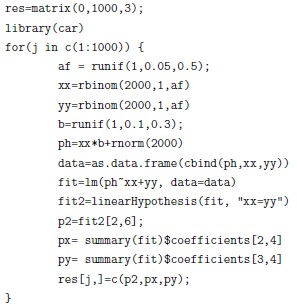
We call positives based on suggested procedure, and compare number of positives called using marginal p-values at two threshold of 1×10⁻⁵ and 1×10⁻⁶ to declare significance. We used threshold of 0.01 to declare insignificance.
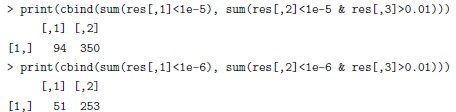
The result demonstrates that the suggested procedure has a much lower power compared to the procedure based on marginal statistics.
For the above reasons, the follow-up enrichment analysis is somewhat questionable. Most enrichments are non-significant, and it is likely because the SP and SM groups are diluted with SG SNPs. The P1-P9 groups have nothing to do with POE, and although the observation of increased enrichment for GWAS SNPs with increased pleiotropy is interesting, it is irrelevant for POE.
We will address the dilution concern below. We agree that P1-P9 groups are not directly related to POE. But this is an interesting observation non-theless. As we found such an observation is missing in the literature, we ask to keep it in the paper.
In the same way, section 2.7 is not supported; the claimed maternal and paternal POEs are heavily diluted by simple marginal associations. The same holds for sections 2.82.10. A striking example is Table 3: for clinical trial targets, paternal/maternal eQTLs behave just like simple marginal eQTLs (GG). A similar pattern emerges for combined target enrichment.
The reviewer’s concern that our SP and SM sets are “diluted with SG SNPs” is precisely the issue our Bayes factor thresholds were designed to prevent. By requiring one effect to be significant and the other to be below a low threshold (θ), we explicitly excluded SNPs where both effects are significant and in the same direction (which defines SG).
Regarding Table 3, the reviewer’s interpretation differs from ours. The fact that paternal eQTLs (GP) show significant enrichment for drug targets, while genotype eQTLs (GG) also show enrichment, does not imply dilution. Rather, it suggests there is an overlap in the biological importance of these gene sets, which is expected. The key message of the finding is the asymmetry: GP is significantly more enriched than GG (p=0.035 for combined targets), a pattern that would be washed out if GP were merely a diluted version of GG. This asymmetry supports the interesting biological hypothesis (Moore and Haig, 1991) we discuss. The non-significance for GM further highlights this asymmetry.
I’m not sure how MR would be biased by POE: MR is conducted only if there is a marginal association, i.e., the average maternal and paternal effects are significant. If the expression is causal for a trait, the POE effect is propagated to the outcome; hence, the SNP effect on the exposure will be equally biased as the SNP effect on the outcome, and these cancel out, and the causal effect remains unbiased. Can the authors propose a concrete example of maternal/paternal effects that demonstrates their claimed bias?
We thank the reviewer for this insightful question, which allows us to clarify our point with a concrete example from our data.
Consider a scenario where one wishes to use Mendelian Randomization (MR) to test whether the expression of gene NECAB3 causally influences a particular trait (e.g., obesity). The reviewer is correct that if the causal effect is homogeneous, the average effect might still be captured. However, the bias we caution against arises in stratified analyses or in the interpretation of the genetic instrument itself.
Take the SNP rs4911348 and its effect on NECAB3 (Figure 2). The genotype model shows no marginal association. Therefore, if a researcher were conducting a standard MR study using this SNP as an instrument for NECAB3 expression, they would discard it as an invalid instrument due to the lack of a marginal association. They would miss the true underlying biology entirely. The causal effect of NECAB3 on the trait would be masked in the full population.
More subtly, even if a SNP has a marginal association, using it as an instrument while ignoring POE can lead to incorrect effect estimates in population subgroups defined by parent of origin. This is analogous to ignoring effect modification. For instance, if a treatment (exposure) has a different effect depending on which parent it came from (which is impossible, but the genetic propensity for the exposure does), failing to account for this can bias the instrumental variable estimate if the instrument’s strength varies by an unmeasured factor (parental origin).
Our advice to “check the list of POE SNPs” is a practical caution: if the instrument for an exposure exhibits strong POE, the standard MR assumptions about the homogeneity of the instrument’s effect may be violated, potentially leading to biased estimates or incorrect conclusions about causality.
Minor comments:
(1) In Table 1, the last column header should be -log10(P), not ”P”.
The column labelling is an editorial choice to prevent table overflow. This particularly labelling was explained in the caption.
(2) While BFg/0/1/j are explained in the text, these notations should be explained in the Table caption as well.
Added explanation in caption.
(3) It should also be mentioned in the Table 1 caption how these top 10 SNPs were chosen.
These are sentinel eQTL for each gene. We think the first paragraph of Section 2.3 explains clearly.
(4) “may ”acquires” a cis-eQTL through” → ”may ”acquire” a cis-eQTL through”.
Corrected. Thank you.
(5) “which retained 16, 969 genes out of total 58103”, I assume the 58103 are transcripts, not genes.
You are absolutely correct. We added transcripts after 58103.
(6) In Equation (1), Z is not defined. In this concrete setting, isn’t it simply the identity matrix?
Yes. Z is the identitity (loading) matrix for human study. We added a sentence to clarify in revision.



