
Peer review process
Revised: This Reviewed Preprint has been revised by the authors in response to the previous round of peer review; the eLife assessment and the public reviews have been updated where necessary by the editors and peer reviewers.
Read more about eLife’s peer review process.Editors
- Reviewing EditorXilin ZhangKey Laboratory of Brain, Cognition and Education Sciences, Ministry of Education, South China Normal University, Guangzhou, China
- Senior EditorHuan LuoPeking University, Beijing, China
Reviewer #1 (Public review):
Summary:
This manuscript describes a study examining the relationship between microsaccades and covert attention. This question has been widely investigated, with numerous studies showing that during sustained fixation, when subjects covertly attend to a peripheral stimulus, microsaccades tend to be biased toward the attended location. Here, the authors ask whether this microsaccade bias reflects a shift of covert attention or the maintenance of covert attention. They conclude that the bias is primarily driven by attention shifts, a finding that also helps reconcile the seemingly conflicting results of prior research, where the bias was questioned in paradigms that largely involved attention maintenance rather than shifting.
Strengths:
A large sample size was used.
Weaknesses:
The main weakness is that the authors' response does not adequately resolve concerns about the robustness of the microsaccade analyses. The newly reported event counts reveal that the number of microsaccades per participant is very low, especially in Experiment 2, and highly variable across subjects. Because the key analyses rely on proportions of microsaccades toward versus away from the attended location, estimates based on so few events are likely unstable and may not provide reliable subject-level measures.
A second major concern is that several additional analyses introduced in the revision appear to suffer from the same limitation. The permutation analyses and angle-partition analyses may give the impression of statistical rigor, but if the underlying averages are based on very few microsaccadic events, the resulting probabilities are difficult to interpret. Further subdividing already sparse data into narrower angular bins likely makes the estimates even less reliable.
A third concern is that the authors have not fully addressed issues related to microsaccade detection and fixation control. The presence of very small-amplitude events with relatively high velocities raises the possibility that some detected microsaccades may be artifacts. The authors also did not implement the requested exclusion of microsaccades smaller than 5 arcmin or the suggested reanalysis using stricter fixation criteria. These omissions leave open the possibility that the reported effects are influenced by detection errors.
A fourth weakness is that some of the requested analyses or clarifications were addressed only superficially. The comparison with Brandolani et al. remains minimal, despite being highly relevant to interpreting whether the observed microsaccade-direction effect is transient or sustained. Similarly, the gaze-density plots do not show the raw gaze-position distributions that were requested and may therefore be misleading, because difference maps cannot determine whether subjects were actually fixating centrally.
Overall, the revision raises additional concerns rather than resolving the original ones. The main conclusions remain insufficiently supported unless the authors can demonstrate that the effects are robust at the individual-subject level, based on adequate numbers of microsaccadic events, reliable detection criteria, and appropriate controls for fixation behavior.
Reviewer #2 (Public review):
Summary:
This study aims to test the hypothesis that microsaccades are linked to the shifting of spatial attention, rather than the maintenance of attention at the cued location. In two experiments, participants were required to judge an orientation change at either a validly cued location (80% of the time) or an invalidly cued location (20% of the time). This change was presented at varying intervals (ranging from 500 to 3,200 ms) after cue onset. Accuracy and reaction times both showed attentional benefits at the valid versus invalid location across the different cue-target intervals. In contrast, microsaccade biases were time-dependent. The authors report a directional bias primarily observed around 400 ms after the cue, with later intervals (particularly in Experiment 2) exhibiting no biases in microsaccade direction towards the cued location. Noteworthy, it would have been interesting to observe whether directional biases in microsaccades are also evident when compared to a neutral condition. The authors argue that this finding supports their initial hypothesis that microsaccade biases reflect shifts in attention, but that maintaining attention at the cued location after an attention shift is not correlated with microsaccade direction.
Strengths:
The results are straightforward given the chosen experimental design. The manuscript is clearly written, and the presentation of the study and its visualisations are of a high standard.
Weaknesses:
The link between attention and microsaccades has been the subject of extensive research over the past two decades. The authors present a potential solution to the conflicting past findings, arguing that attention should be considered a dynamic process that can be broken down into an attention shift and a sustained attention phase. To differentiate between the two components, the authors varied the interval between the onset of the attention cue and the test stimulus. It would have been nice to use a theory-driven criterion (or an independent measure), in addition to their data-driven approach, to distinguish between these components of a dynamic attention concept. Moreover, it is important to note that the current experiments take a purely correlational approach.
Author response:
The following is the authors’ response to the current reviews.
We thank the reviewers for their time and for their valuable inputs throughout the review process. We wish to clarify, one final time, the primary scope and empirical grounding of our work for prospective readers.
Our study was designed to evaluate whether microsaccades track (in a correlative manner) covert visual-spatial attentional shifting, maintenance, or both. We did so within a single dedicated paradigm, across a large sample (N = 48 human participants). Despite remaining criticisms concerning per-participant event counts and microsaccade classification criteria, the key observation remains a striking dissociation (of the link between microsaccades and covert attention) during the initial shifting and the subsequent maintenance of visual-spatial attention. Moreover, we note how the robust effect observed during shifting (but not maintaining) attention, mitigates residual concerns regarding microsaccade sparsity or signal-to-noise ratio.
We thus remain confident in the empirical foundation of our work and we invite readers to examine the full paper, supplementary materials, and open-access data to evaluate these findings independently.
The following is the authors’ response to the original reviews.
We sincerely thank the reviewers and the editors for their careful evaluation of our article and for their valuable input. Building on these suggestions, we were able to further corroborate our main conclusions, make our article more comprehensive, and thereby substantially strengthen the manuscript.
We have one additional point of our own: we noticed that in our original submission, we had smoothed the data more than intended. Having caught this, we have now reduced the smoothing employed by 2.5 times compared to the original amount of smoothing (the exact smoothing values have also been added to the methods section). Importantly, however, while this has affected how the results look, this has not affected any of our original conclusions.
General summary
We would like to first respond to the major points brought forward by both the editorial summary and the public reviews. As we understand, the two main points that were raised regard: (1) the novelty and theoretical importance of our work and (2) the (in)completeness of our results. We start by providing our response to both of these main points below.
Novelty and theoretical relevance of the work
Regarding the novelty of our work, we believe the reviews and, by extension, the editorial summary underappreciated the main theoretical value of the question we addressed. Our work set out to investigate whether microsaccades track covert attentional shifting, attentional maintenance, or both. We fully recognise that there are ample prior studies that investigated and reported a link between microsaccades and covert attention, but also underscore how other studies report seemingly contradicting evidence by reporting that there is no such link. One such example is a recent paper by Willett & Mayo in PNAS (2023). Prompted by the recent hypothesis that this seemingly conflicting evidence may be due to prior work investigating attention ‘in different stages’ (van Ede, PNAS, 2023), we set out to address precisely this using a dedicated task that we designed for this purpose. As acknowledged by the summary and public reviews, this helps to reconcile seemingly opposing views in the literature. In our view, such reconciliation has substantial theoretical value.
While we appreciate that our reported insights may resonate and appear plausible to those working on this topic, we are not aware of any prior studies that directly addressed whether the link between covert attention and microsaccades may fundamentally depend on the ‘stage’ of attentional deployment (‘shift’ vs. ‘maintain’). To fill this key gap and address this timely issue, we developed a dedicated experiment designed to evaluate the relationship between microsaccades and the different stages of attention within a single paradigm. We did so by varying the cue-target intervals to uniquely incentivise early shifting (by having short intervals), while also being able to assess microsaccade biases during subsequent maintenance (in the longer trials). To our knowledge, no previous task has jointly examined these components in this manner.
Finally, our inclusion of two widely adopted approaches to fixational control provides yet another source of novelty. Together, we believe that these features position our work as a substantive advance that reconciles seemingly opposing theoretical views.
Completeness of results
Regarding the completeness of our results, the editorial summary points to “the absence of independent measures, single-trial analyses, and neutral-condition controls needed to substantiate the central claims”. While the raised points are valuable, they pertain to issues that are tangential to our primary question and stem from unfortunate misunderstandings of key analytical choices, as we now better clarify. We consider our results complete and comprehensive with regards to the main question our studies set out to answer.
First, regarding the portrayed “need” for independent measures to define the ‘shift window’ of interest, we clarify how our main analysis is completely agnostic to predetermined time windows, as we employ a cluster-based permutation approach to assess our rich time-resolved data across the full time axis. For the complementary analyses that address the ‘shift’ and ‘maintain’ windows more directly, we use a priori defined windows that are based on ample prior literature (from prior literature studying microsaccade biases, as well as from prior literature on the time course of top-down attention as studied through SOA manipulations). Accordingly, even these ‘zoomed in’ analyses rely on time windows that are empirically grounded in prior research.
Second, regarding the use of single-trial analyses, we want to emphasise that single-trial predictability is not where our theoretical question resides. We start from the perspective that the relationship between covert visual-spatial attention and microsaccades is inherently probabilistic. Our aim is not to address or question this. Rather, our aim is to determine whether this probabilistic relationship behaves similarly during attentional shifting and maintenance— an issue our analyses directly address. In addition, we also explicitly discuss how the link between microsaccades and attention is fundamentally probabilistic at the single-trial level in our discussion, and prompted by the valuable feedback, we have expanded on this important contextualisation as part of our revision.
Finally, regarding the portrayed “need” for a neural-attention control condition, we agree that inclusion of a neutral attention condition could be informative for disentangling the ‘benefits’ versus ‘costs’ of attentional cueing. However, such disambiguation is tangential to our central aim. Rather, our behavioural data primarily serve to verify attentional ‘allocation’ also at later cue-target intervals. Observing a difference between valid and invalid cues suffices for this central aim. We also note how inclusion of a neutral condition would have reduced trial numbers and statistical power for our critical conditions of interest. Accordingly, we do not see this as a limitation that challenges our main conclusions. Having clarified this, we embraced this valuable reflection and revised the article to ensure that we do not mention selective ‘benefits’ or ‘costs’ of our cueing manipulation, but refer to ‘the presence of an attentional modulation’ instead.
Taken together, the explicit design and analysis choices that we made align with the theoretical aims of our study, and the central question we set out to address. The raised points are valuable and we are grateful to have been able to leverage them to improve our article, but we hope to have also clarified how they do not render our findings “incomplete” (as currently portrayed) with regards to the key goal of our article.
Public Reviews:
Reviewer #1 (Public review):
Summary:
This manuscript describes a study examining the relationship between microsaccades and covert attention. This question has been widely investigated, with numerous studies showing that during sustained fixation, when subjects covertly attend to a peripheral stimulus, microsaccades tend to be biased toward the attended location. Here, the authors ask whether this microsaccade bias reflects a shift of covert attention or the maintenance of covert attention. They conclude that the bias is primarily driven by attention shifts, a finding that also helps reconcile the seemingly conflicting results of prior research, where the bias was questioned in paradigms that largely involved attention maintenance rather than shifting.
Strengths:
The paradigm and conclusions appear sound and supported by the results. A large sample size was used.
We thank the reviewer for this clear and supportive summary of our work.
Weaknesses:
Weaknesses are mostly related to how the authors enforced fixation in the task, and clarifications are needed regarding some methodological details. A more direct comparison of the effect in the two experimental conditions is missing.
We thank the reviewer for raising these valuable points. We have now added a direct statistical comparison of the main effect in the two experimental conditions (page 5: “When directly comparing this spatial saccade bias between experiments, we observed that the effect was significantly larger in Experiment 1 than in Experiment 2 from 535 to 745 ms (cluster p=0.013) and 1153 to 1309 ms after cue onset (cluster p=0.029)”). Regarding the fixation points, we will address them in our point-by-point replies below.
Reviewer #2 (Public review):
Summary:
This study aims to test the hypothesis that microsaccades are linked to the shifting of spatial attention, rather than the maintenance of attention at the cued location. In two experiments, participants were required to judge an orientation change at either a validly cued location (80% of the time) or an invalidly cued location (20% of the time). This change was presented at varying intervals (ranging from 500 to 3,200 ms) after cue onset. Accuracy and reaction times both showed attentional benefits at the valid versus invalid location across the different cue-target intervals. In contrast, microsaccade biases were time-dependent. The authors report a directional bias primarily observed around 400 ms after the cue, with later intervals (particularly in Experiment 2) exhibiting no biases in microsaccade direction towards the cued location. The authors argue that this finding supports their initial hypothesis that microsaccade biases reflect shifts in attention, but that maintaining attention at the cued location after an attention shift is not correlated with microsaccade direction.
Strengths:
The results are straightforward given the chosen experimental design. The manuscript is clearly written, and the presentation of the study and its visualisations are both of a high standard.
We thank the reviewer for this clear summary of our work.
Weaknesses:
The major weakness of this paper is its incremental contribution to a widely studied phenomenon. The link between attention and microsaccades has been the subject of extensive research over the past two decades. This study merely provides a limited overview of the key insights gained from these papers and discussions. In fact, it attempts to summarise previous work by stating that many experiments found a link, while others did not, and provides only a relatively small number of references. To make a significant contribution, I believe the authors should evaluate the field more thoroughly, rather than merely scratching the surface.
We thank the reviewer for this valuable reflection. For an elaborate response to the perceived novelty, please see our general summary reply above. In addition, we have added a more thorough evaluation of the field to the introduction (page 2, find relevant paragraph below). We hope that this will provide more context for the manuscript and strengthen its contribution to the field.
Revised paragraph from introduction:
“This link between microsaccades and covert visual-spatial attention has been demonstrated repeatedly. Early studies linked the direction of microsaccades to the deployment of covert attention [14, 15] and these findings were later replicated and extended. For example, it has been demonstrated in both humans [14–25] and non-human primates [26, 27]; during both externally directed perceptual attention [14, 15, 17, 20, 21, 24–27] and internally directed attention within visual working memory [16, 18, 19, 22, 23]; and in both perception and action tasks following directional cues [28]. Several studies have further linked the directional microsaccade bias to task performance [18, 21, 25, 28, 29]. For example, following spontaneous microsaccades, perception of visual targets presented in the same direction is better [25], and visual discrimination benefits may start already prior to microsaccade execution [21]. Recent evidence further suggests that microsaccades may even play a causal role in shaping the perception of peripheral stimuli [30].”
The authors then present a potential solution to the conflicting past findings, arguing that attention should be considered a dynamic process that can be broken down into an attention shift and a sustained attention phase. Although the authors present this as a novel concept, I cannot think of anyone in the field who considers spatial attention to be a static entity. Nevertheless, I was curious to see how the authors would attempt to determine the precise timing of the attention shift and manipulate the different stages individually. However, the authors only varied the interval between the onset of the attention cue and the test stimulus, failing to further pinpoint their dynamic attention concept.
The current version of the experiment, therefore, takes a correlational approach, similar to initial studies by Engbert and Kliegl (2003) and Hafed and Clark (2002). Meanwhile, we have learned a great deal about the link between microsaccades and attention. Below, I will list just a few of these findings to demonstrate how much we already know. It is important to note that, while the present study cites some of these papers, it does not provide a clear overview of how the current study goes beyond previous research.
(1) Yuval-Greenberg and colleagues (2014) presented stimuli contingent on online-detected microsaccades. A postcue indicated the target for a visual task, and the target could be congruent or incongruent with the microsaccade direction. The authors showed higher visual accuracy in congruent trials. The authors cited that paper, but it is still important to emphasize how this study already tried to go beyond purely correlational links on a single trial level.
(2) The Desimone lab (Lower et al., 2018) showed that firing rates in monkey V4 and IT were increased when a microsaccade was generated in the direction of the attended target.
(3) However, attention can modulate responses in the superior colliculus even in the absence of microsaccades (Yu et al., 2022)
(4) Similarly, Poletti, Rucci & Carrasco (2017) observed attentional modulations in the absence of microsaccades, or comparable attention effects irrespective of whether a microsaccade occurred or not (Roberts & Carrasco, 2019).
Thus, in light of these insights, I believe the current study only adds incrementally to our understanding of the link between microsaccades and spatial attention.
We thank the reviewer for this insightful comment, and for pointing out several important studies on this topic. While we appreciate that our reported insights may resonate and appear plausible to those working on this topic, we are not aware of any prior studies that directly addressed whether the link between covert attention and microsaccades may fundamentally depend on the ‘stage’ of attentional deployment (‘shift’ vs. ‘maintain’).
To fill this key gap and address this timely issue, we developed a dedicated experiment designed to evaluate the relationship between microsaccades and the different stages of attention within a single paradigm. We did so by varying the cue-target intervals to uniquely incentivise early shifting (by having short intervals), while also being able to assess microsaccade biases during subsequent maintenance (in the longer trials). To our knowledge, no previous task has jointly examined these components in this manner. Moreover, our inclusion of two widely adopted approaches to fixational control provides yet another source of novelty. Together, we believe that these features position our work as a substantive advance that reconciles seemingly opposing theoretical views.
Regarding the use of single-trial analyses, we want to emphasise that single-trial predictability is not where our theoretical question resides. We start from the perspective that the relationship between covert visual-spatial attention and microsaccades is inherently probabilistic. Our aim is not to address or question this. Rather, our aim is to determine whether this probabilistic relationship behaves similarly during attentional shifting and maintenance— an issue our analyses directly and appropriately address. In addition, we also explicitly discuss how the link between microsaccades and attention is fundamentally probabilistic at the singletrial level in our discussion. Prompted by the reviewer’s valuable feedback, we have expanded on this important contextualisation in our discussion section (page 8: “Therefore, even if microsaccades may more reliably track shifting than maintaining attention, as our current findings show, our findings should not be taken as evidence that microsaccades reliably track attentional shifts at the single-trial level.”). We also incorporated the valuable reference suggestions in our revised manuscript, including in the revised paragraph in our introduction where we provide a more extensive overview of the prior literature, as shown in response to the preceding comment and in the discussion where we discuss the relationship between microsaccades and attention on a single-trial level.
In general, it is important to have an independent measure of the dynamics of an attention shift. I think a shift of 200-600 ms is quite long, and defining this interval is rather arbitrary. Why consider such a long delay as the shift? Rather than taking a data-driven approach to defining an interval for an attention shift, it would be more convincing to derive an interval of interest based on past research or an independent measure.
We thank the reviewer for their question. We wish to clarify how our main analysis is completely agnostic to predetermined time windows, as we employ a cluster-based permutation approach to assess our rich time-resolved data across the full time axis. For the complementary analyses that address the ‘shift’ and ‘maintain’ windows more directly, we use a priori defined windows that are based on ample prior literature (from prior literature studying microsaccade biases, as well as from prior literature on the time course of top-down attention as studied through SOA manipulations). Accordingly, even these ‘zoomed in’ analyses rely on time windows that are empirically grounded in prior research.
The present analyses report microsaccade statistics across all trials, but do not directly link single-trial microsaccades to accuracy. Similarly, reaction times and accuracy were analyzed only with respect to valid vs. invalid trials. Here, it would be important to link the findings between microsaccades and performance on a single-trial level. For instance, can the authors report reaction times and accuracy also separately for trials with vs. without microsaccades, and for trials with congruent vs. incongruent microsaccades?
We thank the reviewer for their sincere interest in our findings and for the great suggestion of an additional analysis. We have now investigated whether trials with a congruent, incongruent or no microsaccade in the shift window (where congruent or incongruent was determined as based on the first microsaccade within the shift window) have, on average, different reaction times. This analysis did not show significant differences between these three conditions (congruent microsaccade, incongruent microsaccade, no microsaccade).
In interpreting this observation, we would like to stress that our experiment is not particularly well-suited to this analysis, as the amount of time between cue onset and the target events are highly variable across trials. Because of this clear drawback, we have decided not to include these analyses.
The study would benefit greatly from including a neutral condition to substantiate claims of attentional benefits and costs. It is highly probable that invalid trials would also demonstrate costs in terms of reaction times and accuracy. It would be interesting to observe whether directional biases in microsaccades are also evident when compared to a neutral condition.
We thank the reviewer for this valuable reflection. We agree that the inclusion of a neutral attention condition could be informative for disentangling the ‘benefits’ versus ‘costs’ of attentional cueing. However, such disambiguation is tangential to our central aim. Rather, our behavioural data primarily serve to verify attentional ‘allocation’ at later cue-target intervals. Observing a difference between valid and invalid cues suffices for this central aim. We also note how inclusion of a neutral condition would have reduced trial-numbers and statistical power for our critical conditions of interest. Accordingly, we do not see this as a limitation that in any way challenges our main conclusions.
Prompted by this reflection, we have ensured to not mention selective ‘benefits’ or ‘costs’ of our cueing manipulation throughout the article, but refer to this only as ‘the presence of an attentional modulation’ instead (such changes were made on pages 3 and 9, and we kept this phrasing consistent in our additions on pages 5 and 22).
Recommendations for the authors:
Reviewer #1 (Recommendations for the authors):
(1) The results resemble recent findings by Brandolani et al. (2025), who also showed that the microsaccade bias-in a similar task and using a comparable analysis approach-was restricted to a narrow time window, primarily around the time of the attention shift. The authors should reference this work, discuss similarities and differences, and, given their larger sample size, consider whether they observe a similar correlation between response times and microsaccade rate.
We thank the reviewer for pointing out this useful reference to us. We have included this article in our introduction, when sketching the current state of the field (page 2) and also mentioned this related article in the discussion (page 8).
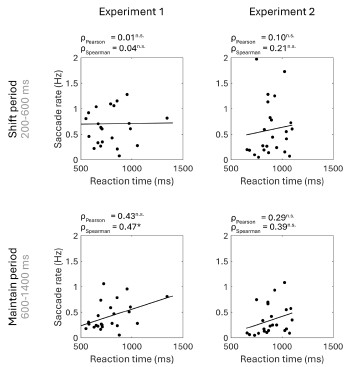
In addition, prompted by this comment, we have investigated whether we observe a similar correlation between response times and microsaccade rate in valid trials. We have investigated this for both possible timeframes: (1) the ‘shift’ timeframe and (2) the ‘maintain’ timeframe. For both experiments, there was no consistent correlation between response times and overall microsaccade rate, as shown in Author response image 1.
Author response image 1.
Relationship between the reaction time and the overall saccade rate. This figure shows the relationship between the average reaction time and the average overall saccade rate for both the ‘shift’ period (from 200 to 600 ms after cue onset) and the ‘maintain’ period (from 600 to 1400 ms after cue onset). Each dot represents one participant. Throughout the entire figure, the following significance levels were used: *: p< 0.05, **: p < 0.01, ***: p < 0.001, ****: p < 0.0001.
(2) I could not find information on the average number of trials per condition and the average number of microsaccades per subject per condition. Ideally, these numbers should be reported (e.g., in a supplementary table). Since the analysis is based on microsaccade direction, knowing how many microsaccades each subject contributed per condition is critical. Microsaccade rates vary substantially across individuals, and subjects with very few events may add noise to the analysis, as proportions of toward/away microsaccades become unreliable.
We thank the reviewer for pointing out that this relevant information was missing. We have now included these numbers in a supplementary table as suggested (page 17).
(3) Relatedly, it was unclear whether the time-course analyses were based on collapsing all microsaccade events across subjects or on subject-level averages. In the Methods, the authors state that "the permutation distribution of the largest cluster size was acquired by randomly permuting the trial-average data at the group level 10,000 times," but this is ambiguous. Please clarify.
We thank the reviewer for pointing out this ambiguity. We have changed the methods section to reflect more clearly that we first obtain time-courses of the microsaccade rate per participant, and subject these time courses to second level statistics using cluster-based permutation analysis (page 13). We have also reworded the sentence you quoted to remove any ambiguity (page 13): “A permutation distribution of the largest cluster size was acquired by randomly permuting the condition labels of each participant’s trial-averaged time course data (i.e. randomly flipping the sign of the difference in rate of toward vs. away saccades) 10,000 times and identifying the size of the largest clusters observed in these randomised data after each permutation.”
(4) The authors analyze only downward microsaccades, but the cutoff definition is not specified. Presumably, this includes all directions between 180{degree sign} and 360{degree sign}, which may also include nearly horizontal events. This should be clearly stated. In addition, the rate of upward microsaccades should still be shown, divided into up-left and up-right quadrants to parallel the toward/away analysis. This would provide informative context on whether upward microsaccade rates change systematically over time.
We thank the reviewer for pointing out that this information was missing, and for suggesting this valuable additional analysis. In the methods section, we now explicitly state the angular cutoffs used for the main analysis (page 12). Additionally, we have added a supplementary figure that shows the time course of upwards microsaccades over time (page 21), please see Supplementary Figure S4.
(5) If the dataset contains enough microsaccadic events per subject, it would be useful to test more conservative angular cutoffs for defining "toward" versus "away."
We thank the reviewer for this insightful suggestion. We have included an additional analysis, where only microsaccades were included with a direction within a 45° angle around the exacttoward and exact-away directions. This replicated our main finding. The results from this analysis are now included in the supplementary materials (page 24), please see Supplementary Figure S8.
(6) Figure 2C: It is unclear what the "Center" and "Border" lines represent. The figure is also potentially confusing because it shows microsaccade amplitudes rather than landing positions. Small amplitudes may still bring gaze close to the target; this distinction should be clarified.
We thank the reviewer for pointing this out. We have changed the “centre” and “border” labels to include more information (pages 6 and 19). We have also added an in-text clarification of the distinction between saccade amplitude and landing position (page 5: “Note that Figure 2C does not show saccade landing positions. While it is theoretically possible for multiple small unidirectional saccades to lead to a larger change in gaze position, a complementary analysis shows that fixation was maintained during the period of peak microsaccade rate in both experiments (see Supplementary Figure S6).”). In addition, in response to the related comment below, we have now also added heatmaps of gaze showing that gaze overall remained close to fixation in our tasks.
(7) From the Methods, it appears that in Experiment 1, there was no automatic criterion for discarding trials in which gaze deviated from fixation. In Experiment 2, trials were terminated if gaze left a 2{degree sign} window, but given that the target was only 5{degree sign} from fixation, this seems a relatively loose criterion. It would be important to show the distribution of gaze positions during the task to assess whether fixation control was adequate.
We thank the reviewer for this great suggestion. We have now added a figure to the supplementary materials (page 23) that shows the probability density of gaze position throughout the ‘shift’ period, for left cued trials and right cued trials separately, please see Supplementary Figure S6. We hope that this will further show that even in Experiment 1, fixational control was successful. We also show the difference between left cued and right cued trials, which again shows a gaze bias towards the cued item.
(8) Did the authors examine whether there was a response time benefit (e.g., RT in congruent microsaccade trials minus RT in incongruent microsaccade trials, as in Brandolani et al., 2025) or an accuracy benefit when microsaccades were directed toward the target?
We thank the reviewer for their interest in our findings and for the great suggestion of an additional analysis. As we discussed also in response to the general summary from reviewer #2 above, we have now investigated whether trials with a congruent, incongruent or no saccade in the shift window (where congruent or incongruent was determined as based on the first saccade within the shift window) have, on average, different reaction times. This analysis did not show significant differences between these three conditions (congruent microsaccade, incongruent microsaccade, no microsaccade).
In interpreting this observation, we would like to again stress how our experiment is not particularly well-suited to this analysis, as the amount of time between cue onset and the target events are highly variable across trials. Because of this clear drawback, we decided not to include these analyses. However, please note that we did now include the outcomes of another analysis that more directly targeted the relation between the spatial modulations in microsaccades and task performance, as we turn to below.
(9) Was there a relationship between the size of the attentional effect and the magnitude of the microsaccade bias?
We thank the reviewer also for this insightful question. We have investigated the relationship between the magnitude of the microsaccade bias during the ‘shift’ period and the behavioural benefit. We have done this separately for a response time benefit and an accuracy benefit. Experiment 1 shows a significant correlation for both reaction times and accuracy with the magnitude of the microsaccade bias, but for Experiment 2 both of these relationships did not survive. Because this relationship did not prove robust across both experiments, but is nonetheless a set of findings our readers will likely be interested in, we have included this figure in the supplementary materials (page 22). Please see Supplementary Figure S5.
(10) The criteria for minimum microsaccade amplitude and duration are not specified. This should be clarified. I recommend excluding events smaller than ~5 arcmin, as these are likely noise-especially since eye tracking was monocular. Monocular "microsaccades" can be spurious, but this can be determined only with binocular tracking. It is also unclear whether subjects used chin/head rests. A main-sequence plot in the supplementary material would be helpful.
We thank the reviewer for pointing this out. We have included a main-sequence plot in the supplementary materials (page 23). The main-sequence plot can also be found in Supplementary Figure S7 and suggests that our saccade-detection algorithm worked well with detected saccades following the main sequence. We have also stated more clearly in the methods section that subjects used a chinrest (page 11).
(11) Please specify the asterisk convention in figure captions (i.e., what * vs. ** vs. *** correspond to in terms of p-values).
We thank the reviewer for pointing out that these significance levels were not mentioned in every figure caption, so we have added this information to every figure caption where they were missing (page 4, 6, 7 and 19).
(12) The fact that stricter fixation criteria reduced the size of the effect suggests the possibility that gaze drift toward the target might have conferred an eccentricity advantage in this discrimination task. A direct comparison of the effect in the two experiments would be valuable. The authors should comment on this. It would be informative to plot the average gaze position around the time of peak microsaccade rate in both experiments. Reanalyzing the data post hoc with a stricter trial-selection criterion (e.g., excluding trials where gaze deviated more than 1{degree sign} from fixation) could also be very valuable, as it would systematically test how fixation control influences the observed microsaccade-attention relationship. This would be informative for the community studying this topic.
We thank the reviewer for these valuable reflections. We have now added a direct statistical comparison of the main effect in the two experimental conditions (page 5: “When directly comparing this spatial saccade bias between experiments, we observed that the effect was significantly larger in Experiment 1 than in Experiment 2 from 535 to 745 ms (cluster p=0.013) and 1153 to 1309 ms after cue onset (cluster p=0.029)”).
Regarding the average gaze position around the time of peak microsaccade rate: in response to reviewer #1, under point (7), we have included Supplementary Figure S6 that shows the probability distribution of gaze position throughout the ‘shift’ period (the same figure is found on page 23 in the article), which shows that fixational control was successful in both experiments. This period is also the period of peak microsaccade rate in both experiments.
We wholeheartedly agree that systematically investigating the effect of fixational control is important for the field as a whole, and this is also precisely why we set out to perform the same experiment in two different experimental settings with regards to fixational control, and why we decided to include the results from both experiment variants side-by-side in our article.
Reviewer #2 (Recommendations for the authors):
In addition to my general concerns in the public review, I have the following recommendations.
(1) Did the authors distinguish between the initial and subsequent microsaccades during their analysis? Is it possible to produce multiple microsaccades when shifting attention, or do the authors only consider the first microsaccade to be linked to an attention shift?
We thank the reviewer for pointing out this ambiguity. We have now stated more clearly in the methods section that we consider all microsaccades for our analyses (page 12: “Crucially, we did not restrict our analyses to initial saccades; rather, all detected saccades were included. This allowed us to examine oculomotor behaviour during later trial phases, where initial saccades are unlikely to occur.”). We also believe this methodological choice is important, as otherwise it would be conceivable that no microsaccade bias can be found during the ‘sustain’ period, simply because no ‘first’ microsaccades occur anymore.
(2) Two microsaccades had to be separated by at least 100 ms. This is an unusually long delay.
Could the authors please specify how many microsaccades were discarded using this criterion?
This inter-saccade-interval is quite large on purpose, as we want to minimise the probability of counting the same microsaccade twice. We have re-analysed the data with a minimum ISI of 50 ms, and this led to an increase of found saccades of a, respectively, 5.1% and 1.9% increase for Experiments 1 and 2. However, two participants in Experiment 1 led to a much higher increase in saccades than all other participants (these participants had z-scores of 3.9 and 2.4 for the number of additionally found saccades with an ISI of 50 ms; all other z-scores for Experiment 1 were between -0.5 and 0.5). When those two participants were removed, in Experiment 1 only 1.6% more saccades were found.
(3) If I understand correctly, the authors did not use staircase procedures to eliminate differences in task difficulty between participants. Could the authors demonstrate how task difficulty relates to the link between microsaccades and performance? For example, is the time course of the microsaccade direction bias correlated with performance?
We thank the reviewer for this suggestion (that overlaps with a comment of Reviewer 1). We have investigated the relationship between the magnitude of the microsaccade bias during the ‘shift’ period and the behavioural benefit. We have done this separately for a response time benefit and an accuracy benefit. Experiment 1 shows a significant correlation for both reaction times and accuracy with the magnitude of the microsaccade bias, but for Experiment 2 both of these relationships did not survive. Because this relationship did not prove robust across both experiments, but is nonetheless a set of findings our readers will likely be interested in, we have included this figure in the supplementary materials (page 22). Please see Supplementary Figure S5.
(4) The authors reported using equiluminant stimuli. Could the authors please specify the exact luminance?
We thank the reviewer for pointing out this missing information. We have now included this information in the methods section (page 11: “, with a luminance of 88.5 cd/m2.”). We have also included the luminance of the background (page 11: “luminance: 29.0 cd/m2”).
(5) Could the authors please provide a full polar plot showing all microsaccade directions, and colour-code those included in the analysis?
We thank the reviewer for this great suggestion on how to present our results even more clearly and comprehensively. We have included a supplementary figure showing the full polar histograms (with 20 radial bins), for all three timeframes of interest: the whole trial, the ‘shift’ period and the ‘maintain’ period (page 20). As requested, the saccades included in the main analyses are colour-coded. See Supplementary Figure S3
(6) Can the authors please directly compare the main effects between experiment 1 and experiment 2 (Figure 2B)?
We thank the reviewer for this great suggestion (that was also made by reviewer 1). We have now added a direct statistical comparison of the main effect in the two experimental conditions (page 5: “When directly comparing this spatial saccade bias between experiments, we observed that the effect was significantly larger in Experiment 1 than in Experiment 2 from 535 to 745 ms (cluster p=0.013) and 1153 to 1309 ms after cue onset (cluster p=0.029)”).



