
Peer review process
Revised: This Reviewed Preprint has been revised by the authors in response to the previous round of peer review; the eLife assessment and the public reviews have been updated where necessary by the editors and peer reviewers.
Read more about eLife’s peer review process.Editors
- Reviewing EditorShelly FlagelUniversity of Michigan, Ann Arbor, United States of America
- Senior EditorMichael TaffeUniversity of California, San Diego, San Diego, United States of America
Reviewer #1 (Public review):
Summary:
Poh and colleagues investigate dopamine signaling in the nucleus accumbens (ventromedial striatum) in rats engaged in several forms of go/no-go tasks, that differed in reward controllability (self-initiated reward seeking or cue-evoked/quasi-pavlovian), and in the specific timing of the action-reward contingencies. They analysis dopamine recordings made with fast scan cyclic voltammetry and find that dopamine signals vary most consistently to cues that signal a required action (go cues) vs cue signaling action withholding (no go cues). Through various analysis they report that dopamine signals align most clearly with action initiation and with the approach to the reward-delivery location. Collectively these data support aspects of a variety of frameworks related to accumbens dopamine signaling in movement, action vigor, approach, etc.
Strengths:
These studies use several task variants that consolidate a few different components of dopamine signal functions and allow for a broad comparison of many psychological and behavioral aspects. The behavioral analysis is detailed. These results touch on many previous findings, larger showing consistent results with past studies.
Weaknesses:
The paper is dense and could benefit from some revision to increase clarity of the figures, the methods and analysis. The inclusion of many tasks is a strength but also somewhat overshadows specific points in the data, which could be improved with some revision to focus. There is a lack of strong connection between some of the findings, which if revised would help to emphasize the impact of the work.
Reviewer #2 (Public review):
Here, the authors record dopamine release using fast-scan cyclic voltammetry in the nucleus accumbens/ ventromedial striatum (VMS) while rats perform variants of a go/no-go task. Two versions are self-paced, in that the rat can initiate a trial by nosepoking at the odor port at any time once the ITI had elapsed, whereas the other two require the rat to wait for a cue-light before responding. Two "long" variants also require either more lever-presses on go trials, or a longer nosepoke time for no-go trials, and also incorporate "free" trials in which the rat is rewarded for just heading straight to the food tray. The authors find that dopamine levels increase more during the response requirement for go than no-go trials, indicating a role for invigorating to-be-rewarded actions. Dopamine levels also steadily increased as rats approached the site of reward delivery, and the authors demonstrate quite elegantly that this was not due to orientation to the food tray, or time-to-reward, or action initiation, but instead reflects spatial proximity to the rewarded location. Contrary to previous reports, the authors did not discern any differences in dopamine dynamics depending on whether the trials were cue- or self-paced, and dopamine release did not scale with effort requirements.
The manuscript is well-written and the authors use figures to great effect to explain what could otherwise be a hard-to-parse set of data. The authors make good use of the richness of their behavioral data to justify or negate potential conclusions.
Author response:
The following is the authors’ response to the original reviews.
Public Reviews:
Reviewer #1 (Public review):
Summary:
Poh and colleagues investigate dopamine signaling in the nucleus accumbens (ventromedial striatum) in rats engaged in several forms of Go/No Go tasks, which differed in reward controllability (self-initiated reward seeking or cue-evoked/quasi-pavlovian), and in the specific timing of the action-reward contingencies. They analyze dopamine recordings made with fast scan cyclic voltammetry, and find that dopamine signals vary most consistently to cues that signal a required action (Go cues) vs cues signaling action withholding (No Go cues). Through various analyses, they report that dopamine signals align most clearly with action initiation and with the approach to the reward-delivery location. Collectively, these data support aspects of a variety of frameworks related to accumbens dopamine signaling in movement, action vigor, approach, etc.
Strengths:
These studies use several task variants that consolidate a few different components of dopamine signal functions and allow for a broad comparison of many psychological and behavioral aspects. The behavioral analysis is detailed. These results touch on many previous findings, largely showing consistent results with past studies.
Weaknesses:
The paper could heavily benefit from some revision to 1) increase clarity of the figures, the methods, and the analysis. 2) The inclusion of many tasks is a strength, but also somewhat overshadows specific points in the data, which could be improved with some revision/reworking. 3) Some conclusions are not fully justified. As shown, support for the conclusion "dopamine reflects action initiation but not controllability or effort" is lacking without more analyses and additional context. 4) Further, the notion that the dopamine signals reported here reflect spatial information could be justified more strongly.
We thank the reviewer for their detailed evaluation and constructive feedback. We have made substantial revisions to address each concern raised:
(1) Clarity of figures, methods and analyses
We have revised the organization of the panels in Figure 1 for clarity.
We have revised Figure 2 and its caption: we have labelled all comparisons depicted in the figure, and now included a line, “Subject-wise comparisons of dopamine data were made for all alignments”, to clearly show that all statistical tests shown in Figure 2c-e were performed between subjects.
In the caption of Figure 3, we have now added, “... and trial-wise statistical Kruskal-Wallis tests were performed for each task-variant.” to clearly show that statistical tests were performed on the trial-wise level for Figure 3c.
We have now added a table to the Methods section (Table 1), detailing the sample size in each task variant and the number of trials within each No-go classification.
We have added more information in the Methods section: we now include Videos to show the classified No-go behaviors and other trial types (Go and Free); and provide a schematic of the DLC workflow in the supplementary materials (Supplementary Figure S9).
(2) Strengthening specific points in the data
To improve clarity of our main findings, we have revised the layout of the Results section such as including more descriptive headers:
“Behavioral performance in Go/No-go (“short task”) was unaffected by controllability of reward pursuit”
“Behavioral performance in Go/No-go/Free (“long task”) was unaffected by controllability of reward pursuit”
“Motivation to approach the reward magazine was similar between Go and No-go trials”
“VMS dopamine release encodes reward-related action initiation”
“VMS dopamine release does not only reflect reward-related action initiation”
“Maximum VMS dopamine release encodes spatial but not temporal proximity to rewards”
“Motivational state reflected by No-go behavioral strategy correlates with dopamine signal size during reward approach”
(3) (4) Conclusions drawn from data
We have carefully revised our conclusions to accurately reflect our experimental design and analyses, emphasising our core finding that VMS dopamine was consistently increased in Go versus No-go trials, throughout manipulation of the type of trial start (self- and cue-initiated) and effort manipulation (short and long task variants).
We thank the reviewer for the feedback regarding our VMS dopamine signals reflecting spatial proximity to reward. We performed additional analyses, which we present in Supplementary Figure S10, S11 and S12, to support our interpretation that VMS dopamine encodes spatial proximity to reward.
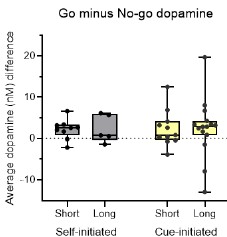
We appreciate the reviewer comment relating to the statement, “Dopamine reflects action initiation but not controllability or effort". We have revised the wording of our conclusion to better reflect our intent, which is to compare the action-selective encoding of dopamine (i.e., action initiation vs action suppression). This subheading is now changed in the Discussion to “Reward-related dopamine depends on action initiation irrespective of controllability and effort”. The additional analyses that we have performed are shown in Author response image 1entitled: “Average Go minus No-go dopamine reveals no effect of controllability (self vs. cue-initiated) or effort (short vs. long).
Additional details on subjects used in each study, analysis details on trialwise vs subjects-wise data, and other context would be helpful for improving the paper.
The number of subjects for each task variant was reported in the Methods Section 3: Behavioral procedures in the original submission of this manuscript.
To improve the paper, we now include a table in Methods Section 6: Statistical Analysis (Table 1), detailing the sample size in each task variant (with FSCV recordings) and the number of trials within each No-go classification.
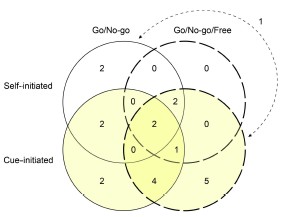
To give more context, we made Author response image 1 to illustrate the number of subjects in each task variant (and their overlap):
Author response image 1.
Number of subjects included in each Go/No-go task variant (total n = 21). Values (n) depict overlap of each subject between task variants. One animal was recorded in self-initiated Go/No-go and Cue-initiated Go/No-go/Free (dotted line with arrowheads).
Reviewer #2 (Public review):
Here, the authors record dopamine release using fast-scan cyclic voltammetry in the nucleus accumbens/ ventromedial striatum (VMS) while rats perform variants of a Go/No Go task. Two versions are self-paced, in that the rat can initiate a trial by nosepoking at the odor port at any time once the ITI has elapsed, whereas the other two require the rat to wait for a cue-light before responding. Two "long" variants also require either more lever-presses on Go trials, or a longer nosepoke time for No Go trials, and also incorporate "free" trials in which the rat is rewarded for just heading straight to the food tray. The authors find that dopamine levels increase more during the response requirement for Go than No Go trials, indicating a role for invigorating to-be-rewarded actions. Dopamine levels also steadily increased as rats approached the site of reward delivery, and the authors demonstrate quite elegantly that this was not due to orientation to the food tray, or time-to-reward, or action initiation, but instead reflects spatial proximity to the rewarded location. Contrary to previous reports, the authors did not discern any differences in dopamine dynamics depending on whether the trials were cue- or self-paced, and dopamine release did not scale with effort requirements.
The manuscript is well-written, and the authors use figures to great effect to explain what could otherwise be a hard-to-parse set of data. The authors make good use of the richness of their behavioral data to justify or negate potential conclusions. I have the following comments.
Re: The lack of relationship between effort to acquire reward in the current study and the magnitude of dopamine release, 1) can the authors unpack this a bit more? 2) Why the difference between the Walton and Bouret studies? Were the shifts in effort requirements comparable across the behavioral tasks? 3) What else could be different between the methodologies?
We thank the reviewer for the feedback and have responded to each of the three questions below (see points 1-3).
Firstly, we tried to improve the clarity of our research aims. Our primary comparison throughout the manuscript is between Go versus No-go within each task variant. We ask whether the Go/No-go difference in dopamine signaling persists across different response demands. Thus, testing effort was not central to this main question, but rather a feature of the task that did not affect the Go-No-go dopamine difference.
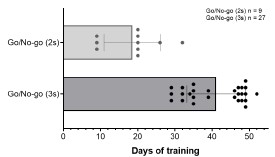
(1) Consistent with this aim, we show that VMS dopamine differs between Go and No-go actions persistently across all task variants despite differences in response requirements (action was always accompanied by greater dopamine release compared to action suppression). Our behavioral-training data suggest that the ability to perform short and long tasks differed: rats were first trained to criterion on either a short (∼2 s) or long (∼3 s) Go/No-go variant, with the longer variant requiring substantially more training sessions (short: 18.5 ± 7.6 sessions vs long: 41.1 ± 7.9 sessions; see Author response image 2), indicating behavioral demands were higher for the long-task.
Author response image 2.
(2) Regarding the apparent discrepancy with Walton and Bouret (2019), we acknowledge that our original description was imprecise (We wrote: “Previous studies have shown that dopamine signals are influenced by the effort required to obtain rewards”). Our intent was not to suggest a direct contradiction, but rather to emphasize that our findings are consistent with the paper’s broader conclusion that effort encoding by dopamine is limited and highly context-dependent. We have now adjusted the manuscript to better reflect our intent by changing the sentence to, “Previous studies have shown that dopamine signals may be influenced by the effort required to obtain reward but only for particular task conditions (Cousins et al., 1996; Gan et al., 2010; see for reviews, Salamone and Correa, 2024; Walton and Bouret, 2019).”
For added clarity, these were the main results highlighted in the Walton and Bouret review: Gan et al. (2010) demonstrated that VMS dopamine sensitivity to low-effort costs is prominent early in training (≤ 2 training sessions) and diminishes after extended experience (> 9 sessions). Similarly, Hollon et al. (2014) reported that cue-evoked VMS dopamine primarily tracks reward magnitude with minimal modulation by effort. In line with this literature, our rats were highly trained (≥ 9 sessions until the first recording), and exhibited no difference of average Go minus No-go dopamine between short and long task variants within controllability type (see Author response image 3), supporting the idea that extended training exhibits minimal effort-related modulation of VMS dopamine.
Author response image 3.
Average Go minus No-go dopamine reveals no effect of controllability (self vs. cue-initiated) or effort (short vs. long). A 2 × 2 Bayesian ANOVA (Cauchy prior: fixed effects r = 0.5; random effects r = 1) consistently favoured the null model over all alternatives. The main effect of controllability and effort showed moderate evidence of absence (controllability: BF10 = 0.324; effort: BF10 = 0.309). The model including both main effects performed more poorly (BF10 = 0.101), and the full model including a controllability × effort interaction was the least supported of all models examined (BF10 = 0.043). These results provide moderate evidence in favour of H0, suggesting that neither controllability, effort, nor their interaction meaningfully predicted average Go minus No-go dopamine responses.
(3) With respect to task comparability and methodological differences, our behavioral paradigm differs in important ways from those highlighted by Walton and Bouret, where effort was often manipulated by training animals to associate cues with different numbers of lever presses within the same session, and typically involved only action initiation. In contrast, our task required both action initiation and action suppression, and changes in response contingencies occurred across separate recording sessions rather than within-session cue-based manipulations. Although these paradigms are not directly comparable, and only had the same dopamine recording technique in common (FSCV), a key takeaway of our results is that regardless of effort differences, VMS dopamine during action initiation is consistently higher than during action suppression.
I would argue that the cue- vs self-initiated distinction was pretty minor, given that there was a fixed ITI of 5s. How does this task modification compare to those used previously to show that dopamine release corresponds to behavioral controllability? It would help the reader if the authors could spend more time discussing these disparate findings and looking for points of methodological divergence/commonality.
We agree that clarifying how our manipulation of controllability compares to prior work improves the manuscript, and we have made the necessary adjustments. However, we would first like to correct an incomplete characterization of the task design.
While the short-task variant used a fixed 5 s inter-trial interval (ITI), the long-task variant employed a variable ITI ranging from 15–25 s. In the long-task variant, the timing of trial onset was less predictable, and we believe this manipulation reduced animals’ ability to precisely estimate when reward pursuit could begin. Under these conditions, whether trials were Self-initiated or Cue-initiated had a substantial impact on animals’ control over the initiation of reward pursuit. That said, we agree that the Self- versus Cue-initiated distinction overall represents a moderate manipulation of controllability compared to those used in studies that focus on controllability.
A key source of divergence across studies lies in the definition of controllability. We defined controllability as the animals’ ability to choose the time point of beginning the reward pursuit, rather than whether an action was required, and have now added the following sentence in the:
- Introduction section: “... controllability of reward seeking, defined as the ability to determine when to initiate reward pursuit (Self- vs Cue-initiated trials)...”;
- Results section: “We defined controllability as the rats’ ability to choose the time point of reward pursuit. In Cue-initiated trials, the time point at which trials could be started was dictated by a cue light, whereas in Self-initiated trials rats were able to choose intrinsically (control) when to attempt a trial start.”;
- Discussion section
Importantly, the action requirements for Go, No-go, and Free trials were identical across these trial-start conditions. We found that the degree to which controllability was manipulated in our task was insufficient to modulate the action-specific VMS dopamine signal (Go vs No-go difference), which remained robust across conditions.
In contrast, controllability has been defined by others as the presence versus absence of an operant action requirement for reward. For example, Goedhoop et al. (2023) directly contrasted operant (lever press required) and Pavlovian (no action required) conditions, removing action execution as a prerequisite for reward. In that context, cues signaling operant control elicited sustained VMS dopamine release, which was interpreted as reflecting anticipation or preparation for executing a learned action. Similarly, Hamid et al. (2021) demonstrated that dopamine “wave” directionality across striatal regions depends on controllability defined by operant versus Pavlovian conditioning.
Taken together, these comparisons (results from the present study and in the literature) suggest that dopamine sensitivity to controllability may depend on how it is manipulated. We have clarified these methodological distinctions in the revised Introduction, Results and Discussion, and emphasized that more extreme manipulations (such as removing action requirements entirely or increasing uncertainty over trial timing) may be necessary to reveal controllability-dependent changes in VMS dopamine signaling. Alternatively, the apparent discrepancies across studies may primarily reflect differences in the underlying definitions of controllability rather than conflicting results.
Reviewer #3 (Public review):
Summary:
The manuscript by Poh et al. investigated whether dopamine release in the ventral medial striatum integrates information about action selection, controllability of reward pursuit, effort, and reward approach. Rats were implanted with FSCV probes and trained in four Go/No Go task variants:
(1) trials were self-initiated and had two trial types (Go vs. No Go) that were auditorily cued,
(2) trials were cue-initiated and had two trial types (Go vs. No Go) that were auditorily cued,
(3) trials were self-initiated and had three trial types (Go vs. No Go vs. free reward) that were auditorily cued, and effort was increased,
(4) trials were cue-initiated and had three trial types (Go vs. No Go vs. free reward) that were auditorily cued.
The authors report that dopamine levels rose during Go trials and slowly rose in No Go trials, but this pattern did not differ across task variants that modified effort and whether trials were cued or initiated. They also report that dopamine levels rose as rats approached the reward location and were greater in rats that bit the noseport while holding during the No Go response.
Strengths:
(1) Interesting task and variants within the task paradigm that would allow the authors to isolate specific behavioral metrics.
(2) The goal of determining precisely what VMS dopamine signals do is highly significant and would be of interest to many researchers.
Weaknesses:
(1) This Go/No-Go procedure is different from the traditional tasks, and this leads to several problems with interpreting the results:
(a) Go/No Go tasks typically require subjects to refrain from doing any action. In this task, a response is still required for the No Go trials (e.g., continue holding the nosepoke). The problem with this modified design is that failure to withhold a response on No Go trials could be because i) rats could not continue holding the response, as holding responses are difficult for rodents, or ii) rats could not suppress the prepotent go response. This makes interpreting the behavior and the dopamine signal in No Go trials very difficult.
We appreciate the reviewer raising this important methodological consideration. We acknowledge that our Go/No-go task differs from traditional paradigms used in humans and primates (e.g. Raud et al. 2020, 10.1016/j.neuroimage.2020.11658; Eagle, Bari & Robbins 2008, 10.1007/s00213-008-1127-6; Roitman & Loriaux 2013, 10.1152/jn.00350.2013).
However, our design addresses the specific constraints of studying dynamics in freely moving rodents while maintaining the core feature of Go/No-go tasks: requiring suppression of a prepotent response. Our task accomplishes the primary aim of our study, which is to compare VMS dopamine dynamics during action initiation and action suppression, and below we list the reasons why. Therefore, we do not believe that this difference compromises the validity and interpretation of our results.
It has been suggested for decades that the two main processes governed by mesolimbic dopamine are reward learning and motivated action, and our study aimed to better understand how VMS dopamine integrates reward-related information and motivated action, rather than studying them in isolation. To do so, we trained rats in a modified Go/No-go task.
More recent work (Syed et al. 2016; Hamid et al. 2016; Mohebi et al. 2019) demonstrates that VMS dopamine signaling incorporates both action and reward-related information, rather than either of the two alone. Importantly, in freely-moving rodents, examining this relationship requires preventing the approach response that occurs when reward delivery is anticipated (Pavlovian bias, go for rewards). Traditional Go/No-go designs that simply require "doing nothing" would not achieve this control in freely-moving rats, as animals immediately approach the reward magazine as soon as reward is inferred (as seen in our Free trials). Thus, we require a No-go condition, as we and others have defined (Syed et al. 2016), whereby animals have to actively suppress the ‘initiation’ response. Action initiation is defined at the beginning of the Discussion section: “... at two distinct points after trial start: 1) when rats began lever pressing (Go), and 2) when rats walked to the reward magazine, either without action requirement (Free) or after successful trial completion (Go and No-go)”.
To further strengthen our interpretation that we compare action initiation and suppression, and to facilitate cross-species translation of our results (i.e., rodent to human), we also include Free trials, where reward delivery requires no specific action (which are essentially like “doing nothing” trials in traditional tasks). This addition allowed us to directly compare No-go and Free trials, where animals must actively suppress responding while maintaining task engagement, to a condition where no overt action is required for a reward, respectively. The dramatic difference in VMS dopamine between No-go and Free trials demonstrates that VMS dopamine reflects active action suppression during No-go trials, rather than merely the absence of action requirements. This has now been discussed.
Finally, we only report correct Go, No-go, and Free trials, which differs from that of human go/no-go studies that focus on the failure of appetitive no-go trials (i.e., inhibiting the pre-potent response). In the present study, the dopamine signals that we interpret are restricted to successful trials only: action initiation (moving the lever press), action suppression (i.e., suppressing the prepotent Go response while maintaining their position in the nose-poke port), or no action (no lever press, not staying in the port). While this design differs from human Go/No-go paradigms, we believe our study of correctly performed Go, No-go, and Free trials are necessary for isolating action-dependent components of dopamine signaling in freely moving rats (action initiation vs action suppression vs action free).
(b) Most Go/No Go tasks bias or overrepresent Go trials so that the Go response is prepotent, and consequently, successful suppression of the Go response is challenging. 1) I didn't see any information in the manuscript about how often each trial type was presented or 2) how the authors ensured that No Go responses (or lack thereof) were reflecting a suppression of the Go response.
We appreciate the reviewer's attention to this important methodological consideration. The originally submitted version of the manuscript already addressed both concerns raised.
Trial type presentation frequencies
The Methods section describes our trial presentation approach: "On recording days, the trial types were counterbalanced. Within a session, Go left, Go right, and No-go trials were presented with 33% probability each, without replacement. For sessions with Free trials, trials were presented with a 25% chance without replacement."
This design results in overrepresentation of Go trials overall (66% in the short-task; 50% in the long-task), which establishes the prepotent Go response as intended in standard Go/No-go paradigms. To improve clarity, this detail has now been included in the Methods section.
Ensuring No-go responses reflect suppression of Go response
Our paradigm incorporates multiple features that ensure successful No-go performance reflects suppression of the prepotent Go response:
First, the overrepresentation of Go trials (addressed above) establishes response prepotency. Second, during No-go trials, rats must maintain their snout in the nose-poke port for the duration of the action cue, which creates the requirement to suppress the natural tendency to approach rewards (i.e., Pavlovian bias; Jones et al. 2017, 10.1016/j.bbr.2017.05.044; Guitart-Masip et al. 2014, 10.1007/s00213-013-3313-4; Dayan et al. 2006; 10.1016/j.neunet.2006.03.002). In Go trials, such natural bias does not require suppression as the lever can be approached and pressed during the action-cue period. This conflict between the instrumental No-go requirement and the Pavlovian-instrumental bias toward action makes action suppression particularly challenging (consistent with computational accounts of similar paradigms; Lloyd & Dayan 2023, 10.1371/journal.pcbi.1011569; Jones et al. 2017, Guitart-Masip et al. 2014, Dayan et al. 2006).
Figure 3 provides behavioral evidence of this challenge: animals frequently left the nose-poke port and developed spontaneous motor strategies (such as biting and digging) to stay in the port, suggesting Pavlovian bias interfering with response suppression for rewards. Importantly, all reported No-go data include only correct trials (i.e., those without lever presses), ensuring that the dopamine signal reflects successful response suppression rather than failed Go attempts.
(2) The authors observe relatively consistent differences in the DA signal between Go and No Go trials after the action-cue onset. However, the response type was not randomized between trial type, so there is a confound between trial type (Go/No Go) and response (lever/nosepoke). The difference in DA signal may have nothing to do with the cue type, but reflects differences in DA signal elicited by levers vs. nosepokes.
As stated in the Introduction section and discussed in our rebuttal to point 1a, the focus of our investigation is how VMS dopamine signals differ during action initiation versus action suppression for rewards, as this is a central unanswered question in the dopamine field. More recent work demonstrates that dopamine incorporates not only RPE but also action initiation (Syed et al. 2016; Hamid et al. 2016; Mohebi et al. 2019), and our goal is to further our understanding of action-dependent VMS signals during reward pursuit.
The reviewer suggests that dopamine differences may reflect differences in lever vs. nosepoke rather than cue type (Go vs No-go). We respectfully suggest this concern reflects a misunderstanding by the reviewer of our experimental question. The cue-action relationship is the experimental manipulation itself. It is not possible to study how dopamine encodes instructed action initiation versus suppression without linking specific cues to specific actions. The suggestion to 'randomize' action type across cue types would eliminate the very phenomenon we are investigating: how dopamine signals differ when cues instruct different action requirements.
Our experimental design specifically compares reward pursuit with action requirements (Go trials: lever press; No-go trials: sustained hold) to reward pursuit without action requirements (Free trials: direct magazine approach). This design allows us to isolate how action initiation and action suppression influence reward-related dopamine signaling, which can reveal how the timing of action initiation influences RPE-dopamine. And which is the point of the study: to show how actions influence RPE dopamine signaling.
Supporting this interpretation:
Firstly, trial types were randomly interleaved, and each auditory cue explicitly instructed a specific behavioral response. Our design directly follows established methods demonstrating that VMS dopamine encodes whether actions are initiated or suppressed following action cues (Syed et al. 2016). That study, like ours, intentionally linked cue identity to a specific action requirement to assess how dopamine reflects instructed behavioral control. Thus, the fact that Go and No-go cues map onto different actions is inherent to the question being addressed, not an unintended confound.
Second, as discussed in our response to point 1b, the asymmetry between Go and No-go trials is theoretically essential. Go trials align with Pavlovian approach tendencies (action initiation to reward), while No-go trials create conflict with this bias by requiring action suppression despite the cue being associated with a reward. This Pavlovian-instrumental conflict makes suppression particularly challenging (Lloyd & Dayan 2023, PLoS Comput Biol 10.1371/journal.pcbi.1011569) and allows us to examine the role dopamine in overriding prepotent responses.
Third, the inclusion of Free trials (discussed in point 1a) demonstrates that our findings reflect instructed action control rather than simply motor execution. Free trials require neither lever pressing nor nose poke maintenance, yet show dopamine dynamics distinct from both Go and No-go trials, confirming that dopamine signals encode action requirements beyond motor output per se.
Finally, we demonstrate that VMS dopamine differs in the same trial type (No-go) and can be classified based on different movement patterns (Biting, Digging, Calm). Importantly, the difference in VMS dopamine only appeared after the action was completed, particularly during reward approach (Figure 3). This data argues against the idea that VMS dopamine is particularly tied to the specific operant manipulanda as suggested by the reviewer, but rather, may reflect an internal motivational state for reward.
Together, the aim of the present study is not to redefine Go/No-go paradigms for rodents, but to utilize this task structure to investigate action-dependent dopamine signalling for rewards, which cannot be answered without the cue-action mapping that we have used.
(3) Both Go and No Go trials start with the rat having their nose in the noseport. One cue (Go cue) signals the rat to remove their nose from the noseport and make two lever responses in 5 seconds, whereas the other cue (No Go cue) signals the rat to keep their nose in the noseport for an additional 1.7-1.9 s. The authors state that the time between cue onset and reward delivery was kept the same for all trial types, and Figure 1 suggests this is 2 s, so was reward delivered before rats completed the two lever presses? I would imagine reward was only delivered if rats completed the FR requirement, but again, the descriptions in the text and figures are incongruent.
The reviewer asks whether reward was delivered before rats completed the two lever presses and notes incongruence between text and figures. We respectfully note that these details were stated in the originally submitted version of the manuscript (see below).
Reward delivery timing
The reviewer asks whether reward was delivered before rats completed the two lever presses, which refers to the short-task variant. No - reward was always delivered immediately after the second lever press for all Go trials. This is described in Methods Section 3: Behavioral procedures - Self-initiated task variant. For added clarity, we have now added the term “immediately”: “... food pellet dispensed into the reward-magazine immediately.”
In the Results section, we report that the average latency to complete two lever presses was 1.8s, which closely matches the 1.7-1.9s nose-poke hold maintenance required for No-go trials in the “short” variant. Thus, the time point of reward delivery was matched between Go and No-go trial types.
Representation of reward delivery timing in figure and text
The reviewer's confusion appears to stem from the schematic representation in Figure 1 and the task variant structure. There were two overarching task variants with different trial requirements:
“Short-task” variants: Go trials required two lever presses (completed on average in 1.8s);
No-go trials required 1.7-1.9s nosepoke maintenance
“Long-task” variants: Go trials required a ‘rewarded’ press to occur 2.7-3.2s after cue onset (completed within ~3s); No-go trials required 2.7-3s nosepoke maintenance.
For simplicity in depicting action-cue onset in Figure 2c, we used grey shading with a speaker icon at approximately 0-2s and 0-3s to represent these two variants. This schematic representation was not intended to indicate the precise reward delivery time, which (as stated in the Methods) occurred only upon successful completion of trial requirements in the short-task variant, or 2s after successful completion of trial requirements in the long-task variant. To improve clarity, we have adjusted the legend of Fig. 2 for more clarity, adding “Shaded gray area depicts approximate duration of action-cue onset for “short” and “long” task variants.”, and included more information under Results: “In the short-task variants, action-cues switched off after trial completion and a reward was delivered immediately” and “n the long-task variants, action-cues switched off after trial completion, or in the case of Free trials after 3s, and reward was delivered 2s later (Figure 1a).”
(4) The manuscript is difficult to understand because key details are not in the main text or are not mentioned at all. I've outlined several points below:
(a) The author's description in the manuscript makes it appear as a discrimination task versus a Go/No Go task. I suggest including more details in the main text that clarify what is required at each step in the task. Additionally, providing clarity regarding what task events the voltammetry traces are aligned to would be very useful.
We respectfully note that the requested details were already present in the originally submitted version of the manuscript (see below). However, we acknowledge that the task design is complex and may benefit from additional clarity in the main text to aid reader comprehension.
Behavioral task
The reviewer suggests our task appears more like a discrimination task than a Go/No-go task. We acknowledge that our paradigm differs from traditional Go/No-go tasks used in humans and primates, as discussed in our responses to points 1a and 2. However, we classify this as a Go/No-go task because it shares the defining feature: requiring action initiation (Go) and suppression (No-go). This classification is consistent with established rodent literature examining action initiation versus suppression (Syed et al. 2016).
Moreover, as discussed in our response to point 1a, we included Free trials specifically to demonstrate that No-go trials require active suppression rather than discrimination alone. The distinct dopamine dynamics across Go, No-go, and Free trials confirm that our task captures action initiation, action suppression, and action-free states, which is an important contrast that we needed to address our research question about action-dependent dopamine signaling.
The key requirements for each trial type and task variant are described at the beginning of the Results section. A full description of each step required in the task was provided in the Methods Section 3: Behavioral procedures, to avoid repetition in the Results. Specifically:
Self-initiated Go/No-go task variant (“short”)
Self-initiated Go/No-go/Free task variant (“long”)
Cue-initiated Go/No-go and Go/No-go/Free task variant
To improve clarity, we have added a reference in the Results section to the Methods: Behavioral procedures for additional procedural details.
Voltammetry trace alignment
The events to which voltammetry traces are aligned were stated in the legend:
“... when traces were aligned to action-cue onset…”
“... aligned to the time when animals departed the nose-poke port…”
“... we realigned traces to the moment animals arrived at the reward magazine… “
Figure 2c legend: "c) Traces aligned to action-cue onset"
Figure 2d-e legend: “d) Traces aligned to nose-poke exit and e) magazine arrival….”
However, to improve clarity, we have now added “aligned to action-cue onset.. “ to make the trace alignment more immediately apparent when results are first presented, and added: “Dopamine data were aligned to events of interest: action-cue onset, nose-poke exit, and magazine arrival.”
(b) How many subjects were included in each task variant? The text makes it seem like all rats complete each task variant, but the behavioral data suggest otherwise. Moreover, it appears that some rats did more than one version. Was the order counterbalanced? If not, might this influence the DA signal?
The number of subjects for each task variant was reported in the Methods Section 3: Behavioral procedures, where each task variant description includes the corresponding sample size (“Self-initiated Go/No-go task (‘short’; n =9)”, “Self-initiated Go/No-go/Free task (“long”; n = 5)”, “A total of n = 11 and n = 15 were included in the Cue-initiated Go/No-go and Cue-initiated Go/No-go/Free tasks, respectively.”
For added clarity, we have also added a table for the separation of No-go trials and the number of subjects that it has come from in the Methods.
Task variant completion
Not all animals completed all task variants. As stated in Methods Section 4: Real-time dopamine recordings and analysis, animals had to achieve >60% success rate for each trial type on at least two consecutive training sessions to proceed to recording. Other reasons include electrode degradation before all recordings could be completed (See Author response image 1).
Training order
We trained four cohorts of animals. One cohort was trained first in the short-task variant
(Cue-initiated Go/No-go), and the remaining three cohorts were trained first in Cue-initiated Go/No-go (3s) long-task variant (i.e., without Free trials, behavioral and FSCV data not presented in the manuscript). Training order was not fully counterbalanced due to constraints described above.
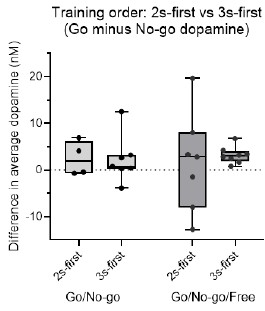
Following additional analyses, our data suggest that training order did not influence our core comparison of Go minus No-go dopamine. To directly address whether training order influenced dopamine signals, we separated animals based on whether they were first trained in the Cue-initiated Go/No-go (2s) or the Cue-initiated Go/No-go/Free (3s). We calculated the average dopamine of each rat during the action-cue period and then calculated the difference between them (Author response image 4). We observed absence of evidence of a difference between the groups.
Author response image 4.
Average Go minus No-go dopamine reveals no effect of the initial training variant (2s-first vs 3s-first) or test task version (Go/No-go vs. Go/No-go/Free). A 2 × 2 Bayesian ANOVA (Cauchy prior: fixed effects r = 0.5; random effects r = 1) consistently favoured the null model over all alternatives. The main effect of the initial training variant and test task version both showed moderate evidence of absence (initial training variant: BF10 = 0.378; test task version: BF10 = 0.367). The model including both main effects performed more poorly (BF10 = 0.134), and the full model including an initial training variant × test task version interaction was the least supported of all models examined (BF10 = 0.069). These results provide moderate evidence in favour of H0, suggesting that neither the variant animals were first trained on, the task version administered at test, nor their interaction meaningfully predicted average Go minus No-go dopamine responses.
(5) There is a major challenge in their design and interpretation of the dopamine signal. Both trial types (Go and No Go) start with the rat having their nose in the noseport. An auditory cue is presented for 2-3 s signaling to the rat to either leave the noseport and make a lever response (Go trial) or to stay in the noseport (No Go trial). The timing of these actions and/or decisions is entirely independent, so it is not clear to me how the authors would ever align these traces to the exact decision point for each trial type. They attempt to do this with the nose-port exit analysis, but exiting the noseport for a Go trial (a rat needs to make 2 lever presses and then get a reward) versus a No Go trial (a rat needs to go retrieve the reward) is very different and not comparable.
We respectfully disagree with the reviewer’s assertion that our data alignment approach is problematic. Aligning neural activity to specific behavioral epochs that occur at different times and across conditions is a widely used method to investigate the relationship between neural activity and behavior. Just to mention some examples: data collected with fiber photometry (e.g., Tan et al. 2026, doi: 10.1038/s41386-026-02368-4; Hart et al. 2024, doi: 10.1016/j.celrep.2024.113828) and voltammetry (Hamid et al. 2016, doi: 10.1038/nn.4173; Syed et al. 2016, doi:10.1038/nn.4187).
Alignment method
We intentionally designed the task so that overall action timing is matched between trial types (as described in our response to point 3), while specific behavioral epochs occur at different times. This allows us to compare dopamine dynamics during comparable behavioral events across Go and No-go trials (e.g., nose-poke exit).
We align data to three critical behavioral epochs, stated in the Methods Section 4: Real-time dopamine recordings and analysis - FSCV measurement and analysis: action-cue onset, nose-poke exit, and magazine arrival. Each alignment addresses a specific aspect of our research question:
Action-cue onset alignment captures VMS dopamine dynamics when animals have explicit knowledge of trial type and the required action. This allows us to characterize how dopamine evolves following correct action selection, which is central to our research question about how dopamine differs during successful Go versus No-go action execution, as well as no overt action (Free) in the long-task variant.
Nose-poke exit alignment captures dopamine dynamics at the moment animals initiate movement. The reviewer suggests that exiting for Go versus No-go trials is "very different and not comparable" because subsequent actions differ (two lever presses vs. direct reward retrieval). However, this is precisely our experimental manipulation: we compare dopamine signals when animals exit the nose-poke port to perform different actions. This comparison is both valid and necessary to address our research question (does dopamine encode action initiation?).
Magazine arrival alignment captures dopamine dynamics at reward approach. This allows us to differentiate between spatial proximity to reward from other concepts including temporal proximity (how soon is reward) and action requirements.
We acknowledge that we cannot identify the precise moment of decision formation. In fact, the precise moment of decision formation is irrelevant for our question. However, our aim is to characterize VMS dopamine dynamics during successful action execution for rewards, following cues associated with specific actions.
(6) The voltammetry analysis did not appear to test the hypotheses the authors outlined in the intro. All comparisons were done within task variants (DA dynamics in Go vs. No Go trials, aligned to different task events), but there were no comparisons across task variants to determine if the DA signal differed in cued vs self-initiated trials.
Our aim was to investigate whether VMS dopamine signals consistently differed between action initiation and action suppression during reward pursuit. To test this within-variant contrast (Go > No-go), we manipulated how reward pursuit is initiated (self- vs cue-initiated) and the “effort” requirements (short vs long task variants), and our results show that they did not affect the differential between Go and No-go.
The consistent Go > No-go dopamine that we observed across all task variants, together with the consistent increase during magazine approach, supports our conclusion that VMS dopamine integrates motivated action and reward.
The reviewer suggests that we should have compared dopamine signals across self- vs cue-initiated task variants. We acknowledge this is an interesting, but entirely different, question and have addressed it in the Discussion section. We note that differences in controllability altered the time course of increased VMS dopamine, presumably by triggering earlier positive RPEs in Cue-initiated tasks as compared to Self-initiated tasks (illumination of the nose-poke light being the earliest predictor of reward). However, since our primary research question relates to the difference in VMS dopamine between action initiation and suppression, our results show that this difference was unaffected in two variants (short and long), strengthening our conclusions about the relationship between action and reward-related dopamine signaling.
(7) Classification of No Go behaviors was interesting, but was not well integrated with the rest of the paper and was underdeveloped. It also raised more questions for me than answers. For example:
(a) Was the behavior classification consistent across rats for all No Go trials? If not, did the DA signal change within subjects between biting vs digging vs calm?
(b) If "biting rats" were not always biting rats on every No Go trial, then is it fair to collapse animals into a single measure (Figure 3C).
(c) Some of the classification groups only had 2 or fewer rats in them, making any statistical comparison and inference difficult.
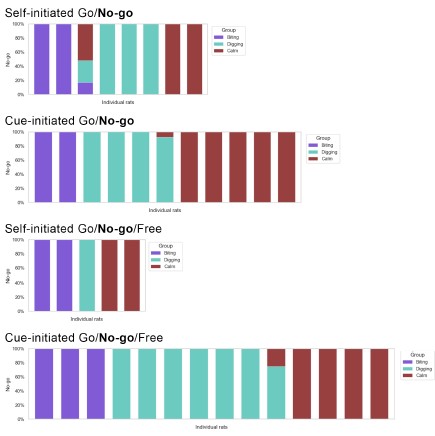
Behavioral classification for each rat was consistent across trials (i.e., 100%, see Author response image 5). Upon reviewing the consistency of classifications within individual animals, we found that “Biting” animals exhibited biting behavior across the majority of their No-go trials. Only one animal (in the Self-initiated Go/No-go "short" variant) showed mixed classifications across trials, occasionally exhibiting digging or calm behavior. For all other animals, the predominant behavioral classification was highly consistent within subjects across sessions. The occasional trials where “biting” animals did not bite were too infrequent to permit meaningful within-animal comparisons. Therefore, we believe collapsing animals by their predominant behavioral phenotype in Figure 3C is appropriate and accurately represents stable individual differences in No-go response strategies.
As stated in the Methods Section 6: Statistical Analysis - Clustering No-go behaviors and regrouping animals (last-line), we specifically avoided between-subjects statistical comparisons for groups with n≤2, as this would be inappropriate (see Author response image 5), and reported qualitative observations only. These exploratory findings at the individual-trial level suggest behavioral heterogeneity during No-go trials, that others may use for future investigation, but do not form primary conclusions.
The behavioral classification is integrated with our central findings on VMS dopamine encoding spatial proximity. Our results demonstrate that individual variation in action suppression strategy, in particular Biting behaviors, consistently manipulates the timing of max dopamine release during subsequent reward approach, but not during the action itself (Figure 3b-c). This links our observations of action-dependent dopamine (Figure 2c) with spatial reward approach (Figure 2e). We believe that our findings shed new light into the understanding of how action modulates reward-related dopamine dynamics at the individual level. This has been discussed in Discussion section: Dopamine dynamics are linked to motivated action.
Author response image 5.
Rats predominantly stick to a particular strategy to perform No-go trials. Each bar represents an individual animal, and colours represent the % of each classification type.
Recommendations for the authors:
Reviewer #1 (Recommendations for the authors):
(1) Figures: It would be helpful to have more panel labels on the figures - 1C, for example, labels 4 different dataset panels, similar to a few other cases. This would really help to improve readability, as there are a lot of task types, trial types, behavioral measures, and labels to sift through. The figures overall are very busy, and it is a bit of a challenge to process the tasks and trial comparisons, as well as interpret what the quantification insets mean.
We thank the reviewer for their suggestion. We have added more panel labels to Figure 1 to improve the ability to follow with the main text. We hope that the reviewer finds it acceptable.
(2) Figures: A bit more specifically, in Figure 2, the boxplot insets are pretty hard to see, and it's not clear what scale they are on or what data they reflect. Similarly, it's unclear what the horizontal bars reflect in terms of which conditions are being compared. Why are box plots used for some comparisons, and why are some comparisons based on time series bootstrapping, but others are not clear? I would consider broadly reworking this figure and its description for clarity. Figure 3, by comparison, is easier to understand - the quantifications are clearer and labeled.
We have now labeled the comparisons being depicted by the horizontal bars in Fig 2c. We have also clarified the boxplot analysis in Fig 2d and Fig 2e by adding 'Max dopamine’ labels to the figure, and have made these analysis methods more explicit in the figure legend.
We used time-series bootstrap analysis to identify when dopamine signals diverged between trial types, which depicts dopamine differences during distinct action requirements. The latency-to-max quantification provides a summary measure to test specific encoding hypotheses (temporal vs. spatial proximity to reward).
(3) Broadly, more clarity on the FSCV analysis is warranted.
(a) Targeting: It looks like the dataset contains a mix of medial shell and mostly core accumbens placements. The paper treats VMS as a uniform dopamine region, but it is more standard to separate core and shell (and also other parts of the shell) into subregions. Many of the reported encoding profiles here are known to differ across the accumbens. So, some consideration of this seems appropriate - a minimal signal-behavior comparison for the shell vs core subgroups, for example.
We thank the reviewer for raising this point. Upon careful re-examination of our histological analysis, we identified an error that occurred when we made the overlay of electrode placements across rostrocaudal planes (to project placements onto a single plane for the sake of simplicity; Fig 2a): We incorrectly assigned some recordings to the nucleus accumbens shell. We corrected this error, which shows that the vast majority of recordings were in the core, with only 2 animals in the shell (black stars). We have adjusted Fig 2a to reflect this, and added an anatomically more complete illustration of electrode placements across rostrocaudal planes as Supplementary Figure S8.
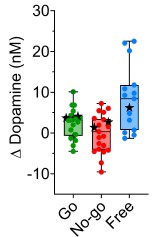
While we acknowledge reported differences between core and shell dopamine in some contexts, the small number of shell placements precludes meaningful statistical comparison. However, to determine whether average dopamine concentrations differed between core and shell during the action-cue period, we have plotted the values in Author response image 6. The fact that shell data mostly falls centrally into the overall core-data distribution suggests no consistent difference in dopamine release.
Furthermore, in our experience (and that of colleagues (personal communication)) with appetitive operant tasks, core and shell FSCV dopamine signals do not substantially differ for action-selective encoding and reward approach. Given the sample distribution and our focus on general VMS function in Go/No-go behavior, we believe pooling these regions is appropriate.
Author response image 6.
Average dopamine release during the action cue in nucleus accumbens core (circles) and shell (stars) animals showed no distinct separation between regions. Each symbol represents an animal.
(b) Design: In my understanding of the design, the main distinction between the short and long task variants is a 2-second versus a 3-second required nose poke hold. 3 seconds here is "long" and more "difficult". I'm not sure I agree that a 1-sec distinction really reflects a difference in task difficulty or effort. Can the authors point to a past paper that demonstrates this variation is sufficient to engage a behavioral difference and/or a neural encoding difference? Broadly, some justification of the validity of this manipulation is needed, I think.
While we lack direct citations for this specific manipulation, we believe that the 2s and 3s hold requirements represent meaningful differences in difficulty based on our extensive rat-behavior experience and behavioral evidence in Author response image 2.
Importantly, the difficulty of No-go trials does not stem merely from the required time to hold their snouts in the nose-poke port, but from suppressing the motivational/Pavlovian bias to approach reward-associated cues. In No-go trials, subjects must suppress the prepotent tendency to immediately approach reward-related stimuli and instead maintain active suppression of this approach behavior. Even the 2s hold is challenging as animals tend to perform better on Go trials compared to No-go trials (Fig 1b and 1c), demonstrating the inherent difficulty of response suppression even at the shorter duration. The additional 1-second substantially increases this demand, as it represents a 50% increase in hold duration.
Our training data clearly demonstrate the difficulty in reaching task criterion when increasing the required action (for Go and No-go trials) from 2s to 3s. Across four cohorts of animals trained in Go/No-go task variants, one cohort that was trained first in the 2s task variant, and the remaining three cohorts were trained in the 3s task variant of Go vs No-go. Animals required 41.1 ± 7.9 (n = 27) sessions to learn the 3s hold (approximately 8 weeks), versus
18.5 ± 7.6 sessions for the 2s hold (approximately 4 weeks; mean ± SEM). This indicates that despite only a 1-second difference in required action performance, animals needed more than double the number of training days to reach criterion, clearly indicating differential effort demands.
(c) Figure 2 results: the authors state that because there is a greater DA signal to Go vs No Go cues in all the task variants, this means that controllability of reward pursuit and increased task effort do not affect VMS dopamine. But the magnitude of the signals looks different across the task variants - it looks clearly stronger overall in the self-initiated tasks, for example. Given that dopamine signals are not compared across task variants (I think the tasks are all between-subjects?), I don't think the above conclusion is justified.
We respectfully clarify that our conclusion does not claim controllability and effort have no effect on dopamine magnitude, but rather that these manipulations do not affect the action-selective difference in dopamine (Go > No-go). Our central finding is that the relative difference between Go and No-go remains consistent across all task variants (within-subjects comparison).
We did not perform across-variant comparisons of absolute dopamine magnitudes because that was not our primary research question. Our focus was to understand whether dopamine differs between action initiation and suppression, and whether this difference can be modulated by controllability or effort.
We acknowledge the reviewer’s observation that absolute magnitudes appear larger in self-initiated vs cue-initiated task variants. We believe that this likely reflects differences in RPE timing rather than controllability per se: in cue-initiated tasks, the nose-poke light provides an early trial-start signal, distributing RPE temporally across the trial. In self-initiated tasks, trial-initiation and action requirements are temporally integrated. Though understanding how controllability affects absolute dopamine magnitude is an interesting question for future work (e.g., using sophisticated regression-based encoding models), it was beyond the scope of our current investigation, which focuses on action-selective encoding.
(4) Broadly, I don't think these data, as shown, support the conclusion "dopamine reflects action initiation but not controllability or effort" without more analysis and additional context.
We have revised the wording of our conclusions throughout the manuscript to better reflect our intent, which is to compare the action-selective encoding of dopamine (i.e., action initiation vs action suppression). It is now “Reward-related dopamine depends on action initiation irrespective of controllability and effort”.
(a) Figure 3 - more description of the classified behaviors would be helpful for interpreting this part of the data. When are the behaviors occurring - during the hold cue? Or is the classification related to what they do immediately after holding? Or something in between> I guess I'm not sure what digging and biting are in the context of a nose poke hold. As described, it's not clear what the signal differences relate to - movement differences? Generally, it's not clear what to make of the behaviors. They seem to emerge spontaneously, but it's not clear whether the specific actions mean anything, so it's a bit difficult to know what to glean from the dopamine is greater during "biting". It's a very different movement pattern, so perhaps this result relates to that, rather than task engagement or motivational drive per se?
We thank the reviewer for the comment. We have added relevant information in the figure caption and in the Results section to clarify that classified behaviors occurred during the action-cue period (for No-go trials, the hold cue; Figure 3a caption). In addition, we have included Videos to better depict the classified No-go behaviors during the action-cue period.
We agree with the comment that these classified behaviors, such as biting, seem to emerge spontaneously. Our interpretation of these behaviors is that they may represent the motivational state of each subject. Most importantly, whereas the behavioral differences occurred during the action-cue period (while animals had to suppress actions and stay within the nose-poke port), the difference in VMS dopamine was only observable after this behavior was completed. Thus, the movement pattern per se is likely not relevant to the dopamine release occurring after its completion. This has been discussed in the Discussion section: Dopamine dynamics are linked to motivation action.
Based on our videos, it appears as though Digging could be perceived as more vigorous (i.e., more general movement in the nose-poke port). However, we did not observe more dopamine during the action-cue period of Digging trials as compared to Biting trials. Furthermore, more vigor during the action-cue period (e.g. Digging trials) did not result in more dopamine during the reward approach period. Together, the data suggest that another process may underlie the large increase in VMS dopamine in Biting trials during reward approach, such as varying attribution of incentive salience.
(b) In some cases, but not all, dopamine measurement comparisons are done on a total trial basis, and in others, it seems to be subject averages. It's not clear why different approaches are used for different parts of the data. But also, for the trialwise analysis, what statistical steps were taken to incorporate the subject as a random factor in the analysis? If that is not done, then a trial-wise analysis artificially increases the power for the stat (n=trial#).
We used different analytical approaches depending on sample size and data structure. To compute differences in Go vs No-go dopamine within each animal, as intended by our experimental design, we performed subject-level comparisons (Figure 2).
For the behavioral classification analysis (No-go, Figure 3), we performed trial-level analyses to increase the statistical power and better characterize this unexpected and interesting phenomenon. We explicitly chose not to perform subject-level group comparisons because
(1) some groups had only n=2-3 animals, making subject-level statistics underpowered, and (2) behavioral classifications were highly stable within individual animals (see Author response image 5). We acknowledge that formal between-group comparisons (across subjects) are underpowered due to small n, but the stability of within-subject No-go behavioral strategy and qualitatively distinct VMS dopamine profile suggest that these differences may be biologically meaningful and worthy of future investigation in larger samples. We have made these limitations more explicit in the Results.
This relates to Figure 3, where all trial data are shown next to individual subjects - the subject-wise group comparisons are between 2-5 or so rats, which is quite low. In Figure 2, a subject n of 27 is listed, so it's not clear why this analysis is on such a small set of rats. Generally, it's not clear how many rats/subjects are in each data bit. The methods say only 5 rats are in the long self-initiated task, but 15 in the cue-initiated task. Clarity in all this is needed, including in the figures/captions.
We have now added detail about the statistical test performed in Figure 3’s caption:
“After action-cue offset: No-go (trials)’: Individual No-go trials classified by No-go behavior, and trial-wise statistical Kruskal-Wallis tests were performed for each task-variant.” We have also added in a table in Methods (Table 1), showing the number of trials in each No-go classification, and animals regrouped based on their predominant No-go strategy (see Methods section: Statistical analysis - Clustering No-go behaviors and regrouping animals).
For the small sample sizes based on the regrouping of animals based on their predominant No-go strategy, we have now added in the caption, “... Rats classified based on their predominant No-go strategy, with no statistical tests performed.”
(5) I'm also a little confused about the paper's narrative that the dopamine data reflect spatial (but not temporal) proximity to reward - it seems that this conclusion is based on the dopamine signal peaking at magazine entry, but that is different, I think, than a spatial signal per se (space is not manipulated in this study). I think more analysis of the signals during the magazine approach behaviors would be helpful, and possibly comparing rewarded vs unrewarded approaches. The emphasis, including in the title, that a major take-home of the data is that dopamine encodes reward proximity, is not really borne out by the current analyses. Reward expectation is not manipulated independently of the approach action, so it's hard to pin this on "space" vs "reward is soon". This is admittedly a general complexity in characterizing dopamine ramps.
As the reviewer notes, we acknowledge that 'spatial proximity' and 'reward is soon' are challenging to fully dissociate in appetitive approach paradigms. However, we believe that our data and new additional analyses, which is now included in Results: Maximum VMS dopamine release encodes spatial but not temporal proximity to rewards and Supplementary Figures S10-12, provide compelling evidence that VMS dopamine primarily reflects spatial proximity to the expected reward location, rather than temporal proximity to reward delivery.
Evidence against full temporal encoding:
(1) Max VMS dopamine occurred up to 3s before reward delivery in Free trials (Fig 2e, open circles vs triangles). Furthermore, when we calculated the max values of individual trials of realigned traces, maximum dopamine does not consistently coincide with reward delivery across trial types (new Supplementary Figure S11).
(2) If dopamine encoded temporal proximity from the earliest reward-predictive cue, we would expect consistent accumulation from cue onset (action cue for self-initiated, nose-poke light for cue-initiated). However, realigned trials also did not show a consistent accumulation around these events (new Supplementary Figure S12).
Evidence for spatial encoding:
(1) Max dopamine consistently occurred when animals arrived at the magazine across all trial types and task variants, regardless of when reward was actually delivered (Fig. 2e).
(2) Across individual trials, max dopamine values concentrated around the magazine-panel, with a striking accumulation when animals were in close proximity to it (new Supplementary Figure S10) showing a distance-dependent distribution.
(3) Assessment of unrewarded magazine approaches during the intertrial interval (ITI) revealed no increase in dopamine release (Fig 2f), indicating that VMS dopamine requires task-relevant reward expectation.
(6) Examples of the DLC workflow in a supplement would be appropriate. Also, video examples of the 3 kinds of behaviors from the clustering analysis could be useful for understanding what they are/what they mean.
We have added supplementary figures showing the DeepLabCut workflow (Supplementary Figure S9) and Videos 1-3 demonstrating the three behavioral classifications (biting, digging, calm) during No-go trials.
(7) Referencing/scholarship: I would suggest broadening the citation pool for the paper to include more older work that has established the notion that dopamine signaling and the accumbens act as a motivation-action interface, as this has been a longstanding notion since at least the 1980s. There is also a sizable literature on dopamine signaling of effort, some of which would be appropriate to cite here.
We thank the reviewer for the recommendation and have now expanded our citations to include foundational literature to work from the 1980s-90s. These can be found in the Introduction, Results, and Discussion.
Reviewer #2 (Recommendations for the authors):
(1) Lines 353-357- This came as a surprise, as the relevant results are only featured in supplementary information. These should be moved to the main manuscript. As both the biting behavior and faster lever-press completion lead to larger peak dopamine, does this represent response vigor?
We appreciate the reviewer’s interest in these data. However, we believe that the data that we report in “Supplementary Fig 7: Quartile analysis of Go trials shows coordinated changes in last lever-press timing and VMS dopamine, does not warrant movement to the main manuscript.”
The purpose of the lever-press timing analysis was to demonstrate that maximum dopamine release coincides with the moment animals arrived at the magazine, rather than with the action period itself. By sorting Go trials based on last lever-press latency, we show temporal coordination between action completion and dopamine timing but critically, dopamine peaks after action completion, not during it.
This temporal dissociation argues against a 'response vigour' interpretation. If dopamine encoded motor vigour, we would expect the signal to coincide with or precede the vigorous action. Instead, both the lever-press data (Supplementary Figure S7) and the classified No-go trial data (Figure 3, biting behavior) show that changes in max dopamine occur after the actions themselves, during the subsequent approach to reward.
Together, these findings demonstrate that VMS dopamine reflects spatial approach to the reward location following action completion, not the vigour of the required actions per se. The lever-press analysis serves as supporting evidence for this temporal relationship but does not introduce a novel finding that warrants main figure emphasis. We mentioned this temporal coordination in Results to ensure readers are aware of the converging evidence while maintaining focus on our central findings regarding action initiation versus suppression.
(2) Line 13- the experimental work cited refers to midbrain dopamine neurons, rather than dopamine release within the VMS. Please correct.
We thank the reviewer for pointing out this error. We have now corrected the citation to refer to studies measuring striatal dopamine rather than midbrain dopamine neurons.
(3) Line 166 - Shouldn't this say "consistently delayed for No Go trials"? Looks like peak dopamine occurs later for these trial types.
This statement refers to traces aligned to nose-poke exit (not action-cue onset). The peak Go dopamine occurred later than other trial types following exit (Green arrows in Figure 2d).
(4) Lines 391-392 - however however
Thank you for the comment, we have adjusted the text.



