Neutralizing human monoclonal antibodies that target the PcrV component of the type III secretion system of Pseudomonas aeruginosa act through distinct mechanisms

- Univ. Grenoble Alpes, CEA, CNRS, Institut de Biologie Structurale (IBS), France
- Laboratoire d'Immunologie, CHU Grenoble Alpes, France
- Centre d’Étude des Pathologies Respiratoires INSERM U1100 - UFR de Médecine de Tours, France
- Laboratoire de Bactériologie-Hygiène Hospitalière, CHU Grenoble Alpes, France
- Laboratoire de Virologie, CHU Grenoble Alpes, France
Figures
Figure 1

Screening workflow and donor selection.
(A) Schematic representation of the workflow from patient selection to evaluation of Type 3 Secretion System (T3SS)-blocking activity. (B) Patients’ sera (1/50 dilution) were tested in ELISA against recombinant PcrV and PscF. (C) ExoS-Bla translocation blocking activity of serum IgGs from donors 16 and 25. The dots and bars represent the means and standard deviations of data from three (Donor 16) and two (Donor 25) experiments with three technical replicates each. (D) (top) scheme of depletion experiment of specific Abs on either PscF- or PcrV-loaded columns. (bottom) blocking activity of depleted sera for both donors. The dots and bars represent the means and standard deviations of experimental triplicates. The curves correspond to the modeled log-logistic dose-response curves. The dashed lines represent the mean of normalized ExoS-Bla injection in the absence of Ab. Source Data: Figure 1—source data 1.
-
Figure 1—source data 1
Raw data for plots of Figure 1 - Donor selection.
- https://cdn.elifesciences.org/articles/105195/elife-105195-fig1-data1-v1.xlsx
Figure 2

Selection of B cells from donors 16 and 25.
(A) B cell sorting and isolation using PscF and PcrV baits. (B) Table summarizing the EC50 values of selected Abs obtained by ELISA and the percentage of inhibition of ExoS-Bla injection into epithelial cells at 100 µg/mL. ExoS-Bla inhibitions were compared using ANOVA and ‘No inhibition’ means an absence of significant difference with the control (adjusted p-values >0.05). The P5B3 and P3D6 mAbs exhibited differences with the control (no Ab) with adjusted p-values <0.001. Source Data: Figure 2—source data 1.
-
Figure 2—source data 1
Raw data for table of Figure 2 - Antibody affinity and inhibitory activity.
- https://cdn.elifesciences.org/articles/105195/elife-105195-fig2-data1-v1.xlsx
Figure 3 with 1 supplement

Monoclonal antibodies (mAbs) P5B3 and P3D6 activity on PcrV variants.
(A) PcrV variability in clinical strains. The most variable position (225) can either be Ser, Arg, or Lys. Representative strains are indicated when available (PAO1 for V1, CHA for V2, PA14 for V3, and PA103 for V4). (B) Inhibition of ExoS-Bla activity following infection of A549 epithelial cells with P. aeruginosa expressing the PcrV variants. Normalized ExoS-Bla injection values in the presence of 100 µg/mL Abs were compared to the control (no Ab) using ANOVA (V1 and V4) or Kruskal-Wallis (V2, V3, and V5). Pairwise t-test or Dunn significance is indicated by the symbols *, **, ***, and **** for adjusted p-values below 0.05, 0.01, 0.001, and 0.0001, respectively. The absence of a symbol corresponds to adjusted p-values >0.05. Data correspond to at least two experiments with three technical replicates each. Source Data: Figure 3—source data 1.
-
Figure 3—source data 1
Raw data for plots of Figure 3 - Antibody inhibitory activity.
- https://cdn.elifesciences.org/articles/105195/elife-105195-fig3-data1-v1.xlsx
Figure 3—figure supplement 1

Dose-dependent inhibition by mAbs P5B3 and P3D6 of ExoS-Bla injection from strains expressing five PcrV variants.
Inhibition of ExoS-Bla activity following infection of A495 epithelial cells with P. aeruginosa expressing the V1 (A, B), V2 (C), V3 (D), V4 (E), or V5 (F) variants, with mAbs concentration ranging from 0.01 to 100 µg/mL. The circles, the black line, and the gray area represent the experimental values from two or three experiments with three technical replicates each, the log-logistic modeled dose-response curve and the 95% confidence interval, respectively. The dashed lines represent the mean of normalized ExoS-Bla injection in the absence of antibody. The Ab concentration is presented in logarithmic scale. Monoclonal Ab P5B3 displays dose-response inhibition with the strains expressing the V1, V2, V3, V4, and V5 variants with respective IC50s of 96, 206, 192, 212, and 426 µg/mL (no statistically significant difference). P3D6 (B) displays a dose-response inhibition with the strain expressing the V1 variant, with an IC50 of 3.7 µg/mL, significantly different from the one of P5B3 against the same variant (p-value = 0.015). Source Data: Figure 3—source data 1.
Figure 4

Monoclonal antibody (mAb) P3D6 efficiently inhibits the PopB/PopD translocation pore.
J774 macrophages were infected with P. aeruginosa strain (PAO1, V1) deprived of all three T3SS toxins. The cell death (cytotoxicity) resulting from insertion of the translocon pore was measured by propidium iodide incorporation and normalized to the wild-type strain without addition of mAbs. Data correspond to three experiments with three technical replicates each. (A) Normalized cytotoxicity values in the presence of mAb at 100 µg/mL. Specific mAbs were compared to the control (no Ab) using ANOVA. Pairwise t-test significance is indicated by the symbol ****, meaning p-values below 0.0001. (B, C) Dose-response analysis with mAb concentrations ranging from 0.01 to 100 µg/mL. The circles, the black line and the gray area represent the experimental values, the log-logistic modeled dose-response curve and the 95% confidence interval, respectively. The dashed lines represent the mean of normalized cytotoxicity in the absence of Ab. The Ab concentration is presented in logarithmic scale. No black curve nor gray area is displayed for P5B3 because no dose-response could be modeled. In contrast, P3D6 exhibits an IC50 of 11.8 µg/mL. Source Data: Figure 4—source data 1.
-
Figure 4—source data 1
Raw data for plots of Figure 4 - Antibody inhibitory activity.
- https://cdn.elifesciences.org/articles/105195/elife-105195-fig4-data1-v1.xlsx
Figure 5 with 1 supplement

Structure of Fab P3D6 in complex with PcrV*.
(A) Crystal structure of Fab P3D6 in complex with PcrV*. Fab P3D6 is shown in brown, while PcrV* is in orange. Contacts are made between PcrV* and an interaction platform formed by both HC and LC of P3D6. (B) Close-up of the interaction between PcrV* and P3D6, with the latter being shown as an electrostatic surface where acidic regions are shown in red, and basic in blue. Side (C) and top (D) views of the modeled PcrV pentamer, in light blue onto which the structure shown in (A) was overlaid.
Figure 5—figure supplement 1

Interactions between PcrV* and Fab P3D6.
Chain codes correspond to: Fab HC (chain A), LC (chain C), and PcrV* (chain E). CDR H1, H2, and H3 of the heavy chain, as well as CDR L1 and L3 of the light chain, contribute to PcrV* binding. Interaction diagram generated with LigPlot + v.2.9.9 (Laskowski and Swindells, 2011, https://www.ebi.ac.uk/thornton-srv/software/LigPlus/). Hydrogen bonds are represented by green dashed lines and residues involved in hydrophobic contacts are indicated by spoked arcs.
Figure 6 with 1 supplement

Functional and structural comparisons between anti-PcrV monoclonal antibodies (mAbs).
(A) Dose-dependent inhibition of T3SS in two functional assays reflecting toxin injection (ExoS-Bla injection) and translocon assembly (J774 macrophage cytotoxicity) for three mAbs. Data correspond to three experiments with three technical replicates each. The circles, the dark lines, and the light-colored areas represent the experimental values, the log-logistic modeled dose-response curves and the 95% confidence intervals, respectively. The Ab concentration is presented in logarithmic scale. No red curve nor red area is displayed for MEDI3902 because no dose-response could be modeled. (B) Structures of PcrV-Fab complexes in the context of a PcrV monomer, as well as of a pentamer modeled based on the cryo-EM structure of SipD (Guo and Galán, 2021). The N- and C- termini of PcrV are indicated in all structures, which are referenced in the main text. Source Data: Figure 6—source data 1.
-
Figure 6—source data 1
Raw data for plots of Figure 6 - Antibody inhibitory activity.
- https://cdn.elifesciences.org/articles/105195/elife-105195-fig6-data1-v1.xlsx
Figure 6—figure supplement 1

Dose-dependent inhibition by monoclonal antibodies (mAbs) 30-B8 of ExoS-Bla injection from strains expressing five PcrV variants.
Inhibition of ExoS-Bla activity following infection of A495 epithelial cells with P. aeruginosa expressing the V1, V2, V3, V4, or V5 variants, with mAbs concentration ranging from 0.001 to 1 µg/mL. Monoclonal Ab 30-B8 displays dose-response inhibition with V1, V2, V3, V4, and V5 variants with respective IC50 of 21.3, 12.8, 11.2, 13.0, 10.5 ng/mL. The dark lines and the light-colored areas represent the log-logistic modeled dose-response curve and the 95% confidence interval, respectively, based on three experiments with three technical replicates each. The dashed lines represent the mean of normalized ExoS-Bla injection in the absence of antibody. The Ab concentration is presented in logarithmic scale. Source Data: Figure 6—source data 1.
Tables
Key resources table
| Reagent type (species) or resource | Designation | Source or reference | Identifiers | Additional information |
|---|---|---|---|---|
| Strain, strain background (Escherichia coli) | BL21(DE3) | Thermo Fisher | #EC0114 | Production of recombinant proteins |
| Strain, strain background (Pseudomonas aeruginosa) | CHAΔexoS::exoS-bla | PMID:22299042 | RRID:NCBITaxon_136841 | T3SS functionality assays |
| Strain, strain background (P. aeruginosa) | CHAΔpcrV | PMID:15271936 | RRID:NCBITaxon_136841 | T3SS functionality assays |
| Strain, strain background (P. aeruginosa) | PAO1Δ3Tox | PMID:18039770 | RRID:NCBITaxon_136841 | T3SS functionality assays |
| Cell line (mouse) | J774A.1, macrophages | ATCC | TIB-67; RRID:CVCL_0358 | mycoplasma-free, authenticated by Short Tandem Repeat (STR) profiling by Eurofins Genomics |
| Cell line (human) | A-549, lung epithelial cells | ATCC | CCL-185; RRID:CVCL_0023 | mycoplasma-free, authenticated by Short Tandem Repeat (STR) profiling by Eurofins Genomics |
| Cell line (human) | HEK293-F | Thermo Fisher Scientific | #R79007; RRID:CVCL_6642 | monoclonal antibody production, mycoplasma-free, authenticated by Short Tandem Repeat (STR) profiling by Eurofins Genomics |
| Biological sample (human) | Sera and PBMC | This work | Approved by French ethics committee (ID-RCB 2020A00311-38), screening of patients’ sera (dilution 1:50) and memory B cells, sera available from IBS, Grenoble | |
| Antibody | Patients’ purified IgGs (human polyclonal) | This work | Used: 40–160 µg/mL, available from IBS, Grenoble | |
| Antibody | VRCO1 (human monoclonal) | PMID:20616233 | Produced during this work based on the published sequence, used: 100 µg/mL | |
| Antibody | P5B3 (human monoclonal) | This work | Used: 0.001–100 µg/mL, sequence in Supplementary file 6 | |
| Antibody | P3D6 (human monoclonal) | This work | Used: 0.001–100 µg/mL, sequence in Supplementary file 6 | |
| Antibody | 30-B8 (human monoclonal) | PMID:37918395 | Produced during this work based on the published sequence, used: 0.001–100 µg/mL | |
| Antibody | MEDI3902, (human monoclonal) | Proteogenix | #PX-TA1591 | Used: 0.001–100 µg/mL |
| Antibody | Anti-PcrV, (rabbit polyclonal) | PMID:15271936 | Controls in ELISA, used: 0.001–100 µg/mL | |
| Antibody | Anti-PscF, (rabbit polyclonal) | PMID:15271936 | Controls in ELISA, used: 0.001–100 µg/mL | |
| Antibody | Anti-rabbit AP-coupled (goat polyclonal) | Thermo Fisher Scientific | #65–6122; RRID:AB_2533968 | ELISA (1:10000 dilution) |
| Antibody | Anti-human AP-coupled (goat polyclonal) | Jackson ImmunoResearch Labs | #109-056-098; RRID:AB_2337618 | ELISA (1:10000 dilution) |
| Antibody | Anti-human CD3 VioBlue (human monoclonal) | Miltenyi | #130–114- 519; RRID:AB_2726687 | Sorting of specific memory B cells |
| Antibody | Anti-human CD20 PE- Vio 770 (human monoclonal) | Miltenyi | #130–111- 340; RRID:AB_2656074 | Sorting of specific memory B cells |
| Antibody | Anti-human CD19 PE- Vio 770 (human monoclonal) | Miltenyi | #130–113- 647; RRID:AB_2726200 | Sorting of specific memory B cells |
| Antibody | Anti-human IgM PE (mouse monoclonal) | Miltenyi | #130–093- 075; RRID:AB_1036088 | Sorting of specific memory B cells |
| Antibody | Anti-human IgA PE (mouse monoclonal) | Miltenyi | #130–113- 476; RRID:AB_2733861 | Sorting of specific memory B cells |
| Antibody | Anti-human IgD PE (human monoclonal) | Miltenyi | #130–110- 643; RRID:AB_2652262 | Sorting of specific memory B cells |
| Antibody | Anti-human CD27 APC (human monoclonal) | Miltenyi | #130–113- 636; RRID:AB_2751162 | Sorting of specific memory B cells |
| Recombinant DNA reagent | pIApG-pcrV-V1 (PAO1) (plasmid) | This work | Replicative plasmid for PcrV expression, *Leu6Ala9Ser21Ser225, available from IBS, Grenoble | |
| Recombinant DNA reagent | pIApG-pcrV-V2 (CHA) (plasmid) | This work | Leu6Ala9Ser21Arg225, available from IBS, Grenoble | |
| Recombinant DNA reagent | pIApG-pcrV-V3 (PA14) (plasmid) | This work | Phe6Ala9Pro21Lys225, available from IBS, Grenoble | |
| Recombinant DNA reagent | pIApG-pcrV-V4 (PA103) (plasmid) | This work | Phe6Gly9Pro21Arg225, available from IBS, Grenoble | |
| Recombinant DNA reagent | pIApG-pcrV-V5 (plasmid) | This work | Phe6Gly9Pro21Lys225, available from IBS, Grenoble | |
| Recombinant DNA reagent | pET15b-His-PcrV (plasmid) | PMID:14565848 | PcrV production, available from IBS, Grenoble | |
| Recombinant DNA reagent | pET22b-PscF-His (plasmid) | PMID:16115870 | PscF production, available from IBS, Grenoble | |
| Recombinant DNA reagent | pESPRIT-His-PcrV-avitag (plasmid) | this work | Production of PcrV-avitag for B cell sorting, available from IBS, Grenoble | |
| Recombinant DNA reagent | pESPRIT-His-PscF-avitag (plasmid) | This work | Production of PscF-avitag for B cell sorting, available from IBS, Grenoble | |
| Recombinant DNA reagent | pET15b-PcrV* (plasmid) | This work | Production of PcrV* containing amino acids (1-17)(136-249), available from IBS, Grenoble | |
| Recombinant DNA reagent | Variable domains of heavy and light chains cloned into gamma1 HC, kappa LC, and lambda LC expression vectors | This work, PMID:17996249 | Sequences provided in Supplementary file 6, available from IBS, Grenoble | |
| Chemical compound, drug | Propidium Iodide | Sigma | #P4864 | |
| Chemical compound, drug | Aqua LIVE/DEAD stain | Thermo Fisher Scientific | #L34957 | Sorting of specific memory B cells |
| Chemical compound, drug | Streptavidin BUV737 | BD | #612775; RRID:AB_2869560 | Sorting of specific memory B cells |
| Chemical compound, drug | Streptavidin Vio-515 | Miltenyi | #103-107-459 | Sorting of specific memory B cells |
| Chemical compound, drug | Streptavidin BUV496 | BD | #612961; RRID:AB_2869599 | Sorting of specific memory B cells |
| chemical compound, drug | Streptavidin BV605 | Biolegend | #405229; RRID:AB_2869476 | Sorting of specific memory B cells |
| Chemical compound, drug | protein inhibitor cocktail | Roche | #4693132001 | Protein purification |
| Chemical compound, drug | ni-IDA resin | Macherey-Nagel | #745210–120 | Protein purification |
| Chemical compound, drug | 293 fectin | Fisher Scientific | #10553283 | Transfection reagent for mAb expression |
| Chemical compound, drug | SAX biosensors | Sartorius | #18–5,117 | BLI experiments |
| Chemical compound, drug | SA biosensors | Sartorius | #18–5019 | BLI experiments |
| Chemical compound, drug | CCF2 | Invitrogen | K1039 | Screening of functional antibodies |
| Chemical compound, drug | FreeStyle 293 F | Fisher Scientific | #10319322 | Medium for HEK293F, monoclonal antibody production |
| Commercial assay or kit | Quickchange II | Agilent | #200524 | Site-directed mutagenesis |
Additional files
-
Supplementary file 1
Sequence conservation of V and J regions of selected mAbs compared to germline.
Percentage (%) of identity was obtained by aligning variable region sequences on IMGT database (https://www.imgt.org/).
- https://cdn.elifesciences.org/articles/105195/elife-105195-supp1-v1.docx
-
Supplementary file 2
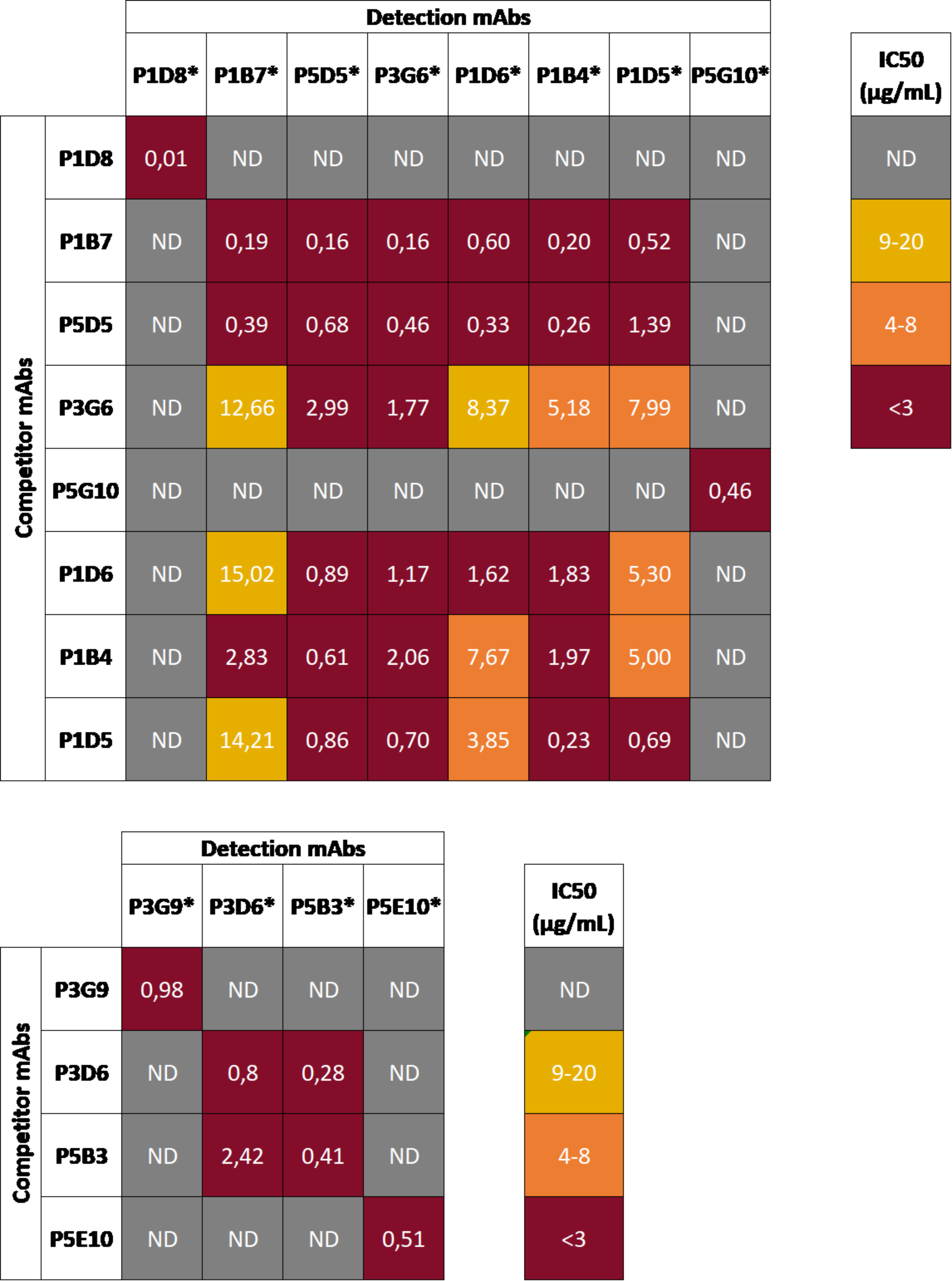
Competition between (A) anti-PscF monoclonal antibodies (mAbs) and (B) anti-PscF mAbs.
The indicated IC50 values correspond to the concentration of competitor mAbs necessary to obtain half of the signal generated by the biotinylated mAbs without competitor. ND corresponds to a non-detectable competition. Source Data: Source data 2.
- https://cdn.elifesciences.org/articles/105195/elife-105195-supp2-v1.png
-
Supplementary file 3
Affinities of anti-PcrV monoclonal antibodies (mAbs) for PcrV.
The reported values correspond to the average of the measurements obtained from two independent experiments (n=2). Standard Deviations were calculated by the BLI analysis software. Source Data: Source data 2.
- https://cdn.elifesciences.org/articles/105195/elife-105195-supp3-v1.png
-
Supplementary file 4
Data collection, phasing, and structure refinement statistics.
- https://cdn.elifesciences.org/articles/105195/elife-105195-supp4-v1.docx
-
Supplementary file 5
Bacterial strains and plasmids.
- https://cdn.elifesciences.org/articles/105195/elife-105195-supp5-v1.docx
-
Supplementary file 6
Antibody variable region sequences.
- https://cdn.elifesciences.org/articles/105195/elife-105195-supp6-v1.docx
-
MDAR checklist
- https://cdn.elifesciences.org/articles/105195/elife-105195-mdarchecklist1-v1.docx
-
Source data 1
Raw data for tables of Supplementary file 2 - Antibody competition.
- https://cdn.elifesciences.org/articles/105195/elife-105195-data1-v1.xlsx
-
Source data 2
Raw data for table of Supplementary file 2 - Antibody affinities.
- https://cdn.elifesciences.org/articles/105195/elife-105195-data2-v1.xlsx
Download links
A two-part list of links to download the article, or parts of the article, in various formats.
Downloads (link to download the article as PDF)
Open citations (links to open the citations from this article in various online reference manager services)
Cite this article (links to download the citations from this article in formats compatible with various reference manager tools)
Neutralizing human monoclonal antibodies that target the PcrV component of the type III secretion system of Pseudomonas aeruginosa act through distinct mechanisms
eLife 14:RP105195.
https://doi.org/10.7554/eLife.105195.3