
Multimodal MRI marker of cognition explains the association between cognition and mental health in the UK Biobank

- Department of Psychology, University of Otago, New Zealand
- Federal University of the São Francisco Valley, Brazil
- National Institute of Social and Affective Neuroscience, Brazil
- School of Computing, University of Otago, New Zealand
Figures
Figure 1

Experimental design.
(a) UK Biobank variables: cognitive tests, mental health, and neuroimaging phenotypes from three Magnetic Resonance Imaging (MRI) modalities. (b). Derivation of the g-factor from cognitive performance scores with Exploratory Structural Equation Modeling (ESEM) and prediction of the g-factor from mental health indices using Partial Least Squares Regression (PLSR). (c) Scheme of the machine learning model (PLSR) with nested cross-validation. (d) Scheme of the two-level predictive modeling and commonality analyses. First, individual neuroimaging phenotypes from diffusion-weighted MRI (dwMRI) (42 phenotypes), resting-state functional MRI (rsMRI) (10 phenotypes), and structural MRI (sMRI) (20 phenotypes) are used as features to predict the g-factor. Then, g-factor values predicted from distinct neuroimaging phenotypes are combined within each modality (‘dwMRI Stacked,’ ‘rsMRI Stacked,’ and ‘Stacked sMRI’) as well as across all modalities (‘All MRI Stacked’) and used as features, resulting in one predicted value per subject per stacked model (ĝdwMRI, ĝrsMRI, ĝsMRI, and ĝallMRI). Finally, values predicted from MRI data together with the values predicted from mental health indices (ĝMH) are used as independent explanatory variables in commonality analyses. XD-scores, XR-scores, Xs-scores, and Y-scores, weighted linear combinations of the original features (dwMRI, rsMRI, and sMRI neuroimaging phenotypes, respectively) in PLSR; WM, white matter; TBSS, tract-based spatial statistics; ACT, anatomically-constrained tractography; iFOD2, Fiber Orientation Distributions; FA, fractional anisotropy; MD, mean diffusivity; MO, diffusion tensor mode; L1, L2, L3, eigenvalues of the diffusion tensor; ICVF, intracellular volume fraction; OD, orientation dispersion index; ISOVF, isotropic volume fraction; BOLD, blood oxygenation level dependent signal; ICA, independent component analysis; GM, grey matter; CSF, cerebrospinal fluid; F1, F2, F3, and F4, latent factors from ESEM; ESEM loadings, loadings of the test scores onto the latent factors and loadings of the latent factors onto the g-factor; X-loadings and Y-loadings, loadings of the predictor (mental health measures; X) and target (g-factor; Y) variables; respectively, onto the PLSR components; XM-scores and Y-scores, the weighted linear combinations of the original predictor (mental health measures) and target (g-factor) variables, respectively; ĝMH, values of the g-factor predicted from mental health features; ĝ, predicted values of the g-factor; r, Pearson r (between original and predicted values of the g-factor); R2, coefficient of determination (between original and predicted values of the g-factor); MAE, mean absolute error; CV, cross-validation.
Figure 2 with 1 supplement

g-factor modeling and the relationship between the g-factor and mental health features.
In our analysis, we derived the g-factor and built machine learning models in each outer fold separately. For visualization purposes, we display the results of the (a) Exploratory Structural Equation Modeling (ESEM) performed on a sample of 31,614 participants and (b) Partial Least Squares Regression (PLSR) model for the g-factor and mental health built on a sample of 21,077 participants with a single train/test split (80%/20%) as representations of ESEM and PLSR model structures across fivefolds. (a) Loadings of the cognitive test scores onto four latent factors and loadings of the latent factors onto the g-factor based on the ESEM. (b) Scatterplot of the observed g-factor and g-factor predicted from mental health indices with PLSR. Out-of-sample predictive performance of the PLSR model is evaluated with Pearson r and R2 averaged across fivefolds. (c) Pearson correlations between the g-factor and mental health indices. Mental health features are grouped into categories. Within each category, a feature with the highest absolute value of Pearson r is annotated. Pale and bright dots represent non-significant and significant correlations, respectively. (d) Loadings of mental health indices in the PLSR model showing the relationships between the features (mental health) and the target variable (g-factor). The loadings are averaged across all PLSR components and weighted by R2 in the training set. Mental health features are grouped into categories. Within each category, a feature with the highest absolute value of the loading is annotated. SD, standard deviation (mean across fivefolds).
-
Figure 2—source data 1
Source data containing factor loadings, scatterplot data, PLSR results, and the cognitive test correlation matrix underlying all panels of Figure 2.
- https://cdn.elifesciences.org/articles/108109/elife-108109-fig2-data1-v1.xlsx
Figure 2—figure supplement 1

Heatmap plot of the correlations between twelve scores from eleven cognitive tests of the UK Biobank cognitive test battery (N=31,614).
Figure 3

Predictive performance of machine learning models based on 72 individual neuroimaging phenotypes.
Bootstrap distribution of Pearson r for the g-factor derived from Exploratory structural equation modeling ESEM and g-factor predicted from each neuroimaging phenotype, and corresponding 95% confidence intervals (95% CI). Values at the top and bottom of the plots indicate the lower and upper 95% CI for the bootstrap Pearson r.
-
Figure 3—source data 1
Source data containing the bootstrapped predictive performance metrics of machine learning models based on dwMRI, rsMRI, and sMRI neuroimaging phenotypes.
- https://cdn.elifesciences.org/articles/108109/elife-108109-fig3-data1-v1.xlsx
Figure 4

Predictive performance of machine learning models based on neuroimaging phenotypes stacked within and across three Magnetic Resonance Imaging (MRI) modalities.
Bootstrap distribution of Pearson r between the g-factor derived from Exploratory structural equation modeling (ESEM) and the g-factor predicted from neuroimaging phenotypes stacked within diffusion-weighted MRI (dwMRI), resting-state functional MRI (rsMRI), structural MRI (sMRI), and across all MRI modalities. Values at the top of each plot mark the median Pearson r.
-
Figure 4—source data 1
Source data containing the bootstrapped predictive performance metrics of machine learning models based on neuroimaging phenotypes stacked within and across the three MRI modalities.
- https://cdn.elifesciences.org/articles/108109/elife-108109-fig4-data1-v1.xlsx
Figure 5 with 3 supplements

Feature importance maps for neuroimaging features with the highest predictive performance for cognition derived via the Haufe transformation.
The color of the lines (resting-state functional MRI, rsMRI, and diffusion-weighted MRI, dwMRI) and subcortical structures (sMRI) indicates the magnitude and direction of Pearson correlations between the predicted g-factor and features from the top-performing neuroimaging phenotype. Correlations were computed in test sets pooled across five outer folds. rsMRI: A connectogram displays network-level feature importance for functional connectivity between 55 neuronally driven independent components (IC) grouped into seven networks (Thomas Yeo et al., 2011 parcellation). Full correlation matrices rather than tangent space parameterization were used for interpretability. The IC with the highest activation within each network is highlighted in color, and its corresponding functional connectivity map is overlaid. dwMRI: The importance of structural connections (streamline count) between brain regions parcellated using the aparc (Desikan-Killiany) MSA-I atlases for predicting cognition is shown as a glass brain plot, with cortical/subcortical nodes (circles) and their connecting edges (lines) colored by correlation direction and strength. sMRI: Regional volumes of subcortical structures derived from FreeSurfer subcortical volumetric subsegmentation are overlaid on a glass brain. Values of Pearson r for the top correlations are illustrated in Figure 5—figure supplements 1–3.
-
Figure 5—source data 1
Source data containing feature importance metrics for dwMRI structural connectivity (streamline counts), rsMRI functional connectivity (IC correlations), and sMRI subcortical volumes.
- https://cdn.elifesciences.org/articles/108109/elife-108109-fig5-data1-v1.xlsx
Figure 5—figure supplement 1

Feature importance plot for diffusion-weighted MRI (dwMRI) neuroimaging phenotype with the highest predictive performance for cognition.
Bars display the direction and strength of Pearson correlations (r≥0.2) between the predicted g-factor and white matter streamline counts across each pair of brain regions parcellated using the aparc (Desikan-Killiany) MSA-I atlases. Pearson r was computed in outer-fold test sets pooled across fivefolds.
Figure 5—figure supplement 2

Feature importance plot for resting-state functional MRI (rsMRI) neuroimaging phenotype with the highest predictive performance for cognition.
Bars display the direction and strength of Pearson correlations (r≥0.15) between the predicted g-factor and functional connectivity across 55 neuronally driven independent components (IC). Pearson r was computed in outer-fold test sets pooled across fivefolds.
Figure 5—figure supplement 3

Feature importance plot for structural MRI (sMRI) neuroimaging phenotype with the highest predictive performance for cognition.
Bars show the direction and magnitude of Pearson correlations (r≥0.2) between the predicted g-factor and volumes of subcortical structures derived from FreeSurfer subcortical volumetric subsegmentation. Pearson r was computed in outer-fold test sets pooled across fivefolds.
Figure 6

Results of commonality analyses: the contribution of neuroimaging phenotypes to the relationship between cognition and mental health.
Stacked bar plot diagrams of the results of commonality analyses for each neuroimaging phenotype. Unique variance, proportion (%) of variance in the g-factor explained uniquely by mental health and neuroimaging phenotypes; Common variance, proportion (%) of variance in the g-factor shared between mental health and neuroimaging phenotypes; aparc.a2009s, Destrieux cortical atlas; Schaefer7n200p, Schaefer Atlas for seven networks and 200 parcels; Schaefer7n500p, Schaefer Atlas for seven networks and 500 parcels; I, Melbourne Subcortical Atlas I; IV, Melbourne Subcortical Atlas IV; SIFT2, Spherical-Deconvolution Informed Filtering of Tractograms 2; FA, fractional anisotropy; MD, mean diffusivity; MO, diffusion tensor mode; L1, L2, and L3, eigenvalues of the diffusion tensor; OD, orientation dispersion index; ICVF, intracellular volume fraction; ISOVF, isotropic volume fraction; TBSS, Tract-Based Spatial Statistics; Func. Connectivity, functional connectivity; Subseg., FreeSurfer subsegmentation; ASEG, FreeSurfer automated subcortical volumetric segmentation; FSL FAST, FSL FMRIB’s Automated Segmentation Tool; WM, white matter; GM, gray matter; FSL, FIRST FMRIB’s Integrated Registration and Segmentation Tool; DKT, Desikan-Killiany-Tourville; BA, FreeSurfer ex-vivo Brodmann Area Maps.
-
Figure 6—source data 1
Source data containing the results of commonality analyses quantifying the contribution of dwMRI, rsMRI, and sMRI neuroimaging phenotypes to the relationship between cognition and mental health.
- https://cdn.elifesciences.org/articles/108109/elife-108109-fig6-data1-v1.xlsx
Figure 7

Scatterplot of the relationship between the Partial Least Squares Regression (PLSR) performance of individual neuroimaging phenotypes and the proportion of the cognition–mental health relationship they capture.
-
Figure 7—source data 1
Source data containing the PLSR performance of individual neuroimaging phenotypes and the proportion of the cognition–mental health relationship captured by these phenotypes.
- https://cdn.elifesciences.org/articles/108109/elife-108109-fig7-data1-v1.xlsx
Figure 8

The contribution of neuroimaging phenotypes stacked within each and across all Magnetic Resonance Imaging (MRI) modalities to the relationship between cognition and mental health: Results of predictive modeling and commonality analyses.
(a–d) Distributions of the g-factor values derived from cognitive tests via Exploratory structural equation modeling (ESEM) and predicted from neuroimaging phenotypes stacked within diffusion-weighted MRI (dwMRI) (a) resting-state functional MRI (rsMRI) (b), structural MRI (sMRI) (c), and across all MRI modalities (d). (e–l) Venn diagrams of the results of commonality analyses. (e–h) The proportion (%) of variance in the g-factor explained uniquely by mental health and neuroimaging phenotypes stacked within dwMRI (e), rsMRI (f), sMRI (g), and across all MRI modalities (h), as well as the common effects between mental health and MRI modalities. (i–l) The proportion (%) of variance in the g-factor explained uniquely by mental health, neuroimaging phenotypes stacked within dwMRI (i), rsMRI (j), sMRI (k), and across all MRI modalities (l), and age and sex, as well as the common effects among all explanatory variables.
-
Figure 8—source data 1
Source data containing the distributions of the observed and predicted g-factors across MRI modalities and the estimates of unique and shared contributions of mental health, neuroimaging phenotypes, and age and sex to the variance in the g-factor.
- https://cdn.elifesciences.org/articles/108109/elife-108109-fig8-data1-v1.xlsx
Tables
Table 1
Characteristics of the train and test sets used to build the g-factor.
| Fold | Number | Age, Mean (SD) | Females, % | |||
|---|---|---|---|---|---|---|
| Train | Test | Train | Test | Train | Test | |
| 1 | 25290 | 6323 | 64.52±7.64 | 64.48 (7.74) | 51.39 | 51.16 |
| 2 | 25291 | 6322 | 64.53±7.66 | 64.44 (7.62) | 51.19 | 51.96 |
| 3 | 25290 | 6323 | 64.53±7.66 | 64.45 (7.65) | 51.38 | 51.19 |
| 4 | 25290 | 6323 | 64.5±7.66 | 64.56 (7.65) | 51.27 | 51.64 |
| 5 | 25291 | 6322 | 64.48±7.67 | 64.63 (7.61) | 51.49 | 50.78 |
-
SD, standard deviation.
Table 2
Goodness-of-fit indices for the hierarchical g-factor model across fivefolds.
| Fold | χ2 | p-value for χ2 | df | CFI | TLI | BIC | RMSEA | SRMR |
|---|---|---|---|---|---|---|---|---|
| 1 | 1812.236 | <0.001 | 30 | 0.969 | 0.933 | 805169.905 | 0.048 | 0.026 |
| 2 | 892.577 | <0.001 | 30 | 0.985 | 0.967 | 804456.322 | 0.034 | 0.016 |
| 3 | 805.374 | <0.001 | 30 | 0.987 | 0.971 | 804114.165 | 0.032 | 0.017 |
| 4 | 1335.887 | <0.001 | 30 | 0.978 | 0.951 | 804537.156 | 0.041 | 0.019 |
| 5 | 1926.098 | <0.001 | 30 | 0.967 | 0.928 | 805461.947 | 0.050 | 0.027 |
-
χ2, Chi-square test statistic; df, degrees of freedom; CFI, Comparative Fit Index; TLI, Tucker-Lewis Index; BIC, Bayesian Information Criteria; RMSEA, Root Mean Square Error of Approximation; SRMR, Standardised Root Mean Square Residual.
Table 3
Out-of-sample predictive performance of mental health features in the Partial Least Squares Regression (PLSR) model across fivefolds.
| MSE | MAE | R2 | r | p-value | |
|---|---|---|---|---|---|
| Fold 1 | 0.425 | 0.521 | 0.142 | 0.377 | <0.01 |
| Fold 2 | 0.621 | 0.624 | 0.061 | 0.25 | <0.01 |
| Fold 3 | 0.696 | 0.667 | 0.059 | 0.244 | <0.01 |
| Fold 4 | 0.448 | 0.531 | 0.12 | 0.347 | <0.01 |
| Fold 5 | 0.448 | 0.527 | 0.114 | 0.34 | <0.01 |
| Mean performance: | 0.53 | 0.57 | 0.10 | 0.31 |
-
MSE, mean squared error; MAE, mean absolute error; R2, coefficient of determination; r, Pearson r.
Table 4
Mean (averaged across fivefolds) out-of-sample predictive performance of Magnetic Resonance Imaging (MRI) modalities stacked using four machine learning algorithms.
| Algorithm | R2 | r | MSE | MAE | |
|---|---|---|---|---|---|
| dwMRI | ElasticNet | 0.027 | 0.227 | 0.97 | 0.782 |
| Random Forest | 0.073 | 0.265 | 0.924 | 0.764 | |
| Support Vector Regression | 0.036 | 0.247 | 0.961 | 0.777 | |
| XGBoost | 0.061 | 0.26 | 0.936 | 0.768 | |
| rsMRI | ElasticNet | 0.100 | 0.325 | 0.897 | 0.752 |
| Random Forest | 0.105 | 0.325 | 0.891 | 0.75 | |
| Support Vector Regression | 0.101 | 0.327 | 0.896 | 0.751 | |
| XGBoost | 0.102 | 0.326 | 0.895 | 0.751 | |
| sMRI | ElasticNet | 0.094 | 0.294 | 0.903 | 0.755 |
| Random Forest | 0.093 | 0.293 | 0.904 | 0.755 | |
| Support Vector Regression | 0.095 | 0.298 | 0.902 | 0.753 | |
| XGBoost | 0.095 | 0.296 | 0.902 | 0.754 | |
| All MRI modalities | ElasticNet | 0.131 | 0.374 | 0.866 | 0.738 |
| Random Forest | 0.152 | 0.383 | 0.845 | 0.729 | |
| Support Vector Regression | 0.139 | 0.383 | 0.859 | 0.734 | |
| XGBoost | 0.159 | 0.398 | 0.838 | 0.726 |
-
R2, coefficient of determination; r, Pearson r; MSE, mean squared error; MAE, mean absolute error; dwMRI, diffusion-weighted MRI; rsMRI, resting-state MRI; sMRI, T1-weighted and T2-weighted structural MRI. The algorithms that yielded the highest R2 are highlighted in bold.
Table 5
Demographics for each subsample analyzed: number, age, and sex of participants who completed all cognitive tests, mental health questionnaires, and Magnetic Resonance Imaging (MRI) scanning.
| N participants | Age: mean (SD) years | Age: Range | % Females | |
|---|---|---|---|---|
| Cognitive Tests | 31 614 | 64.51 (7.66) | 46.0–83.0 | 51.35% |
| Mental Health Questionnaire | 21 077 | 64.63 (7.63) | 47.0–82.0 | 53.0% |
| Cognitive Tests, Mental Health Questionnaire, and dwMRI | 17 250 | 64.25 (7.53) | 47.0–82.0 | 54.68% |
| Cognitive Tests, Mental Health Questionnaire, and rsMRI | 17 005 | 64.2 (7.52) | 47.0–82.0 | 54.92% |
| Cognitive Tests, Mental Health Questionnaire, and sMRI | 14 793 | 64.21 (7.56) | 47.0–82.0 | 54.62% |
| Cognitive Tests, Mental Health Questionnaire, and all MRI | 14 256 | 64.04 (7.49) | 47.0–82.0 | 54.97% |
-
SD, standard deviation.
Table 6
Cognitive tests and core measures of the UK Biobank cognitive test battery used in the study.
| Test | Cognitive domain | Core measures | Field ID |
|---|---|---|---|
| Reaction Time | Reaction time and processing speed | Mean time to correctly identify matches | 20023 |
| Numeric Memory | Working memory | Maximum digits remembered correctly | 4282 |
| Fluid Intelligence | Verbal and numerical reasoning | Fluid intelligence score | 20016 |
| Prospective Memory | Prospective memory | Initial answer | 4292 |
| Trail Making | Executive function | Duration to complete numeric path (trail 1) Duration to complete alphabetic path (trail 2) | 6348 6350 |
| Matrix Pattern Completion | Non-verbal fluid reasoning | Number of puzzles correctly solved | 6373 |
| Symbol Digit Substitution | Processing speed | Number of symbol digit matches made correctly | 23324 |
| Picture Vocabulary | Vocabulary (crystallized cognitive ability) | Specific cognitive ability | 26302 |
| Tower Rearranging | Planning abilities (a component of executive function) | Number of puzzles correct | 21004 |
| Paired Associate Learning | Verbal declarative memory | Number of word pairs correctly associated | 20197 |
| Pairs Matching | Visual memory | Number of incorrect matches in round | 399 |
Table 7
Whole-sample distributions of cognitive performance scores used to derive the g-factor (N=31,614).
| No | Variable | Statistics/Values | Frequencies | Distribution plot |
|---|---|---|---|---|
| 1 | Reaction time (log(x)) | Mean (SD): 6.4 (0.2) min<med<max: 5.8<6.4<7.4 IQR (CV): 0.2 (0) | 550 distinct values | 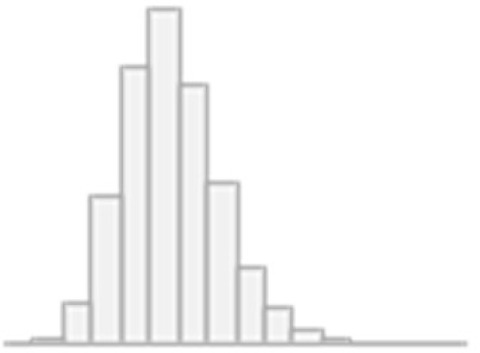 |
| 2 | Fluid intelligence score | Mean (SD): 6.6 (2) min <med<max: 1<7<13 IQR (CV): 3 (0.3) | 13 distinct values | 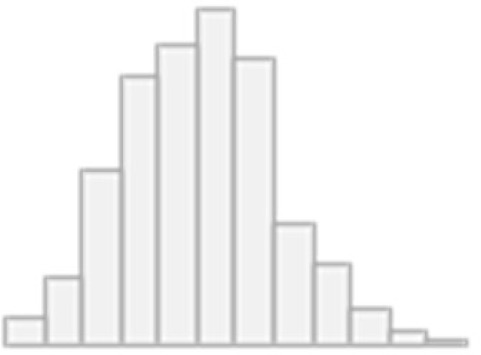 |
| 3 | Numeric memory: Maximum digits remembered correctly | Mean (SD): 6.8 (1.3) min<med<max: 2<7<12 IQR (CV): 2 (0.2) | 11 distinct values | 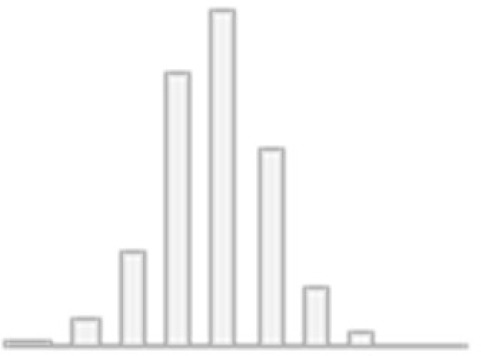 |
| 4 | Trail making: Duration to complete numeric path (log(x)) | Mean (SD): 5.4 (0.3) min<med<max: 4.5<5.3<7.5 IQR (CV): 0.3 (0.1) | 638 distinct values | 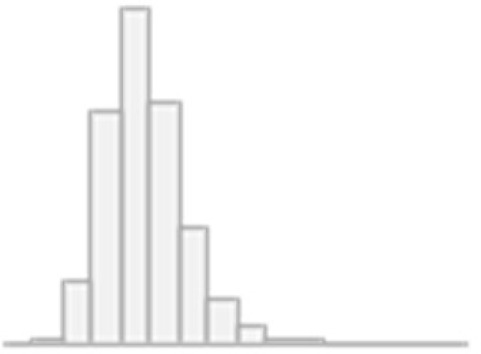 |
| 5 | Trail making: Duration to complete alphabetic path (log(x)) | Mean (SD): 6.3 (0.4) min<med<max: 5.1<6.2<8.7 IQR (CV): 0.5 (0.1) | 1542 distinct values | 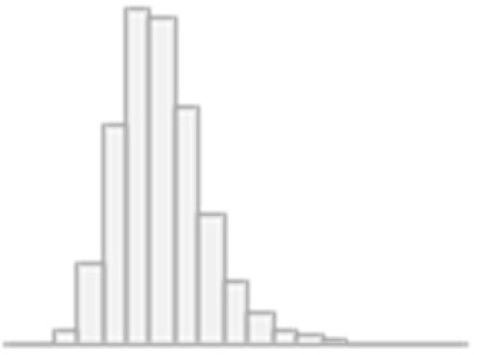 |
| 6 | Symbol digit substitution: Number of correct matches | Mean (SD): 18.9 (5.2) min<med<max: 0<19<37 IQR (CV): 7 (0.3) | 38 distinct values | 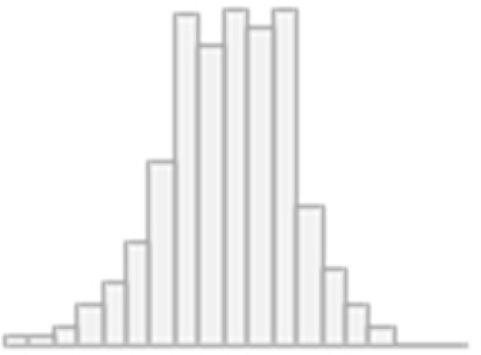 |
| 7 | Paired associate learning: Number of correct pairs | Mean (SD): 7 (2.5) min<med<max: 0<7<10 IQR (CV): 4 (0.4) | 11 distinct values | 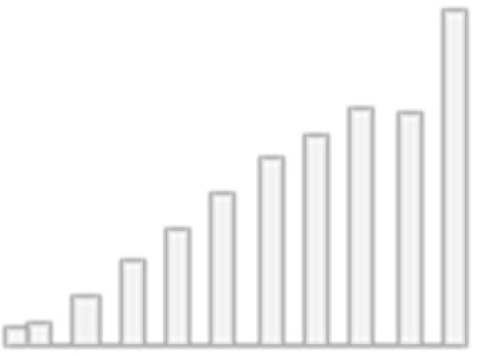 |
| 8 | Tower rearranging: Number of puzzles correct | Mean (SD): 9.9 (3.2) min<med<max: 0<10<18 IQR (CV): 4 (0.3) | 19 distinct values | 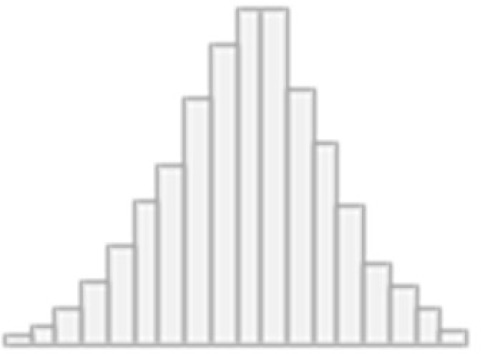 |
| 9 | Matrix pattern completion: Number of puzzles correct | Mean (SD): 8 (2.1) min<med<max: 0<8<15 IQR (CV): 2 (0.3) | 16 distinct values | 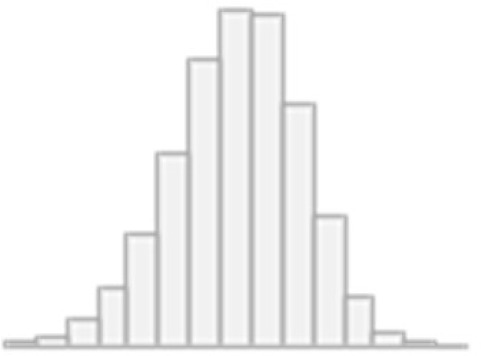 |
| 10 | Pairs matching: Number of incorrect matches (log(x+1)) | Mean (SD): 1.4 (0.6) min<med<max: 0<1.4<3.8 IQR (CV): 0.7 (0.4) | 35 distinct values | 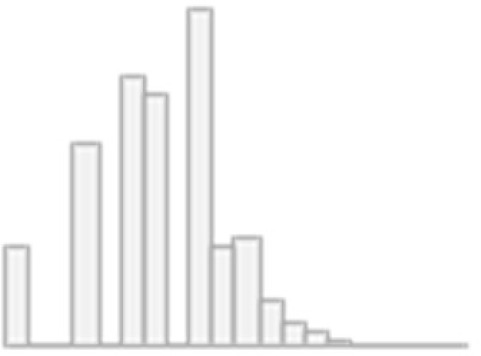 |
| 11 | Picture vocabulary: Specific cognitive ability | Mean (SD): 0.4 (0.1) min<med<max: 0<0.4<0.6 IQR (CV): 0.1 (0.2) | 3834 distinct values | 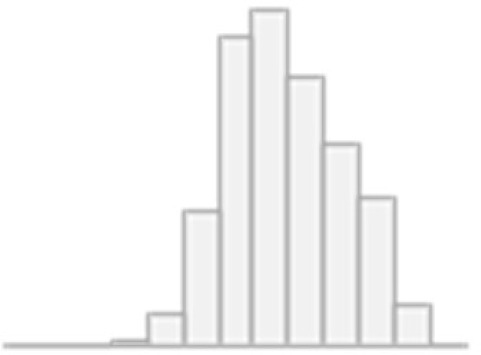 |
| 12 | Prospective memory: Initial answer | Min: 0 Mean: 0.8 Max: 1 | 0: 5502 (17.4%) 1: 26112 (82.6%) |  |
-
SD, standard deviation; IQR, interquartile range; CV, coefficient of variation.
Appendix 1—table 1
Derivation of mental health scores.
| Disorder/Exposure | Definition | Fields | Resources |
|---|---|---|---|
| PHQ-9 | The sum of the nine depressive symptoms scored 0–4: Little interest or pleasure in doing things Feeling down depressed, or hopeless Trouble sleeping Feeling tired Poor appetite or overeating Feeling bad about yourself Trouble concentrating Moving or speaking slowly or fidgety or restless Thoughts that you would be better off dead Answers “Prefer not to answer” were assigned the lowest score (0). | 20507 20508 20510 20511 20513 20514 20517 20518 20519 | Davis et al., 2020 Kroenke et al., 2010 |
| Depression ever | At least one core symptom of depression (Persistent sadness or Loss of interest) that lasted most or all of the day on most or all days within two weeks with some or a lot of impact on normal activity, plus additional depressive symptoms that represent a change in the mental and/or physical state from usual state and occur over the same period with thoughts about death. A total of ≥5 symptoms, including core symptoms. The score is obtained based on the DSM definition of major depressive disorder. | 20435 20436 20437 20439 20440 20441 20446 20449 20450 20532 20536 | Davis et al., 2020 CIDI-SF (Composite International Diagnostic Interview – Short Form), depression module, lifetime version Kessler et al., 1998 |
| Bipolar affective disorder type I | Ever had depression and ever manic/hyper or irritable, plus at least three manifestations of mania or irritability (more talkative, more restless, thoughts racing, needed less sleep, more creative or had more ideas, easily distracted, more confident, more active) or four manifestations if never manic/hyper, plus duration of symptoms for a week or more and symptoms caused significant problems. | 20435 20436 20437 20439 20440 20441 20446 20449 20450 20492 20493 20501 20502 20532 20536 20548 | Davis et al., 2020 Cerimele et al., 2014 Carvalho et al., 2015 |
| Bipolar affective disorder type II | Ever had depression and ever manic/hyper or irritable, plus at least three manifestations of mania or irritability (more talkative, more restless, thoughts racing, needed less sleep, more creative or had more ideas, easily distracted, more confident, more active) or four manifestations if never manic/hyper, plus duration of symptoms for a week or more and symptoms did not cause significant problems. | 20435 20436 20437 20439 20440 20441 20446 20449 20450 20492 20501 20502 20532 20536 20548 | Davis et al., 2020 |
| Subthreshold depressive symptoms ever | Does not meet Composite International Diagnostic Interview (CIDI) diagnostic criteria for depression, but has at least one of the following symptoms: Persistent depression or anhedonia based on CIDI PHQ9 score for current depressive symptoms exceeds the threshold for mild depression The presence of a clinician diagnosis of depression | 20002 20435 20436 20437 20439 20440 20441 20446 20449 20450 20507 20508 20510 20511 20513 20514 20517 20518 20519 20532 20536 20544 | Davis et al., 2020 National Institute for Health and Clinical Excellence. Depression in adults: recognition and management. NICE Clinical Guideline CG90 |
| Depression single episode | A single episode of depression without bipolar disorder type I. | 20435 20436 20437 20439 20440 20441 20442 20446 20449 20450 20492 20493 20501 20502 20532 20536 | Davis et al., 2020 |
| Recurrent depression | More than one episode of depression throughout a lifetime without bipolar disorder type I. | 20435 20436 20437 20439 20440 20441 20442 20446 20449 20450 20492 20493 20501 20502 20532 20536 | Davis et al., 2020 |
| Depression single episode triggered by a loss | A single episode of depression that started within two months after a traumatic event. | 20435 20436 20437 20439 20440 20441 20442 20446 20447 20449 20450 20492 20493 20501 20502 20532 20536 | Davis et al., 2020 |
| Current depression | At least a single episode of depression (‘Depression ever’) with a minimum of 5 depression symptoms from the PHQ-9 occurring more than half days or for several days for suicidal thoughts. | 20435 20436 20437 20439 20440 20441 20446 20449 20450 20507 20508 20510 20511 20513 20514 20517 20518 20519 20532 20536 | Davis et al., 2020 Manea et al., 2012 |
| Current severe depression | At least a single episode of depression (‘Depression ever’) As current depression (above) with PHQ score >15. | 20435 20436 20437 20439 20440 20441 20446 20449 20450 20507 20508 20510 20511 20513 20514 20517 20518 20519 20532 20536 | Davis et al., 2020 Manea et al., 2012 |
| GAD-7 | The sum of the recent symptoms of anxiety scored 0–3: Feelings of nervousness or anxiety Inability to stop or control worrying Worrying too much about different things Trouble relaxing Restlessness Easy annoyance or irritability Feelings of foreboding | 20505 20506 20509 20512 20515 20516 20520 | Davis et al., 2020 Kroenke et al., 2010 |
| Lifetime anxiety disorder (GAD ever) | Ever felt worried, tense, or anxious for most of the day for at least six months with difficulties in controlling symptoms. The symptoms were often difficult to control, they interfered with daily activity and were accompanied by at least three somatic symptoms (restless, keyed up or on edge., easily tired, difficulty keeping the mind on current activity, more irritable than usual, tense muscles, trouble falling or staying asleep). | 20417 20418 20419 20420 20421 20422 20423 20425 20426 20427 20429 20537 20538 20539 20540 20541 20542 20543 | Davis et al., 2020 CIDI-SF (Composite International Diagnostic Interview – Short Form), GAD module, lifetime version. Scored based on the DSM definition of GAD Gigantesco and Morosini, 2008 Kessler et al., 1998 National Institute for Health and Clinical Excellence. Generalised anxiety disorder and panic disorder in adults: management. NICE Clinical Guideline CG113 |
| Current anxiety | Ever had GAD (‘GAD Ever’) and GAD-7 score ≥10. Subdivided into mild, moderate, and severe with cut-offs at 5, 10, and 15 | 20417 20418 20419 20420 20421 20422 20423 20425 20426 20427 20429 20505 | Davis et al., 2020 Kroenke et al., 2010 |
| Current anxiety | Ever had GAD (‘GAD Ever’) and GAD-7 score ≥10. Subdivided into mild, moderate, and severe with cut-offs at 5, 10, and 15. | 20506 20509 20512 20515 20516 20520 20537 20538 20539 20540 20541 20542 20543 | Davis et al., 2020 Kroenke et al., 2010 |
| N-12 | The sum of the following scores: Mood swings Miserableness Irritability Sensitivity/hurt feelings Fed-up feelings Nervous feeling Worrier/anxious feelings Tense/‘highly strung’ Worry too long after embarrassment Suffer from ‘nerves’ Loneliness, isolation Guilty feelings | 1920 1930 1940 1950 1960 1970 1980 1990 2000 2010 2020 2030 | Dutt et al., 2022 Smith et al., 2013a |
| PDS | Ever been depressed or unenthusiastic for at least one week and seen either a GP or psychiatrist for nerves, anxiety, tension, or depression. | 2090 2100 4598 4609 4631 5375 | Dutt et al., 2022 |
| RDS-4 | Frequency of depressed mood, disinterest, restlessness, and tiredness during the past two weeks scored 1–4. | 2050 2060 2070 2080 | Dutt et al., 2022 |
| PCL-6 | The sum of scores on the core symptoms of PTSD in the past month: Repeated disturbing thoughts of a stressful experience Felt very upset when reminded of a stressful experience Avoided activities or situations because of a previous stressful experience Felt distant from other people Felt irritable or had angry outbursts in the past month Recent trouble concentrating on things The symptoms are grouped into three clusters: Memories, thoughts, or images, upset when reminded Avoid activities or situations, feeling distance or cut-off Irritable or angry, difficulty concentrating | 20494 20495 20496 20497 20498 20508 | Davis et al., 2020 Lang and Stein, 2005 |
| PTSD | PCL-6 score ≥14. | 20494 20495 20496 20497 20498 20508 | Davis et al., 2020 |
| Unusual experience | Experience of hallucinations or delusions, such as: Unreal voice Unreal vision Believed in an unreal conspiracy against self Believed in unreal communications or signs | 20463 20468 20471 20474 | Davis et al., 2020 Nuevo et al., 2012 |
| Recent unusual experience | Reports at least one or two hallucination or delusion episodes within the last year. | 20467 | Davis et al., 2020 |
| Life not worth living | Ever felt that life was not worth living. | 20479 | Davis et al., 2020 |
| Self-harm | Ever harmed self, whether or not meant to die. | 20480 | Davis et al., 2020 |
| Non-suicidal self-harm | Ever self-harmed without intention to end life, i.e., never attempted suicide. | 20480 20483 | Davis et al., 2020 |
| Suicide attempt | Ever harmed self with intent to end life. | 20480 20483 | Davis et al., 2020 |
| AUDIT | The sum of scores (0–4) on questions about alcohol consumption comprising three domains: Consumption: Frequency, amount of typical drinks, frequency of having six or more drinks Dependence: Unable to stop, failed to do what expected due to drinking, needed to drink first thing Harm: Guilt due to drinking, unable to remember due to drink Plus had injuries due to drinking or advice to cut down on drinking. | 20403 20405 20407 20408 20409 20411 20412 20413 20414 20416 | Davis et al., 2020 Saunders et al., 1993 Reinert and Allen, 2007 |
| Alcohol consumption (AUDIT-C) | Sum of questions 1–3 of the Alcohol Consumption domain. | 20403 20414 20416 | Sanchez-Roige et al., 2019 |
| Problems caused by alcohol (AUDIT-P) | Sum of questions 4–10 of the Alcohol Dependence and Alcohol Harm domains. | 20405 20407 20408 20409 20411 20412 20413 | Sanchez-Roige et al., 2019 |
| Hazardous/Harmful alcohol use | AUDIT score ≥8. | 20403 20405 20407 20408 20409 20411 20412 20413 20414 20416 | Davis et al., 2020 Babor et al., 2001 Stansfeld et al., 2016 |
| Current alcohol dependence | AUDIT score ≥15. | 20403 20405 20407 20408 20409 20411 20412 20413 20414 20416 | Davis et al., 2020 Babor et al., 2001 Drummond et al., 2016 |
| Alcohol dependence ever | Ever physically dependent on alcohol. | 20404 | Davis et al., 2020 |
| Addiction ever | Ever addicted to any substance or behaviour. | 20401 | Davis et al., 2020 |
| Substance addiction | Ever been addicted to alcohol, illicit/recreational drugs, or medication. | 20406 20456 20503 | Davis et al., 2020 |
| Current addiction | Ongoing addiction or dependence. | 20415 20432 20457 20504 | Davis et al., 2020 |
| Cannabis ever | Taking cannabis at least once in life. | 20453 | Davis et al., 2020 |
| Cannabis daily | Maximum frequency of taking cannabis when using it every day. | 20454 | Davis et al., 2020 |
| Childhood adverse events | A positive score if any of the five questions of the Childhood Trauma Screen (CTS) reach the threshold: Felt loved as a child ≤3 (never, rarely, or sometimes) Physically abused by family as a child ≥2 (often or very often) Felt hated by a family member as a child ≥2 (often or very often) Sexually molested as a child ≥2 (often or very often) Someone to take to the doctor when needed as a child ≤4 (never, rarely, sometimes, or often) | 20487 20488 20489 20490 20491 | Davis et al., 2020 Walker et al., 1999 |
| Adult adverse events | A positive score if any of the five questions of the Adult Trauma Screen reach the threshold: Been in a confiding relationship as an adult ≤3 (never, rarely, or sometimes) Physical violence by partner or ex-partner as an adult ≥2 (often or very often) Belittlement by partner or ex-partner as an adult ≥2 (often or very often) Sexual interference by partner or ex-partner without consent as an adult ≥2 (often or very often) Able to pay rent/mortgage ≤4 (never, rarely, sometimes, or often) | 20521 20522 20523 20524 20525 | Davis et al., 2020 |
| Catastrophic trauma | At least one catastrophic event: Victim of sexual assault Victim of physically violent crime Been in a serious accident believed to be life-threatening Witnessed sudden violent death Diagnosed with a life-threatening illness Been involved in combat or exposed to war zones | 20526 20527 20528 20529 20530 20531 | Davis et al., 2020 |
| Wellbeing | The sum of the following scores: General happiness Happiness with own health Belief that life is meaningful | 20458 20459 20460 | Davis et al., 2020 |
| Any distress | Reported functional impairment due to mental distress: Ever sought/received help for mental distress Mental distress prevented usual activities Mental health problems diagnosed by a healthcare professional Plus, a positive diagnosis for a specific condition (Depression ever, GAD ever, Addiction ever, Bipolar ever, Psychotic experiences, PTSD, Self-harm ever). | 20499 20500 20544 | Davis et al., 2020 |
-
N-12, the Eysenck Neuroticism score; PTSD, post-traumatic stress disorder; PCL-6, PTSD Checklist; PHQ-9, Patient Health Questionnaire score; PDS, Probable Depression Status; RDS-4, Recent Depressive Symptoms; AUDIT, Alcohol Use Disorders Identification Test; GAD-7, Generalised Anxiety Disorder score; GP, general practitioner.
Additional files
-
MDAR checklist
- https://cdn.elifesciences.org/articles/108109/elife-108109-mdarchecklist1-v1.pdf
-
Supplementary file 1
The unique variance of each cognitive score that is not explained by the g-factor, the variance of each score explained by the g-factor, and the proportion of covariance in cognitive scores captured by the g-factor.
- https://cdn.elifesciences.org/articles/108109/elife-108109-supp1-v1.xlsx
-
Supplementary file 2
Out-of-sample predictive performance of dwMRI in the PLSR model averaged across five folds.
- https://cdn.elifesciences.org/articles/108109/elife-108109-supp2-v1.xlsx
-
Supplementary file 3
Whole-sample distributions of mental health measures used as features in machine learning models (N = 21,077).
- https://cdn.elifesciences.org/articles/108109/elife-108109-supp3-v1.xlsx
-
Supplementary file 4
UK Biobank neuroimaging variables included in the study.
- https://cdn.elifesciences.org/articles/108109/elife-108109-supp4-v1.xlsx
-
Supplementary file 5
Hyperparameter grids for machine learning algorithms used in the study.
- https://cdn.elifesciences.org/articles/108109/elife-108109-supp5-v1.xlsx
Download links
A two-part list of links to download the article, or parts of the article, in various formats.
Downloads (link to download the article as PDF)
Open citations (links to open the citations from this article in various online reference manager services)
Cite this article (links to download the citations from this article in formats compatible with various reference manager tools)
Multimodal MRI marker of cognition explains the association between cognition and mental health in the UK Biobank
eLife 14:RP108109.
https://doi.org/10.7554/eLife.108109.3






