
Peer review process
Revised: This Reviewed Preprint has been revised by the authors in response to the previous round of peer review; the eLife assessment and the public reviews have been updated where necessary by the editors and peer reviewers.
Read more about eLife’s peer review process.Editors
- Reviewing EditorWarren Andrew AndayiMurang'a University of Technology, Murang'a, Kenya
- Senior EditorDavid RonUniversity of Cambridge, Cambridge, United Kingdom
Reviewer #1 (Public review):
Summary:
The authors presented a simplified E. coli cell-free protein synthesis (eCFPS) system reduces core reaction components from 35 to 7, improving protein expression levels. They also presented a "fast lysate" protocol that simplifies extract preparation, enhancing accessibility and robustness for diverse applications.
Strengths:
The authors present a valuable new protocol for eCFPS, which simplifies its application.
Weaknesses:
The authors provide data for optimization but offer insufficient explanation of the fundamental mechanisms underlying the phenomenon based on data.
Comments on revised version.
The authors have satisfactorily addressed the concerns raised by the reviewers. However, the mechanistic basis of the observed performance gain remains insufficiently substantiated. The attribution of this improvement to enhanced transcription is currently speculative. This point could be directly tested by quantifying mRNA levels, for example, using real-time PCR, in both the initial and optimized systems. Such analysis would significantly strengthen the mechanistic interpretation of the results.
Reviewer #2 (Public review):
Summary:
The authors have made a convincing argument that the current system of in vitro translation using E. coli extracts can be significantly optimized to work with much lesser components, while maintaining activity. They have showcased their improved activity using not only physical but also functional readouts.
Strengths:
The experiments are designed in a very logical and easy to understand manner, which makes it easier not only to follow the paper, but also reproduce the results. Functional assays with the synthesized proteins are a good way to demonstrate functionality and applicability of the system. They also benchmark their system against a commercial kit to show superior performance of their system.
Weaknesses:
The production of the lysate requires special instrumentation, limiting accessibility.
Comments on revised version:
Thank you to the authors for addressing the concerns both textually and experimentally. This work has significant value.
Reviewer #3 (Public review):
Summary:
The authors aimed to overcome the challenges associated with complex, conventional prokaryotic cell-free protein synthesis (CFPS) systems, which require up to thirty-five components, by developing a streamlined and efficient E. coli CFPS platform to encourage broader adoption. The main objective was to reduce the number of reaction components from thirty-five to seven, while also developing an accessible 'fast lysate' preparation protocol that eliminates time-consuming runoff and dialysis steps. The authors also sought to demonstrate the robustness and translational quality of this streamlined system by efficiently synthesising challenging functional proteins, including the cytotoxic restriction endonuclease BsaI and the self-assembling intermediate filament protein vimentin.
Strengths:
This study presents several key strengths of the optimised E. coli cell-free protein synthesis system in terms of its design, performance and accessibility.
- The reaction mixture has been dramatically simplified, with the number of essential core components successfully reduced from up to thirty-five in conventional systems to just seven.
- The "fast lysate" protocol is a significant advance in terms of procedure.
- The system's ability to synthesise challenging, functional proteins is evidence of its robustness.
Weaknesses:
(1) Title: "A simplified and highly efficient cell-free protein synthesis system for prokaryotes".
- This title is misleading since one would expect a simplified and highly efficient cell-free protein synthesis system to yield similar protein levels compared to current cell-free protein synthesis systems. What this study shows is that the composition of cell-free protein synthesis systems can be simplified while maintaining a certain level of protein synthesis. Here, optimisation does not involve maintaining protein synthesis yield while simplifying the cell-free protein synthesis system; rather, it involves developing a simplified cell-free protein synthesis system. As mentioned in my comments below, this study lacks a comparison of protein levels with a typical cell-free protein synthesis system.
- What do the authors mean by "highly efficient"? Highly efficient compared to what experimental conditions? If one is interested by the yield of protein synthesis, is this simplified system highly efficient compared to current systems?
(2) Figure 1, 3-5:
- What do relative luciferase units represent? How are these units calculated?
- In this system, the level of expression depends mainly on the level of NLuc transcripts and the efficiency of NLuc translation. How did the authors ensure that the chemical composition of the different eCFPS buffers only affected protein translation and not transcript levels? In other words, are luciferase units solely an indicator of protein synthesis efficiency, or do they also depend on transcription efficiency, which could vary depending on the experimental conditions?
- How long were the eCFPS reactions allowed to proceed before performing the luciferase activity measurement? Depending on the reaction time, the absence or presence of certain compounds may or may not impact NLuc expression. For example, it can be assumed that tRNA does not significantly affect NLuc levels over a short period of time, and that endogenous tRNA in the lysate is present at sufficient concentrations. However, over a longer period of time, the addition of tRNA could be essential to achieve optimal NLuc levels.
- The authors show that tRNA and amino acids are not strictly essential for the expression of NLuc, likely due to residual amounts within the cell lysate. However, are the protein levels achieved without added amino acids and tRNA sufficient for biochemical assays that require a certain amount of protein? It is important to note that the focus here is on optimising the simplicity of the buffer rather than the level of protein expression. In fact, the simplicity of the buffer is prioritised over the amount of protein produced. This should be made clear.
- How would the NLuc level compare if all the components were optimised individually and present in an optimised buffer, compared to a buffer optimised for simplicity as described by the authors?
(3) Line 71, Streamlining eCFPS: removal of dispensable components. This title is misleading because it creates the false impression that proteins can be produced in vitro without the addition of certain compounds. While this is true, the level of protein produced may not be sufficient for subsequent biochemical analyses. This should be made clear.
(4) Figure 2: In the legend, change "(A) Protein expression levels of the eCFPS system measured at varying concentrations of KGlu and MgGlu2" to "(A) Protein expression levels of the eCFPS system using an Nanoluciferase (NLuc) reporter DNA measured at varying concentrations of KGlu and MgGlu2".
(5) Lanes 302-303: "The thorough optimization of the seven core components was a critical step in achieving high protein expression levels". What are "high expression levels"? Compared to what?
Comments on revised version.
The authors have adequately addressed my previous concerns.
Author response:
The following is the authors’ response to the previous reviews
Reviewer #1 (Public review):
The superiority of the optimized system might simply be due to insufficient T7 RNA polymerase in the initial lysate.
We performed a T7 RNA polymerase titration (0–1600 ng/µL) in the initial system to test this hypothesis. Standard CFPS protocols typically utilize T7 RNA polymerase at ~90–100 ng/µL1. To fully characterize the concentration-dependent effect and determine the exact saturation threshold of T7 RNA polymerase in our system, we tested an extended range from 0 to 1600 ng/µL. As shown in the revised Figure S3B, the initial system's output reaches a plateau at ~800 ng/µL—a concentration nearly ten times higher than standard protocols. Increasing the concentration further (up to 1600 ng/µL) led to a decline in yield, likely due to inhibitory effects of excess enzyme or buffer components. Even under these T7-saturated conditions, our optimized system achieved ~45-fold higher NLuc output compared to the maximum possible output of the initial system. Notably, when the lysate concentration is increased to 70%, the productivity gap reaches nearly 80-fold, further demonstrating the extraordinary efficiency of our platform.
As revised in the Discussion, this improvement confirms that the performance gain is not a result of a mere increase in T7 concentration. Instead, it represents a systemic synergy where our streamlined buffer and the optimized metabolic environment of the fast lysate together alleviate the transcriptional bottlenecks inherent in traditional platforms.
Reviewer #2 (Public review):
Performance or efficiency claims... needs to be supported by comparisons with typical cell free expression systems.
We agree that robust benchmarking is essential for validating our claims of high efficiency. Our comparative evaluation was conducted across three levels:
(1) Literature-based benchmarking: As detailed in Figures 3C, 4A-D, S3A-B, S4, and S5C, we extensively compared our system against the "initial" (35-component) and "PEPbased" platforms, which are established benchmarks widely utilized in CFPS literature. These diverse comparisons consistently demonstrate the superior performance and robustness of our optimized system across various conditions.
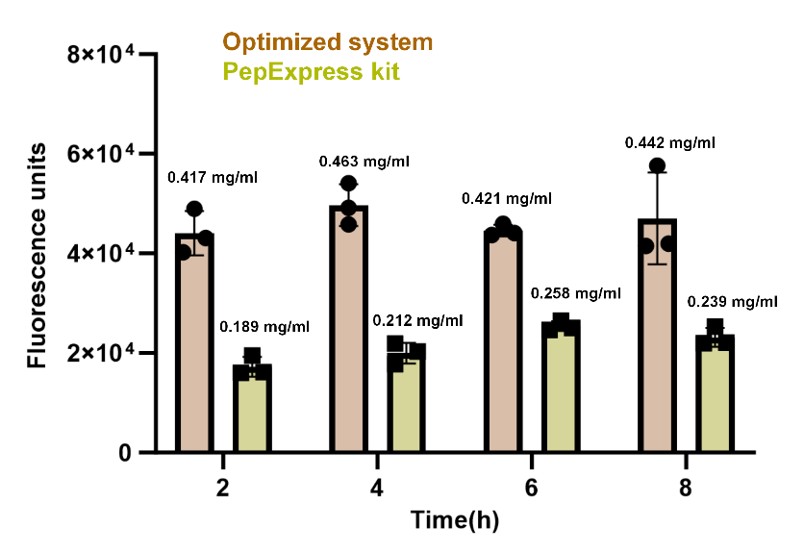
(2) Commercial benchmarking: To provide independent verification, we performed a head-to-head comparison with a high-end commercial E. coli CFPS kit (PePExpress, Shanghai Epizyme, EC010L). As shown in the comparative data provided in this response (See author response image 1), our system exhibited remarkable rapid-expression capability, significantly outperforming the commercial kit in both speed and absolute yield. Our platform reached near-maximum yield within 2 hours, demonstrating a significant efficiency advantage over the commercial alternative.
(3) Robustness and translational quality: The comparison was extended to challenging targets beyond standard reporters. As shown in Figures 4E-H, the successful synthesis of active BsaI restriction enzyme (a cytotoxic protein) and the functional assembly of vimentin (an aggregation-prone protein) demonstrate that our optimized system maintains superior translational quality and robustness compared to typical platforms that often struggle with such complex targets. By outperforming established academic benchmarks and a leading commercial platform in both yield and the ability to handle challenging proteins, our results provide compelling evidence that the simplified 7component system is highly efficient. In the revised Conclusion, we have explicitly contextualized "efficiency" as the integration of high protein productivity, reduced reaction complexity, and accelerated preparation speed.
Author response image 1.
Comparative evaluation of sfGFP yields between our _e_CFPS system (70% lysate) and a commercial kit (PePExpress) over an 8-hour time course.
Summary of revisions: T7 titration data have been added to Supplementary Figure S3B in the revised manuscript. To provide the additional benchmarking evidence requested, commercial comparison data (PePExpress kit) are provided in Author response image 1, while the main manuscript remains focused on the mechanistic synergy and streamlined architecture of the system.
We hope that these substantial new data and the corresponding revisions satisfy the reviewers' queries.
References:
(1) Kigawa, T. et al. Cell-free production and stable-isotope labeling of milligram quantities of proteins. FEBS Lett. 442, 15–19 (1999).



