
Peer review process
Not revised: This Reviewed Preprint includes the authors’ original preprint (without revision), an eLife assessment, public reviews, and a provisional response from the authors.
Read more about eLife’s peer review process.Editors
- Reviewing EditorAlbert CardonaUniversity of Cambridge, Cambridge, United Kingdom
- Senior EditorAlbert CardonaUniversity of Cambridge, Cambridge, United Kingdom
Reviewer #1 (Public review):
Summary:
The study investigates how learning with combined visual and olfactory cues strengthens memory in fruit flies. It demonstrates that pairing colours with odours improves later memory performance, even when only one of the two cues is presented during testing. The authors show that multisensory learning recruits visually responsive Kenyon cells in the mushroom body into memory representations that would otherwise primarily encode odours. Their experiments indicate that the serotonergic DPM neuron links sensory representations that are normally separated, while the APL neuron regulates local GABAergic inhibition of separated learning subcircuits. Together, these findings provide a mechanistic explanation for how a single sensory cue can retrieve a broader memory of a multisensory experience.
Strengths:
A major strength of the paper is its integration of behavioural experiments, targeted neuronal manipulations, and detailed anatomical analysis to address a clear mechanistic question. The findings are supported by multiple complementary experiments showing that multisensory learning enhances memory and recruits visual pathways into olfactory memory representations. Overall, the work provides a coherent mechanistic framework for how multisensory experiences strengthen subsequent memory.
Weaknesses:
A limitation of the paper is that it represents an unusual case, as substantial parts of the broader study were previously published in Nature and subsequently retracted because the physiological findings could not be reproduced. Those physiological experiments would have helped resolve several mechanistic questions raised by the behavioural results and directly test how multisensory information is integrated within the fruit-fly learning circuit. Presenting only the reproducible behavioural and anatomical findings is therefore appropriate and preserves the reliable contribution of the work. Nevertheless, the absence of reproducible physiological evidence makes the mechanistic model less complete and more inferential than it would be in a fully comprehensive study. The conclusions should consequently be framed as a well-supported circuit model rather than a direct demonstration of the underlying physiological processes.
Reviewer #2 (Public review):
Okray et al. identify a novel form of multisensory memory in Drosophila, where pairing reward with a color+odor together gives a stronger memory than color alone or odor alone. Remarkably, this multisensory enhancement occurs even if only one modality is used during testing (i.e. training color+odor, then testing odor alone gives a stronger memory than training odor alone, then testing odor alone), showing that the two modalities are persistently linked following training. The manuscript presents compelling behavioural genetic evidence that the normally visual-selective gamma-d Kenyon cells acquire a functional role in the retrieval of odor memories following odor+color training, and that this occurs via transfer from gamma-main KCs via the serotonergic interneuron DPM.
The key pieces of evidence supporting this conclusion are that olfactory retrieval of multisensory memories requires:
(1) synaptic output from gamma-d KCs during retrieval (but not training);
(2) synaptic output from gamma-main KCs during training and retrieval (whereas it's only required during retrieval, not training, for pure-olfactory memory);
(3) synaptic output from DPM during training and retrieval, and expression of the serotonin receptor 5HT2A in gamma-d KCs.
In the absence of physiological data, the exact nature of the gamma-d KCs' participation in olfactory retrieval following odor+color training remains unclear. For example, do the gamma-d KCs encode the odor identity (i.e., is there an odor-specific pattern of gamma-d KCs activated for a particular odor+color combination), or does their activity provide a general activity boost to other neurons (e.g. gamma-m) that encode odor identity? This will be interesting to address in future studies.
That being said, the behavioural data are clear and back up the authors' conclusion that signaling between KC subtypes via DPM underlies multisensory integration for multimodal memories in the fly mushroom body.
Author response:
We thank the reviewers for their time and insightful comments. We are also grateful for their appreciation of the unusual circumstances that led to the publication of the manuscript in its current form.
In response to reviewer #2’s question about replication, we provide additional details here. The error in our retracted original publication affected only the imaging results. Despite this, we reproduced key behavioural experiments by generating additional datasets (rather than simply rechecking records and authenticating results) and therefore have full confidence in our behavioural findings. We are very happy to share some of these replication experiments below:
Author response image 1.
Data showing replication of key experiments. From L-R these data replicate those shown in Figure 2e, Figure 4h, Figure 4c, Figure 4d.
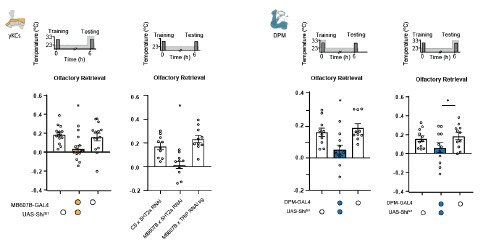
The conceptual framework of the original study remains valid. It was actually formulated based on the behavioural data and before any physiological recordings were made. We believe that it still represents the most parsimonious explanation for the observed behavioural results. Multiple behavioural findings support a model in which multisensory training leads to the recruitment of visual γd Kenyon cells into an otherwise olfactory memory trace. These include: (1) the requirement for γd KC output during olfactory retrieval following multisensory training; and (2) the sequential learning experiments, which were originally designed to test this model and provide independent evidence for its predictions. We nevertheless agree that the loss of the physiological data reduces the amount of evidence supporting the proposed mechanism. The nature of the physiological changes following multisensory learning remains an important question that we intend to address in future work.
We also thank the reviewers for identifying the unfortunate typo in the Abstract, which we believe contributed to the confusion over the dopamine receptors tested in this circuit. We selected these receptors based on our in-house single-cell transcriptomic expression data, together with published evidence indicating their specific expression in the neurons of interest. We have also responded to reviewer comments about the clarity of the figures and added additional labels to figure 2, to clarify the experimental paradigm in each case.



