Peer review process
Revised: This Reviewed Preprint has been revised by the authors in response to the previous round of peer review; the eLife assessment and the public reviews have been updated where necessary by the editors and peer reviewers.
Read more about eLife’s peer review process.Editors
- Reviewing EditorGustavo GoldmanUniversidade de Sao Paulo, Sao Paulo, Brazil
- Senior EditorBavesh KanaUniversity of the Witwatersrand, Johannesburg, South Africa
Reviewer #1 (Public review):
Summary:
In their study the authors investigated the F. graminearum homologue of the Drosophila Misato-Like Protein DML1 for a function in secondary metabolism and sensitivity to fungicides.
Strengths:
Generally, the topic of the study is interesting and timely and the manuscript is well written, albeit in some cases details on methods or controls are missing.
Weaknesses:
However, a major problem I see is with the core result of the study, the decrease of the DON content associated with deletion of FgDML1: Although some growth data are shown in figure 6 - indicating a severe growth defect - the DON production presented in figure 3 is not related to biomass. Also, the method and conditions for measuring DON are not described. Consequently, it could well be concluded that the decreased amount of DON detected is simply due to a decreased growth and specific DON production of the mutant remains more or less the same.
To alleviate this concern, it is crucial to show the details on the DON measurement and growth conditions and to relate the biomass formation on the same conditions to the DON amount detected. Only then a conclusion as to an altered production in the mutant strains can be drawn.
Comments to the revised manuscript:
The authors carefully revised the manuscript and provided explanations for methods in several cases. However, there are still some problems - probably due to misunderstanding - that need revision.
(1) A major problem of the first version of the manuscript was the lack of appropriate description of biomass analysis and the consideration of the respective results for evaluation of production of DON and other metabolites. Although the authors provide some explanation in the response to reviews, I could not find a corresponding explanation or description in the manuscript. It is not sufficient to explain the problem to me, but a detailed explanation and description of the method has to be provided in the manuscript along with the definition of one "unit of mycelium". It is still not entirely clear to me what such a "unit of mycelium" is.
Please clarify this and any other uncertainties that were commented on by me and other reviewers in the manuscript, not only in the response to reviews. Also adjust the reference list accordingly.
(2) Another problem was, that the authors considered FgDML1 a regulator of DON production. As mentioned by me and reviewer 3, FgDML1 is crucial to numerous functions in F. graminearum and its lack causes a plethora of problems for fungal physiology. Hence, although it is clear that the lack of FgDML1 causes alterations in DON production, it is not appropriate to designate this factor as a "regulator".
It seems to me that the authors are afraid that if FgDML1 would not be a "regulator" that this would decrease the value of their study, which is not the case. This is a matter of correct wording. Therefore, please revise the wording accordingly, starting with the title:
...FgDML1 impacts DON toxin biosynthesis...
Moreover, for sure the manuscript might benefit from more detailed description of the whole cascade leading from FgDML1 to DON biosynthesis and production of the other metabolites that change upon deletion. Such explanation can help the reader grasp the relevance of FgDML for regulatory processes as well as on more general versus specific effects.
Reviewer #2 (Public review):
Summary:
The manuscript entitled "Mitochondrial Protein FgDML1 Regulates DON Toxin Biosynthesis and Cyazofamid Sensitivity in Fusarium graminearum by affecting mitochondrial homeostasis" identified the regulatory effect of FgDML1 in DON toxin biosynthesis and sensitivity of Fusarium graminearum to cyazofamid. The manuscript provides a theoretical framework for understanding the regulatory mechanisms of DON toxin biosynthesis in F. graminearum and identifies potential molecular targets for Fusarium head blight control. The paper in innovative, but there are issues in the writing that need to be added and corrected.
Comments on revisions:
The author has addressed my questions.
Author response:
The following is the authors’ response to the original reviews.
Reviewer #1:
Summary:
In their study, the authors investigated the F. graminearum homologue of the Drosophila Misato-Like Protein DML1 for a function in secondary metabolism and sensitivity to fungicides.
Strengths:
Generally, the topic of the study is interesting and timely, and the manuscript is well written, albeit in some cases, details on methods or controls are missing.
Weaknesses:
However, a major problem I see is with the core result of the study, the decrease in the DON content associated with the deletion of FgDML1. Although some growth data are shown in Figure 6, indicating a severe growth defect, the DON production presented in Figure 3 is not related to biomass. Also, the method and conditions for measuring DON are not described. Consequently, it could well be concluded that the decreased amount of DON detected is simply due to decreased growth, and the specific DON production of the mutant remains more or less the same.
To alleviate this concern, it is crucial to show the details on the DON measurement and growth conditions and to relate the biomass formation under the same conditions to the DON amount detected. Only then can a conclusion as to an altered production in the mutant strains be drawn.
We appreciate it very much that you spent much time on my paper and give me good suggestions, we tried our best to revise the manuscript. I have revised my manuscript according to your suggestions. The point to point responds to the reviewer’s comments are listed as following. Our method for DON quantification was based on the amount per unit of mycelium. After obtaining the absorbance value from the ELISA reaction, the concentration of DON was calculated according to a standard curve and a formula, then divided by the dry weight of the mycelium to obtain the DON content per unit of mycelium, with the results finally expressed in µg/g.
(1) Line 139f
... FgDML1 is a critical positive regulator of virulence ....
Clearly, the deletion of FgDML1 impacts virulence, but it is too much of a general effect to say it is a regulator. DML1 acts high up in the cascade, impacting numerous processes, one of which is virulence. Generally, it has to be considered that deletion of DML1 causes a severe growth defect, which in turn is likely to lead to a plethora of effects. Besides discussing this fact, please also revise the manuscript to avoid references to "direct effects" or "regulator".
Thank you very much for your advice. Our method for determining the amount of DON is based on the amount of mycelium per unit. After obtaining the absorbance value through Elisa reaction, we calculate the concentration of DON toxin according to the established standard curve and formula. Then, we divide it by the dry weight of mycelium to obtain the DON toxin content per unit mycelium, and finally present the results in µg/g. In summary, we conclude that the decrease in DON production by ΔFgDML is not due to slower hyphal growth, but rather a decrease in the ability of unit hyphae to produce DON toxins compared to the wild type. Given the decrease in DON toxin synthesis caused by FgDML1 deficiency, we believe that using a regulator is reasonable.
(2) Line 143
Please define "toxin-producing conditions".
Thank you very much for your advice. We have accurately defined the conditions for toxin-producing conditions in the manuscript' toxin-inducing conditions '(28°C, 145 ×g, 7 days incubation)' (in L163-164)
(3) Line 149
A brief intro on toxisomes should be provided in the introduction to better integrate this into the manuscript's results.
Thank you very much for your advice. We have added corresponding content about toxin producing bodies in the introduction section 'The biosynthesis of DON entails a reorganization of the endoplasmic reticulum into a specialized compartment termed the "toxisome" (Tang et al., 2018). The assembly of the toxisome coincides with the aggregation of key biosynthetic enzymes, which in turn enhances the efficiency of DON production. Concurrently, this compartmentalization serves as a self-defense mechanism, protecting the fungus from the autotoxicity of TRI pathway intermediates (Boenisch et al., 2017). The proteins TRI1, TRI4, TRI14, and Hmr1 are confirmed constituents of this structure(Kistler and Broz, 2015; Menke et al., 2013).' (in L86-93)
(4) Line 153
DON production decreases by about 80 %, but not to 0. Consequently, DML1 is important, but NOT essential for DON production.
Thank you very much for your advice. We have made changes to the wording of the corresponding sections based on your suggestions. 'FgDML1 is essential for the biosynthesis of the DON toxin. '(in L161)
(5) Line 168ff
Please provide a reference for FgDnm1 being critical for mitochondrial fission and state whether such an interaction has been shown in other organisms.
Thank you very much for your advice. We have made changes to the wording of the corresponding sections based on your suggestions. 'FgDnm1 is a key dynamin-related protein mediating mitochondrial fission(Griffin et al., 2005; Kang et al., 2023), suggesting that FgDML1 may form a complex with FgDnm1 to regulate mitochondrial fission and fusion processes. To our knowledge, this is the first report documenting an interaction between DML1 and Dnm in any fungal species, including model organisms such as S. cerevisiae. This novel finding provides new insights into the molecular mechanisms underlying mitochondrial dynamics in filamentous fungi. '(in L277-283)
(6) Line 178
Please specify whether Complex III activity was related to biomass and provide a p-value or standard deviation for the value.
Thank you very much for your question. The activity determination of complex III was completed using a complex III enzyme activity kit (Solarbio, Beijing, China) (Li, et al 2022; Wang, et al 2022). Take 0.1 g of standardized mycelium as the sample for the experiment. Given that the mycelium has been homogenized, we believe that there is no necessary correlation between the activity and biomass of complex III. And we also refined the specific measurement steps in the article. ' Briefly, 0.1 g of mycelia was homogenized with 1 mL of extraction buffer in an ice bath. The homogenate was centrifuged at 600 ×g for 10 min at 4°C. The resulting supernatant was then subjected to a second centrifugation at 11,100 ×g for 10 min at 4°C. The pellet was resuspended in 200 μL of extraction buffer and disrupted by ultrasonication (200 W, 5 s pulses with 10 s intervals, 15 cycles). Complex III enzyme activity was finally measured by adding the working solution as per the manufacturer's protocol. Each treatment group contains three biological replicates and three technical replicates. '(in L511-517)
Li C, et al. Amino acid catabolism regulates hematopoietic stem cell proteostasis via a GCN2-eIF2 axis. Cell Stem Cell. 2022 Jul 7; 29(7):1119-1134.e7. doi: 10.1016/j.stem.2022.06.004. PMID: 35803229.
Wang K, et al. Locally organised and activated Fth1hi neutrophils aggravate inflammation of acute lung injury in an IL-10-dependent manner. Nat Commun. 2022 Dec 13;13(1):7703. doi: 10.1038/s41467-022-35492-y. PMID: 36513690; PMCID: PMC9745290
(7) Line 185
Albeit this headline is a reasonable hypothesis, you actually did not show that the conformation is altered. Please reword accordingly.
Please also add references for cyazofamid acting on the QI site versus other fungicides acting on the QO site.
Thank you very much for your advice. We have made changes to the wording of the corresponding sections based on your suggestions. 'Overexpression of FgQCR2, FgQCR8, and FgQCR9 may alters the conformation of the QI site, resulting in reduced sensitivity to cyazofamid. '(in L212-213). For fungicides targeting Qi and QO sites, we have added corresponding descriptions in the respective sections 'Numerous fungicides have been developed to inhibit the Qo site (e.g., pyraclostrobin, azoxystrobin)(Nuwamanya et al., 2022; Peng et al., 2022) and the Qi site (e.g., cyazofamid)(Mitani et al., 2001) of the cytochrome bc1 complex. '(in L327-329)
(8) Line 200
This section on growth should be moved up right after introducing the mutant strain.
Thank you very much for your advice. We have advanced the part of nutritional growth and sexual asexual development before DON toxin to promote better reading and understanding. We arranged the sequence in the previous way to emphasize the new discovery between mitochondria and DON toxin. We found a significant decrease in DON toxin in ΔFgDML1, defects in the formation of toxin producing bodies, and downregulation of FgTRis at both the gene and protein levels. In summary, we believe that the absence of FgDML1 does indeed lead to a decrease in the content of DON toxin, and FgDML1 plays a regulatory role in the synthesis of DON toxin. In addition, our measurements of DON toxin, acetyl CoA, ATP and other indicators are all based on the amount per unit hyphae, excluding differences caused by hyphal biomass or growth. We have further refined the materials and methods to facilitate better reading and understanding.
(9) Line 203
"... significantly reduced growth rates ..."
This is not what was measured here. Figure 6A shows a plate assay that can be used to assess hyphal extension. In the figure, it is also visible that the mycelium of the deletion mutant is much denser, maybe due to increased hyphal branching. Please reword.
Additionally, it is important to include a biomass measurement here under the conditions used for DON assessment. Hyphal extension measurements cannot be used instead of biomass.
Thank you very much for your advice. We have made changes to the wording of the corresponding sections based on your suggestions. 'The ΔFgDML1 strain displayed a distinct growth phenotype characterized by retardation in radial growth and the formation of more compact, denser hyphal networks on all tested media compared to the PH-1 and ΔFgDML-C strains. '(in L136-138).
(10) Line 217
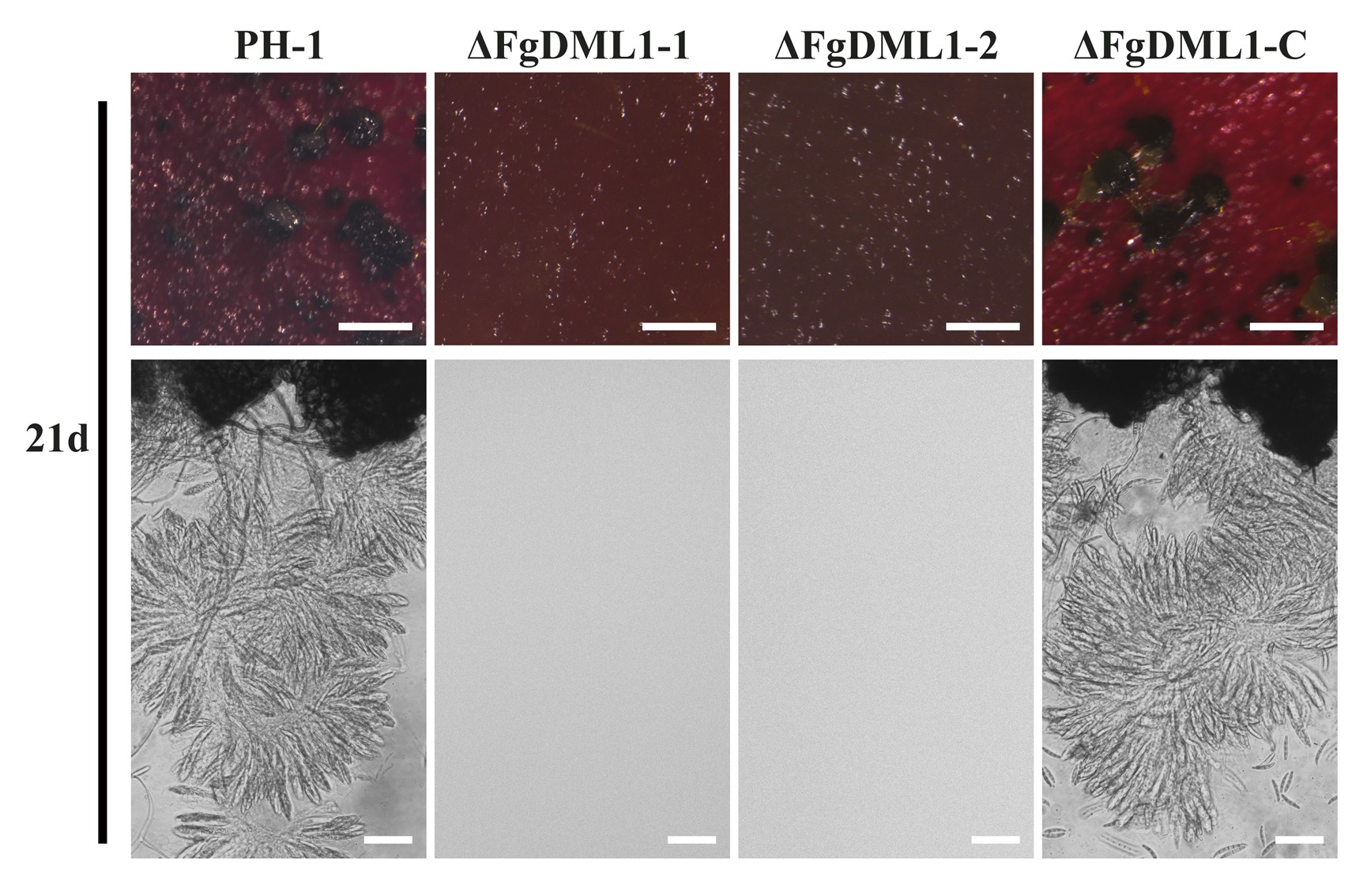
Please include information on how long the cultures were monitored. Given the very slow growth of the mutant, perithecia formation may be considerably delayed beyond 14 days.
Thank you very much for your advice. Based on your suggestion, we have extended the incubation time for sexual reproduction to 21 days to more accurately evaluate its sexual reproduction ability. Our results show that even after 21 days, Δ FgDML1 still cannot produce ascospores and ascospores, which proves that the absence of FgDML1 does indeed cause sexual reproduction defects in F. graminearum.
Author response image 1.
Discussion
(11) Please mention your summary Figure 8 early on in the discussion, and explain conclusions with this figure in mind. Please avoid repetition of the results section as much as possible.
Also, please state clearly what was already known from previous research and is in agreement with your results, and what is new (in fungi or generally).
Thank you very much for your advice. Based on your suggestion, we mentioned Fig8 earlier in the first half of the discussion and provided guidance for the following text. We also conducted a more comprehensive discussion by analyzing our research results and comparing them with previous studies. 'Our study defines a novel mechanism through which FgDML1 governs mitochondrial homeostasis. We demonstrate that FgDML1 directly interacts with the key mitochondrial fission regulator FgDnm1 and positively modulates cellular bioenergetic metabolism, as evidenced by elevated ATP and acetyl-CoA levels (Fig. 8). '(in L250-253). 'The Misato/DML1 protein family is evolutionarily conserved from yeast to humans and plays a critical role in mitochondrial regulation. In S. cerevisiae, DML1 is an essential gene; its deletion is lethal, while its overexpression results in fragmented mitochondrial networks and aberrant cellular morphology, underscoring its necessity for normal mitochondrial function (Gurvitz et al., 2002). Similarly, in Homo sapiens, the homolog Misato localizes to the mitochondrial outer membrane, and both its depletion and overexpression are sufficient to disrupt mitochondrial morphology and distribution (Kimura and Okano, 2007). '(in L241-244).
(12) Line 262ff
Please specify if this interaction was shown previously in other organisms and provide references.
Thank you very much for your advice. We have clearly stated in the corresponding section that the interaction between FgDML and FgDnm is the first reported, and to our knowledge, no relevant reports have been found in other species so far. ' Notably, FgDML1 was found to interact with FgDnm1 (Fig. 5E), FgDnm1 is a key dynamin-related protein mediating mitochondrial fission(Griffin et al., 2005; Kang et al., 2023), suggesting that FgDML1 may form a complex with FgDnm1 to regulate mitochondrial fission and fusion processes. To our knowledge, this is the first report documenting an interaction between DML1 and Dnm in any fungal species, including model organisms such as S. cerevisiae. This novel finding provides new insights into the molecular mechanisms underlying mitochondrial dynamics in filamentous fungi. '(in L276-283)
(13) Line 287ff
There is no result that would justify this speculation. Please remove.
Thank you very much for your advice. We have modified the corresponding wording in the corresponding section. 'In conclusion, our findings suggest that the overexpression of assembly factors FgQCR2, FgQCR7, and FgQCR8 in ΔFgDML1 potentially modifies the conformation of the Qi site, which specifically modulates the sensitivity of F. graminearum to cyazofamid. '(in L352-355)
Materials and methods
(14) A table with all primer sequences used in the study and their purpose is missing. For every experiment, the number of technical and biological replicates needs to be stated.
Thank you very much for your advice. We have presented all the primers used in this study in Supplementary Table 1 (in Table S1) .We added the number of technical and biological replicates in the material and method descriptions for each experiment. 'For each sample, a total of 200 conidia were counted. The experiment included three biological replicates with three technical replicates each.'(in L434-436). 'Each treatment group contains three biological replicates. '(in L444-445). 'Each treatment group contains three biological replicates and three technical replicates. ' (in L463-464). 'Each treatment group contains three biological replicates and three technical replicates. '(in L474-475). 'Each treatment group contains three biological replicates. '(in L483). 'Each treatment group contains three biological replicates and three technical replicates.'(in L501-502). 'Each treatment group contains three biological replicates and three technical replicates. '(in L516-517). 'The experiment was independently repeated three times. '(in L533-534).
(15) Line 369ff
Please provide final concentrations used for assays here.
Thank you very much for your advice. The final concentration has been displayed in the Figure (in Fig6. A, B) (in Fig. S3). And we have provided supplementary Table 2 to reflect the concentration in a more intuitive way.(in Table. S2)
(16) Line 383
Please provide a reference or data on the use of F2du for transformant selection and explain the abbreviation.
Thank you very much for your advice. Based on your suggestion, we have provided the full name and references of F2du. 'Transformants were selected on PDA plates containing either 100 μg/mL Hygromycin B (Yeasen, Shanghai, China) or 0.2 μmol/mL 5-Fluorouracil 2'-deoxyriboside (F2du) (Solarbio, Beijing, China)(Zhao et al., 2022). '(in L405-407).
(17) Line 407
Please provide a reference for the method and at least a brief description.
Thank you very much for your advice. Based on your suggestion, we have added references and provided a brief introduction to the method. 'As previously described (Tang et al., 2020; Wang et al., 2025), Specifically, coleoptiles were inoculated with conidial suspensions and incubated for 14 days, while leaves were inoculated with fresh mycelial plugs and incubated for 5 days, followed by observation and quantification of disease symptoms. DON toxin was measured using a Wise Science ELISA-based kit (Wise Science, Jiangsu, China) (Li et al., 2019; Zheng et al., 2018). '(in L466-471)
(18) Line 414ff
Also, here, the amount of biomass has to be considered for the measurement to be able to distinguish if actually less of the compounds were produced or if the effect seen was merely due to an altered amount of biomass present.
Thank you very much for your advice. We believe that biomass is not within the scope of our measurement indicators, as we have measured and calculated based on unit hyphae. Therefore, we have ruled out experimental bias caused by a decrease in biomass.
RNA and RT-qPCR
(19) Line 461
When the strains were transferred to AEA medium, was the biomass measured, at least wet weight, and in which culture volume was it done? It makes a big difference if the amount of (wet) biomass dilutes a small amount of fungicide-containing culture or if biomass is added in at least roughly equal amounts in sufficient growth medium to ensure equal conditions.
Thank you very much for your question. Our sample processing controlled the wet weight of the samples before dosing, ensuring that the wet weight of the mycelium obtained from each sample before dosing was 0.2g. The mycelium was obtained through AEA with a volume of 100mL. This ensured consistency in the initial biomass between groups before dosing, and also ensured the accuracy of the drug concentration.
(20) Line 466
Please provide the name and supplier of the kit.
Thank you very much for your advice. We have added corresponding content in the corresponding location. 'Mycelium was collected and total RNA was extracted following the instructions provided by the Total RNA Extraction Kit (Tiangen, Beijing, China).' (in L523-524).
(21) All primer sequences must be provided in a table.
Thank you very much for your advice. We have presented all the primers used in this study in Supplementary Table 1. (in Table S1).
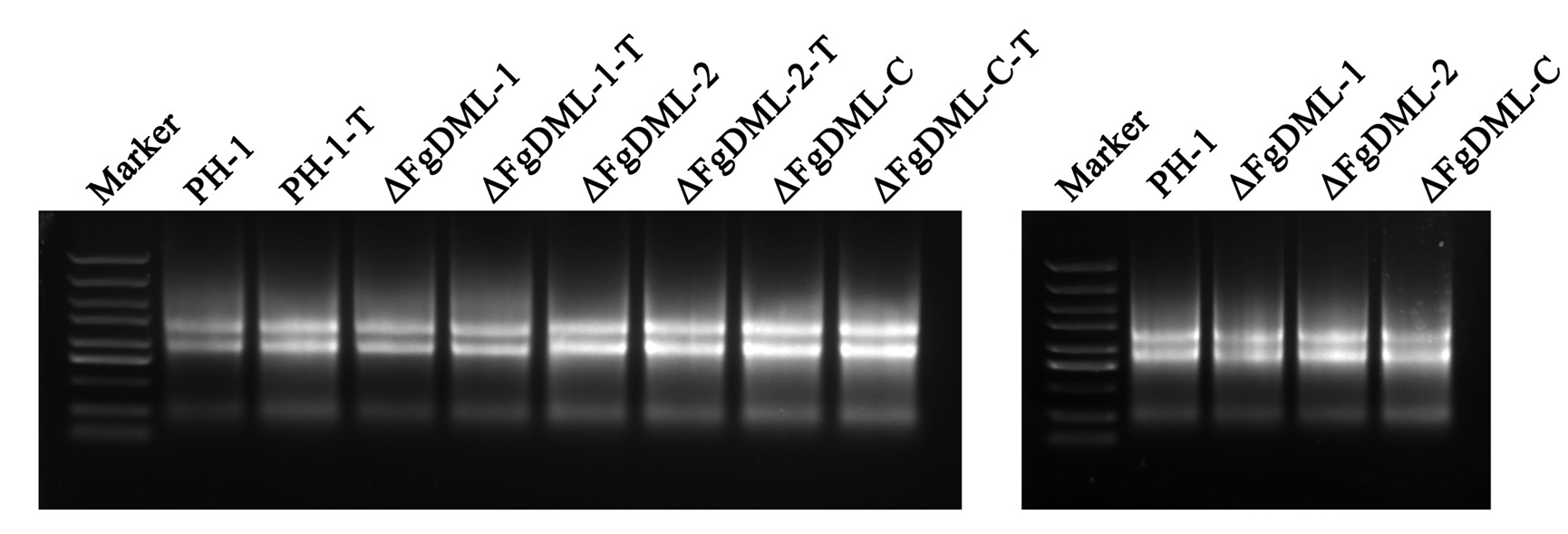
(22) For RT qPCR it is essential to check the RNA quality to be sure that the obtained results are not artifacts due to varying quality, which may exceed differences. Please state how quality control was done and which threshold was applied for high-quality RNA to be used in RTqPCR (like RIN factor, etc).
Thank you very much for your question. We performed stringent quality control on the extracted total RNA. First, a micro-spectrophotometer was used to measure RNA concentration and purity, confirming that the A260/A280 ratio was between 1.8 and 2.0 and the A260/A230 ratio was greater than 2.0, indicating good RNA purity without significant protein or organic solvent contamination.Subsequently, verification by agarose gel electrophoresis revealed distinct 28S and 18S rRNA bands, demonstrating good RNA integrity and absence of degradation.
Author response image 2.
(B): Minor Comments:
(1) Please increase the font size of the labels and annotations of the figures; it is hard to read as it is now.
Thank you very much for your advice. We have increased the size of annotations or numerical labels in the corresponding images for better reading.
(2) Throughout the manuscript: Please check that all abbreviations are explained at first use.
Thank you very much for your advice. We have checked the entire text to ensure that abbreviations have their full names when they first appear.
(3) I do hope that the authors can clarify all concerns and provide an amended manuscript of this interesting story.
Thank you very much for your advice. Sincerely thank you for your suggestions and questions, which have been very helpful to us.
Reviewer #2:
The manuscript entitled "Mitochondrial Protein FgDML1 Regulates DON Toxin Biosynthesis and Cyazofamid Sensitivity in Fusarium graminearum by affecting mitochondrial homeostasis" identified the regulatory effect of FgDML1 in DON toxin biosynthesis and sensitivity of Fusarium graminearum to cyazofamid. The manuscript provides a theoretical framework for understanding the regulatory mechanisms of DON toxin biosynthesis in F. graminearum and identifies potential molecular targets for Fusarium head blight control. The paper is innovative, but there are issues in the writing that need to be addressed and corrected.
We appreciate it very much that you spent much time on my paper and give me good suggestions, we tried our best to revise the manuscript. I have revised my manuscript according to your suggestions with red words. In the response comments, to highlight the specific positions of the revised parts in the manuscript with red line number. The point to point responds to the reviewer’s comments are listed as following.
Weaknesses:
(1) The authors speculate that cyazofamid treatment caused upregulation of the assembly factors, leading to a change in the conformation of the Qi protein, thus restoring the enzyme activity of complex III. But no speculation was given in the discussion as to why this would lead to the upregulation of assembly factors, and how the upregulation of assembly factors would change the protein conformation, and is there any literature reporting a similar phenomenon? I would suggest adding this to the discussion.
Thank you very much for your advice. Based on your suggestion, we have added content related to the assembly factor of complex III in the discussion section and made modifications to the corresponding wording. 'Previous studies have reported that mutations in the Complex III assembly factors TTC19, UQCC2, and UQCC3 impair the assembly and activity of Complex III (Feichtinger et al., 2017; Wanschers et al., 2014). '(in L345-347). 'In conclusion, our findings suggest that the overexpression of assembly factors FgQCR2, FgQCR7, and FgQCR8 in ΔFgDML1 potentially modifies the conformation of the Qi site, which specifically modulates the sensitivity of F. graminearum to cyazofamid. '(in L352-355).
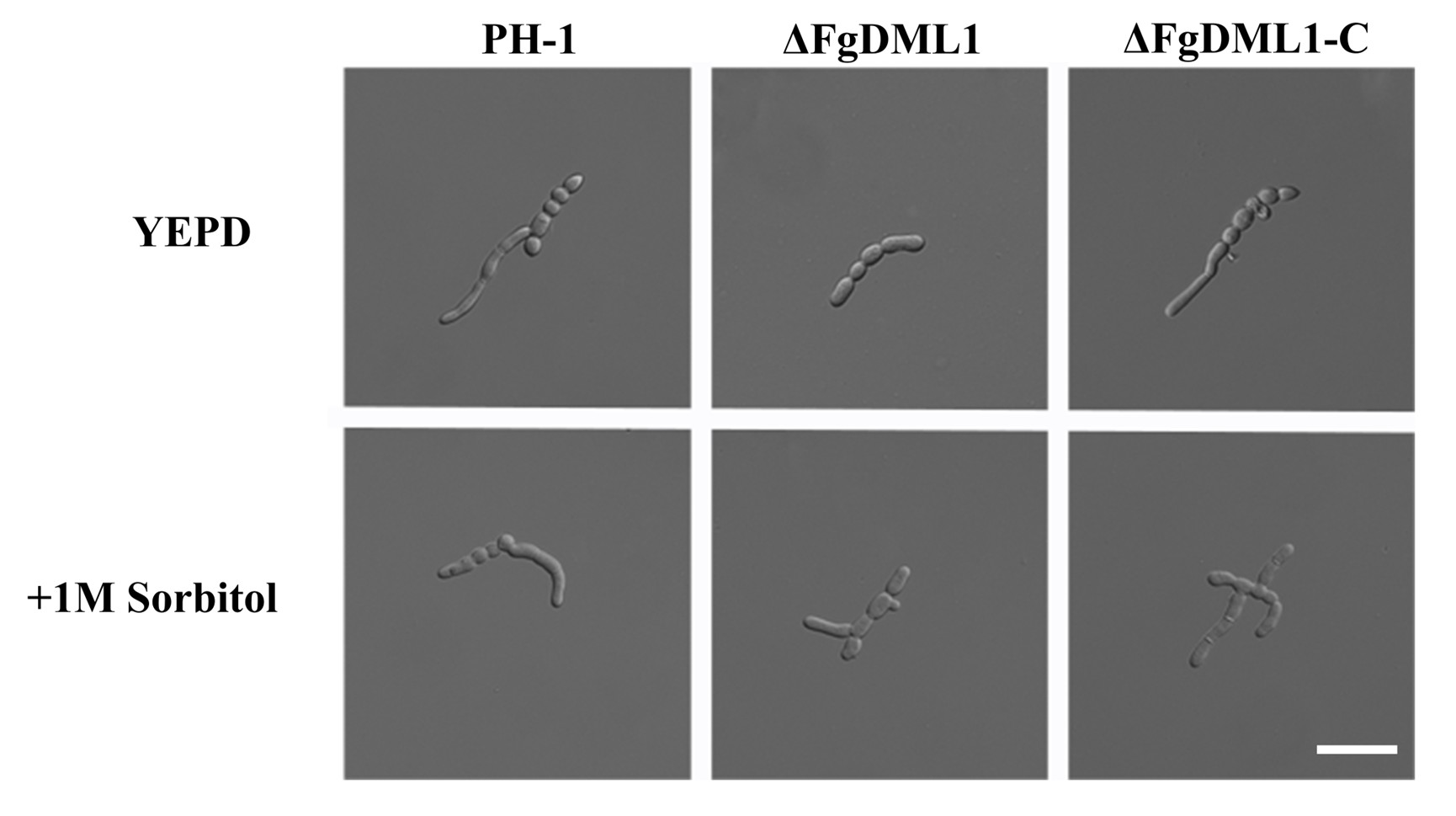
(2) Would increased sensitivity of the mutant to cell wall stress be responsible for the excessive curvature of the mycelium?
Thank you very much for your question. We believe that the sensitivity of ΔFgDML1 to osmotic stress is reduced, which may not be related to hyphal bending, as shown in the Author response image 3. During the conidia stage, ΔFgDML1 cannot germinate in YEPD, while the application of 1M Sorbitol promotes its germination. But it is caused by internal unknown mechanisms, which is also the focus of our future research.
Author response image 3.
(3) The vertical coordinates of Figure 7B need to be modified with positive inhibition rates for the mutants.
Thank you very much for your advice. The display in Figure 7B truly reflects its inhibition rate. In the Δ FgDML1 mutant, when subjected to osmotic stress treatment, the inhibition rate becomes negative, indicating that the colony growth is greater than that of the CK. Therefore, the negative inhibition rate is shown in Figure 7B.
(1) In Figure 1B, Figure 3C, and Figure 6C, the scale below the picture is not clear. In Figure 5D, the histogram is unclear, and it is recommended to redraw the graph.
Thank you very much for your advice. The issue with the above images may be due to Word compression. We have changed the settings and enlarged the images as much as possible to better display them.
(2) The full Latin name of the strain should be used in the title of figures and tables.
Thank you very much for your advice. Based on your suggestion, we have used the full names of the strains appearing in the title of figures and tables.
(3) Proteins in line 117 should be abbreviated.
Thank you very much for your advice. Based on your suggestion, we have abbreviated the corresponding positions. 'The DML1 protein from S. cerevisiae was used as a query for a BLAST search against the Fusarium genome database, resulting in the identification of the putative DML1 gene FgDML1 (FGSG_05390) in F. graminearum. '(in L118-120).
(4) The sentence in lines 187-189, which is supposed to introduce why the test is sensitive to the three drugs, is currently illogical.
Thank you very much for your advice. Based on your suggestion, we have made modifications to the corresponding sections. 'Since Complex III is involved in the action of both cyazofamid (targeting the QI site) and pyraclostrobin (targeting the QO site), the sensitivity of ΔFgDML1 to cyazofamid and pyraclostrobin was investigated. ' (in L214-216).
(5) The expression of FgQCR2, FgQCR7, and FgQCR8 was significantly upregulated in ΔFgDML1 at transcription levels. Do FgQCR2, FgQCR8, and FgQCR9 show upregulated expression at the protein level?
Thank you very much for your question. Based on your suggestion, we evaluated the protein expression levels of FgQCR2, FgQCR7, and FgQCR8 in PH-1 and ΔFgDML1, and we found that the protein expression levels of FgQCR2, FgQCR7, and FgQCR8 in ΔFgDML1 were higher than those in PH-1. (in Fig. 6F).
(6) In Figure 7B, it is recommended to adjust the position of the horizontal axis labels in the histogram.
Thank you very much for your advice. Based on your suggestion, we have made modifications to the corresponding sections.(in Fig. 7B)
(7) There are numerous errors in the writing of gene names in the text. Please check the full text and change the writing of gene names and mutant names to italic.
Thank you very much for your advice. We have checked the entire text to ensure that all genes have been italicized.
(8) All acronyms should be spelled out in figure and table captions. e.g., F. graminearum.
Thank you very much for your advice. Based on your suggestion, we have used the full names of the strains appearing in the title of figures and tables.
(9) In line 492, P should be lowercase and italic.
Thank you very much for your advice. Based on your suggestion, we have made adjustments to the corresponding content.
Reviewer #3:
Summary:
The manuscript "Mitochondrial 1 protein FgDML1 regulates DON toxin biosynthesis and cyazofamid sensitivity in Fusarium graminearum by affecting mitochondrial homeostasis" describes the construction of a null mutant for the FgDML1 gene in F. graminearum and assays characterising the effects of this mutation on the pathogen's infection process and lifecycle. While FgDML1 remains underexplored with an unclear role in the biology of filamentous fungi, and although the authors performed several experiments, there are fundamental issues with the experimental design and execution, and interpretation of the results.
Strengths:
FgDML1 is an interesting target, and there are novel aspects in this manuscript. Studies in other organisms have shown that this protein plays important roles in mitochondrial DNA (mtDNA) inheritance, mitochondrial compartmentalisation, chromosome segregation, mitochondrial distribution, mitochondrial fusion, and overall mitochondrial dynamics. Indeed, in Saccharomyces cerevisiae, the mutation is lethal. The authors have carried out multi-faceted experiments to characterise the mutants.
Weaknesses:
However, I have concerns about how the study was conceived. Given the fundamental importance of mitochondrial function in eukaryotic cells and how the absence of this protein impacts these processes, it is unsurprising that deletion of this gene in F. graminearum profoundly affects fungal biology. Therefore, it is misleading to claim a direct link between FgDML1 and DON toxin biosynthesis (and virulence), as the observed effects are likely indirect consequences of compromised mitochondrial function. In fact, it is reasonable to assume that the production of all secondary metabolites is affected to some extent in the mutant strains and that such a strain would not be competitive at all under non-laboratory conditions. The order in which the authors present the results can be misleading, too. The results on vegetative growth rate appeared much later in the manuscript, which should have come first, as the FgDML1 mutant exhibited significant growth defects, and subsequent results should be discussed in that context. Moreover, the methodologies are not described properly, making the manuscript hard to follow and difficult to replicate.
We appreciate it very much that you spent much time on my paper and give me good suggestions, we tried our best to revise the manuscript. I have revised my manuscript according to your suggestions with red words. In the response comments, to highlight the specific positions of the revised parts in the manuscript with red line number. The point to point responds to the reviewer’s comments are listed as following.
For weaknesses,we arranged the sequence in this way to emphasize the novel discovery between mitochondria and DON toxin. We found a significant decrease in DON toxin in Δ FgDML1, defects in the formation of toxin producing bodies, and downregulation of FgTRis at both the gene and protein levels. In summary, we believe that the absence of FgDML1 does indeed lead to a decrease in the content of DON toxin, and FgDML1 plays a regulatory role in the synthesis of DON toxin. In addition, our measurements of DON toxin, acetyl CoA, ATP and other indicators are all based on the amount per unit hyphae, excluding differences caused by hyphal biomass or growth. We have further refined the materials and methods to facilitate better reading and understanding.
(1) Lines 37-39: The disease itself does not produce toxins; it is the fungus that causes the disease that produces toxins. Moreover, the disease symptoms observed are likely caused by the toxins produced by the fungus.
Thank you very much for your advice. We have made modifications to the wording of the corresponding sections. 'Studies have shown that increased DON levels are positively correlated with the pathogenicity rate of F. graminearum.'(in L36-37).
(2) Lines 82-87: While it is challenging to summarise the role of ATP in just a few words, this section needs improvement for clarity and accuracy. Additionally, I do not believe that drawing a direct link between mitochondrial defects and toxin production is an appropriate strategy in this case.
Thank you very much for your advice. Based on your suggestion, we have added corresponding descriptions in the corresponding positions to provide more information on the relationship between ATP and toxins, in order to better prepare for the following text. 'Pathogen-intrinsic ATP homeostasis is recognized as a critical, rate-limiting determinant for toxin biosynthesis. Previous studies indicate that dual-target inhibition of ATP synthase (AtpA) and adenine deaminase (Ade) by a specific small-molecule probe effectively depletes intracellular ATP, consequently suppressing the synthesis of key virulence factors TcdA and TcdB transcriptionally and translationally(Marreddy et al., 2024). The systemic toxicity of Anthrax Edema Toxin (ET) is primarily attributed to its catalytic activity, which depletes the host cell's ATP reservoir, thereby triggering a bioenergetic collapse that culminates in cell lysis and death(Liu et al., 2025). '(in L78-86).
(3) Lines 125-126: The manuscript does not clearly describe how subcellular localisation was determined. This methodology needs to be properly detailed.
Thank you very much for your advice. The subcellular localization was validated through co-localization analysis with MitoTracker Red CMXRos, a mitochondrial-specific dye. The observed overlap between the FgDML1-GFP signal and the mitochondrial marker confirmed mitochondrial localization. Based on these results, we determined that FgDML1 is definitively localized to the mitochondria.We have incorporated this description in the appropriate section of the manuscript. 'Furthermore, subcellular localization studies confirmed that FgDML1 localizes to mitochondria, as demonstrated by colocalization with a mitochondria-specific dye MitoTracker Red CMXRos (Fig. 1B). '(in L125-127).
(4) Regarding the organisation of the Results section, it needs to be revised. While I understand the authors' intention to emphasise the impact on virulence, the results showing how FgDML1 deletion affects vegetative growth, asexual and sexual reproduction, and sensitivity to stressors should be presented before the virulence assays and effects on DON production. Additionally, the authors do not provide any clear evidence that FgDML1 directly interacts with proteins involved in asexual or sexual reproduction, stress responses, or virulence. Therefore, it is misleading to suggest that FgDML1 directly regulates these processes. The observed phenotypes are, rather, a consequence of severely impaired mitochondrial function. Without functional mitochondria, the cell cannot operate properly, leading to widespread physiological defects. In this regard, statements such as those in lines 139-140 and 343-344 are misleading.
Thank you very much for your advice. We have adjusted the order of the images based on your suggestion, placing the characterization of ΔFgDML1 in nutritional growth, sexual reproduction, and other aspects before DON toxin. And we have made adjustments to the corresponding statements. 'These findings demonstrate that FgDML1 is a positive regulator of virulence in F. graminearum. '(in L140-141).
(5) Lines 185-186: The authors do not provide sufficient evidence to support the claim that FgQCR2, FgQCR8, and FgQCR9 overexpression is the main cause of reduced cyazofamid sensitivity. Although expression of these genes is altered, reduced sensitivity may result from changes in other proteins or pathways. To strengthen this claim, overexpression of FgQCR2, 8, and 9 in the wild-type background, followed by assessment of cyazofamid resistance, would be necessary. As it stands, there is no support for the claim presented in lines 329-332.
Thank you very much for your advice. To establish a causal link between the overexpression of FgQCR2, FgQCR7, and FgQCR8 and the observed reduction in cyazofamid sensitivity, we first quantified the protein levels of these assembly factor. Western blot analysis confirmed their elevated expression in the ΔFgDML1 mutant compared to the wild-type PH-1. We further generated individual overexpression strains for FgQCR2, FgQCR7, and FgQCR8 in the wild-type PH-1 background. Fungicide sensitivity assays revealed that all three overexpression mutants displayed significantly reduced sensitivity to cyazofamid compared to the parental strain. These genetic complementation experiments confirm that upregulation of FgQCR2, FgQCR7, and FgQCR8 is sufficient to confer reduced cyazofamid sensitivity.We have incorporated these explanations and provided supporting images in the appropriate section of the manuscript. 'To further clarify whether the upregulated expression of FgQCR2, FgQCR7, and FgQCR8 genes affects their protein expression levels, we measured the protein levels. The results showed that the protein expression levels of FgQCR2, FgQCR7, and FgQCR8 in ΔFgDML1 were higher than those in PH-1(Fig. 6F). Subsequently, we overexpressed FgQCR2, FgQCR7, and FgQCR8 in the wild-type background, and the corresponding overexpression mutants exhibited reduced sensitivity to cyazofamid(Fig. 6E). '(in L205-211)(in Fig. 6E, F)
(6) Lines 187-190: This segment is confusing and difficult to follow. It requires rewriting for clarity.
Thank you very much for your advice. Based on your suggestion, we have made corresponding modifications in the corresponding locations. 'Since Complex III is involved in the action of both cyazofamid (targeting the QI site) and pyraclostrobin (targeting the QO site), the sensitivity of ΔFgDML1 to cyazofamid and pyraclostrobin was investigated. ''(in L214-216)
(7) Lines 345-346: The authors state that in this study, FgDML1 is localised in mitochondria, which implies that in other studies, its localisation was different. Is this accurate? Clarification is needed.
Thank you very much for your question. In previous studies, the localization of this protein was not clearly defined, and its function was only emphasized to be related to mitochondria. Whether in yeast or in Drosophila melanogaster. (Miklos et al., 1997; Gurvitz et al., 2002)
Miklos GLG, Yamamoto M-T, Burns RG, Maleszka R. 1997. An essential cell division gene of drosophila, absent from saccharomyces, encodes an unusual protein with tubulin-like and myosin-like peptide motifs. Proc Natl Acad Sci 94:5189–5194. doi:10.1073/pnas.94.10.5189
Gurvitz A, Hartig A, Ruis H, Hamilton B, de Couet HG. 2002. Preliminary characterisation of DML1, an essential saccharomyces cerevisiae gene related to misato of drosophila melanogaster. FEMS Yeast Res 2:123–135. doi:10.1016/S1567-1356(02)00083-1
Material and Methods Section
(8) In general, the methods require more detailed descriptions, including the brands and catalog numbers of reagents and kits used. Simply stating that procedures were performed according to manufacturers' instructions is insufficient, particularly when the specific brand or kit is not identified.
Thank you very much for your advice. We have added corresponding content based on your suggestion to more comprehensively display the reagent brand and complete product name. 'Transformants were selected on PDA plates containing either 100 μg/mL Hygromycin B (Yeasen, Shanghai, China) or 0.2 μmol/mL 5-Fluorouracil 2'-deoxyriboside (F2du) (Solarbio, Beijing, China)(Zhao et al., 2022). ' (in L405-407). 'DON toxin was measured using a Wise Science ELISA-based kit (Wise Science, Jiangsu, China) (Li et al., 2019; Zheng et al., 2018) '. (in L469-471)
(9) Line 364: What do CM and MM stand for? Please define.
Thank you very much for your advice. Based on your suggestion, we have made modifications in the corresponding locations. 'To evaluate vegetative growth, complete medium (CM), minimal medium (MM), and V8 Juice Agar (V8) media were prepared as described previously(Tang et al., 2020). '(in L385-387)
Generation of Deletion and Complemented Mutants:
(10) This section lacks detail. For example, were PCR products used directly for PEG-mediated transformation, or were the fragments cloned into a plasmid?
Thank you very much for your question. We directly use the fused fragments for protoplast transformation after sequencing confirmation. We have clearly defined the fragment form used for transformation at the corresponding location. 'The resulting fusion fragment was transformed into the wild-type F. graminearum PH-1 strain via polyethylene glycol (PEG)-mediated protoplast transformation. '(in L403-405).
(11) PCR and Southern blot validation results should be included as supplementary material, along with clear interpretations of these results.
Thank you very much for your advice. In the supplementary material we submitted, Supplementary Figure 2 already includes the results of PCR and Southern blot validation.(in Fig. S2)
(12) There is almost no description of how the mutants mentioned in lines 388-390 were generated.
Thank you very much for your advice. Based on your suggestions, we have added relevant content in the appropriate sections to more comprehensively and clearly reflect the experimental process. 'Specifically, FgDML1, including its native promoter region and open reading frame (ORF) (excluding the stop codon), was amplified.The PCR product was then fused with the XhoI -digested pYF11 vector. After transformation into E. coli and sequence verification, the plasmid was extracted and subsequently introduced into PH-1 protoplasts. For FgDnm1-3×Flag, the 3×Flag tag was added to the C-terminus of FgDnm1 by PCR, fused with the hygromycin resistance gene and the FgDnm1 downstream arm, and then introduced into PH-1 protoplasts. The overexpression mutant was constructed according to a previously described method. Specifically, the ORF of FgDML1 was amplified and the PCR product was ligated into the SacII-digested pSXS overexpression vector. The resulting plasmid was then transformed into PH-1 protoplasts (Shi et al., 2023). For the construction of PH-1::FgTri1+GFP and ΔFgDML1::FgTri1+GFP, the ORF of FgTri1 was amplified and ligated into the XhoI-digested pYF11 vector as described above. The resulting vectors were then transformed into protoplasts of PH-1 or ΔFgDML1, respectively.'(in L413-426).
Vegetative Growth and Conidiation Assays:
(13) There is no information about how long the plates were incubated before photos were taken. Judging by the images, it appears that different incubation times may have been used.
Thank you very much for your advice. Due to the slower growth of ΔFgDML1, we adopted different incubation periods and have supplemented the relevant content in the corresponding section. 'All strains were incubated at 25°C in darkness; however, due to ΔFgDML1 slower growth, the ΔFgDML1 mutant required a 5-day incubation period compared to the 3 days used for PH-1 and ΔFgDML1-C. '(in L490-493).
(14) There is no description of the MBL medium.
Thank you very much for your advice. Based on your suggestion, we have supplemented the corresponding content in the corresponding positions. 'Mung bean liquid (MBL) medium was used for conidial production, while carrot agar (CA) medium was utilized to assess sexual reproduction(Wang et al., 2011). '(in L387-389).
DON Production and Pathogenicity Assays:
(15) Were DON levels normalised to mycelial biomass? The vegetative growth assays show that FgDML1 null mutants exhibit reduced growth on all tested media. If mutant and wild-type strains were incubated for the same period under the same conditions, it is reasonable to assume that the mutants accumulated significantly less biomass. Therefore, results related to DON production, as well as acetyl-CoA and ATP levels, must be normalised to biomass.
Thank you very much for your question. We have taken into account the differences in mycelial biomass. Therefore, when measuring DON, acetyl-CoA, and ATP levels, all data were normalized to mycelial mass and calculated as amounts per unit of mycelium, thereby avoiding discrepancies arising from variations in biomass.
Sensitivity Assays:
(16) While the authors mention that gradient concentrations were used, the specific concentrations and ranges are not provided. Importantly, have the plates shown in Figure 5 been grown for different periods or lengths? Given the significantly reduced growth rate shown in Figure 6A, the mutants should not have grown to the same size as the WT (PH-1) as shown in Figures 5A and 5B unless the pictures have been taken on different days. This needs to be explained.
Thank you very much for your question. Due to the slower growth of ΔFgDML1, we adopted different incubation periods and have supplemented the relevant content in the corresponding section. 'All strains were incubated at 25°C in darkness; however, due to ΔFgDML1 slower growth, the ΔFgDML1 mutant required a 5-day incubation period compared to the 3 days used for PH-1 and ΔFgDML1-C. '(in L490-493).
(17) Additionally, was inhibition measured similarly for both stress agents and fungicides? This should be clarified.
Thank you very much for your question. We have supplemented the specific concentration gradient of fungicides. 'The concentration gradients for each fungicide in the sensitivity assays were set up according to Supplementary Table S2. '(in L493-494)(in Table. S2).
Complex III Enzyme Activity:
(18) A more detailed description of how this assay was performed is needed.
Thank you very much for your advice. We have provided further detailed descriptions of the corresponding sections. 'Briefly, 0.1 g of mycelia was homogenized with 1 mL of extraction buffer in an ice bath. The homogenate was centrifuged at 600 ×g for 10 min at 4°C. The resulting supernatant was then subjected to a second centrifugation at 11,000 ×g for 10 min at 4°C. The pellet was resuspended in 200 μL of extraction buffer and disrupted by ultrasonication (200 W, 5 s pulses with 10 s intervals, 15 cycles). Complex III enzyme activity was finally measured by adding the working solution as per the manufacturer's protocol. '(in L511-517)
(19) Were protein concentrations standardised prior to the assay?
Thank you very much for your question. Protein concentrations for all Western blot samples were quantified using a BCA assay kit to ensure equal loading.
(20) Line 448: Are ΔFgDML1::Tri1+GFP and ΔFgDML1+GFP the same strain? ΔFgDML1::Tri1+GFP has not been previously described.
Thank you very much for your question. These two strains are not the same strain, and we have supplemented their construction process in the corresponding section. 'For the construction of PH-1::FgTri1+GFP and ΔFgDML1::FgTri1+GFP, the ORF of FgTri1 was amplified and ligated into the XhoI-digested pYF11 vector as described above. The resulting vectors were then transformed into protoplasts of PH-1 or ΔFgDML1, respectively. '(in L423-426)
(21) Lines 460 and 468: Please adopt a consistent nomenclature, either RT-qPCR or qRT-PCR.
Thank you very much for your advice. We have unified it and modified the corresponding content in the corresponding sections. 'Reverse Transcription Quantitative Polymerase Chain Reaction (RT-qPCR) was carried out using the QuantStudio 6 Flex real-time PCR system (Thermo, Fisher Scientific, USA) to assess the relative expression of three subunits of Complex III (FgCytb, FgCytc1, FgISP), five assembly factors (FgQCR2, FgQCR6, FgQCR7, FgQCR8, FgQCR9), and DON biosynthesis-related genes (FgTri5 and FgTri6). '(in L526-531)
(22) Lines 472-473: Why was FgCox1 used as a reference for FgCytb? Clarification is needed.
Thank you very much for your question. FgCytb (cytochrome b) and FgCOX1 (cytochrome c oxidase subunit I) are both encoded by the mitochondrial genome and serve as core components of the oxidative phosphorylation system (Complex III and Complex IV, respectively). Their transcription is co-regulated by mitochondrial-specific mechanisms in response to cellular energy status. Consequently, under experimental conditions that perturb energy homeostasis, FgCOX1 expression exhibits relative, context-dependent stability with FgCytb, or at least co-varies directionally, making it a superior reference for normalizing target gene expression. In contrast, FgGapdh operates within a distinct genetic and regulatory system. Using FgCOX1 ensures that both reference and target genes reside within the same mitochondrial compartment and functional module, thereby preventing normalization artifacts arising from independent variation across disparate pathways.
(23) Lines 476-477: This step requires a clearer and more detailed explanation.
Thank you very much for your advice. We provided detailed descriptions of them in their respective positions. 'For FgDnm1-3×Flag, the 3×Flag tag was added to the C-terminus of FgDnm1 by PCR, fused with the hygromycin resistance gene and the FgDnm1 downstream arm, and then introduced into PH-1 protoplasts. '(in L417-419). 'The FgDnm1-3×Flag fragment was introduced into PH-1 and FgDML1+GFP protoplasts, respectively, to obtain single-tagged and double-tagged strains. '(in L541-543)
Western blotting:
(24) Uncropped Western blot images should be provided as supplementary material.
Thank you very much for your advice. All Western blot images will be submitted to the supplementary material package.
(25) Lines 485-489: A more thorough description of the antibodies used (including source, catalogue number, and dilution) is necessary.
Thank you very much for your advice. The antibodies used are clearly stated in terms of brand, catalog number, and dilution. We have added the dilution ratio. 'All antibodies were diluted as follows: primary antibodies at 1:1000 and secondary antibodies at 1:10000. '(in L550-551)
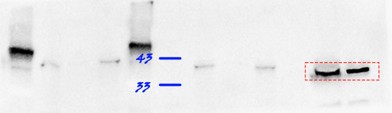
(26) The Western blot shown in Figure 3D appears problematic, particularly the anti-GAPDH band for FgDML1::FgTri1+GFP. Are both anti-GAPDH bands derived from the same gel?
Thank you very much for your advice. We are unequivocally certain that these data derive from the same gel. Therefore, we are providing the original image for your inspection.
Author response image 4.