
Peer review process
Not revised: This Reviewed Preprint includes the authors’ original preprint (without revision), an eLife assessment, public reviews, and a provisional response from the authors.
Read more about eLife’s peer review process.Editors
- Reviewing EditorScott LeiserUniversity of Michigan, Ann Arbor, United States of America
- Senior EditorDavid RonUniversity of Cambridge, Cambridge, United Kingdom
Reviewer #1 (Public review):
This manuscript by Rudich ZD et al. systematically profiled the transcriptomic changes in nine long-lived C. elegans mutants and presented a careful and informative comparative analysis of these aging-related changes. In addition to these valuable datasets and bioinformatics analyses, the authors performed a large-scale RNAi screen to assess the role of the differentially expressed genes (DEGs) in these mutants and identify several potential targets to promote healthy aging. Moreover, the authors have provided a user-friendly website to examine genes of interest in those longevity mutants from their datasets.
Strengths:
Compared to previous transcriptomic analyses of these mutants in different reports, this study minimized the technical variations and benefitted from the advances in RNA-Seq technology and bioinformatics tools. Therefore, it should provide a more consistent and comprehensive view of the molecular mechanisms underlying the longevity of these mutants. The datasets in this manuscript are valuable to other researchers in the biology of aging.
Weaknesses:
Meanwhile, since these mutants have been extensively studied, the advance of this study in unknown ageing mechanisms remains limited.
Comments on revised version.
In the revised manuscript, the authors have addressed most of my concerns. In the text of this manuscript, the authors should still include more discussion on why osm-5 and daf-2 are categorized into two different groups.
Reviewer #2 (Public review):
Summary:
In the manuscript titled "Multiple Molecular Pathways to Longevity: Opposing Gene Expression Programs Define Distinct Aging Strategies", the authors investigated diverse genetic pathways that contribute to lifespan extension in Caenorhabditis elegans and aimed to identify shared and distinct molecular mechanisms among various longevity mutants. Through comprehensive RNA sequencing of different longevity mutants representing seven distinct pathways, the authors showed that these mutants cluster into three primary groups based on their gene expression profiles. This transcriptomic analysis revealed that while some longevity genes are commonly regulated across multiple pathways, others exhibit opposing expression patterns, suggesting that distinct molecular strategies can lead to increased lifespan. Specifically, they identified a set of 196 genes that are consistently upregulated in most longevity mutants, many of which are involved in innate immunity and stress defense. By performing RNAi-based screening, the authors further validated the functional roles of several candidates, including C08F11.7, ugt-62, and K05C4.9, supporting their contributions to longevity and stress resistance. The authors conclude that longevity is mediated through multiple molecular pathways and provide a public online tool to study these complex transcriptomic landscapes.
Significance:
This study provides a systematic, side-by-side transcriptomic comparison of nine genetically distinct long-lived C. elegans mutants, revealing that lifespan extension arises from both shared and opposing gene expression programs. By identifying three distinct longevity groups and demonstrating that key pathways can be modulated in opposite directions to achieve long life, the work challenges the notion of a single universal transcriptional signature of aging. Importantly, functional validation shows that select commonly regulated genes can directly modulate lifespan and stress resistance, highlighting actionable molecular targets for promoting healthy aging.
Comments on revised version:
The authors addressed my concerns successfully.
Author response:
Reviewer #1:
Major comments
(1) Although I myself believe that the datasets in this study should be more consistent and comprehensive, the authors should perform a data mining analysis of previously reported transcriptomic changes of these mutants or similar mutants in the same longevity pathway and compare the reported changes with their findings to highlight the necessity and advances of this study.
According to this suggestion, we have compared the differentially expressed genes identified in this study to previous gene expression studies involving these long-lived mutant strains. To our knowledge no previous studies have examined gene expression in sod-2 or ife-2 mutants, and at the time that we performed the RNA sequencing gene expression in osm-5 worms had not been examined (it took us a long time to complete this paper). We have included weighted Venn diagrams to illustrate the overlap and supplemental tables to list the overlapping di erentially expressed genes. For our current study, we felt it was important to compare RNA-seq data generated under exactly the same experimental and analysis paradigms in order to best compare across the nine long-lived mutants. These new analyses are included in Figures S19 – S25 and Table S2 . Please see lines 111-114, Figure S19-25, and Table S2.
(2) This manuscript does not perform any regulon or transcription factor (TF) analyses. TFs are the drivers of the transcriptomic changes and multiple conserved TFs (e.g., daf-16) have already been identified in these pathways. Therefore, it is necessary to examine and compare the regulons/TFs in these new datasets by bioinformatics. Such analyses can: a) provide more information of the driving force of these transcriptomic changes; b) show the role of these known longevity TFs; c) propose new TFs driving longevity; d) support the findings of 'longevity strategies' and 'longevity groups' from the perspective of TFs.
According to this suggestion, we have now performed transcription factor analysis on the RNA-seq data to determine which transcription factors might be driving the longevity-associated transcriptional changes. To do this we used two complementary approaches: (1) transcription factor inference, which is based on the coordinated expression changes of known transcription factors; and (2) motif enrichment analysis, which is based on identifying transcription factor binding motifs in the promoters of di erentially expressed genes. After identifying which transcription factors were identified for each individual mutant, we then compared the identified transcription factors across all nine mutants. Interestingly, while 33 of the same transcription factors were implicated in group 1 and group 2 longevity mutants, 25 are modulated in different directions (activated in group 1, repressed in group 2 or vice versa) while only 5 are modulated in the same direction. This indicates that although group 1 and group 2 longevity mutants may modulate overlapping pathways to achieve long lifespan, in most cases these pathways are modulated in opposite directions. These new analyses are included in Figure S31 and Table S5. Please see lines 194-208, Figure S31, and Table S5.
(3) osm-5 and daf-2 are categorized into two different groups in this study. Since the longevity of cilia (-) mutants is through daf-16, the same master TF driving daf-2 longevity, please perform further analyses or discussion to clarify this issue.
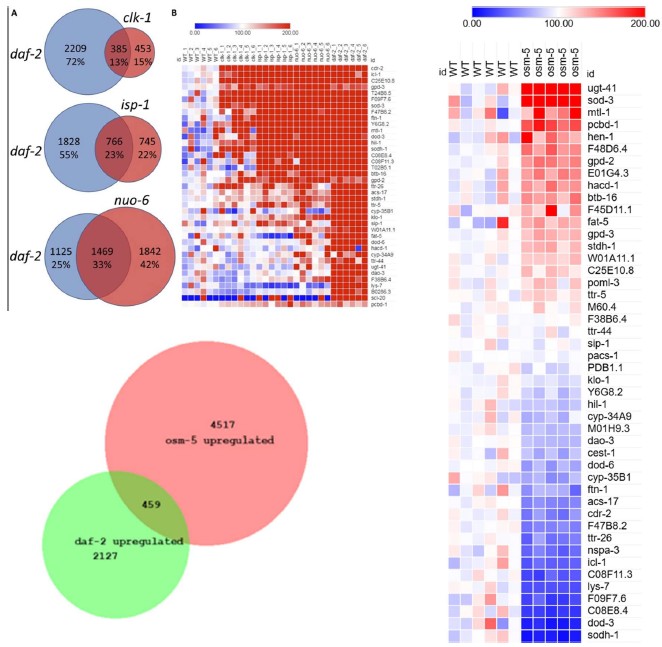
Loss of daf-16 is generally detrimental to lifespan. Disruption of daf-16 decreases the lifespan of all nine long-lived mutants that we examined (see supplemental table in our review paper PMID:37127095). However, loss of daf-16 also decreases wild-type lifespan. Thus, without further evidence it is hard to distinguish between the loss of daf-16 non-specifically decreasing lifespan verse activation of DAF-16 actually contributing to lifespan extension. In daf-2 mutants and the long-lived mitochondrial mutants there is increased nuclear localization of DAF-16 and upregulation of DAF-16 target genes. The differentially expressed genes in the long-lived mitochondrial mutants exhibit about a 50% overlap with the differentially expressed genes in daf-2 mutants (see Author response image 1). In contrast, osm-5 mutants show upregulation of some DAF-16 upregulated genes, no change in some DAF-16 upregulated genes and downregulation of other DAF-16 upregulated genes (see Author response image 1). Only about 10% of the differentially expressed genes in osm-5 mutants overlap with differentially expressed genes in daf-2 mutants. We believe that these results are consistent with loss of DAF-16 causing a general decrease in lifespan and not specifically contributing to osm-5 longevity. These comparisons will be included in a manuscript that we are currently preparing on osm-5 mutant longevity.
Author response image 1.
(4) This manuscript focused on genes whose RNAi suppressed the mutants longevity. Please also use bioinformatics to analyze the functions of those whose RNAi extends the mutants longevity, because these genes could tell the health price these mutants pay and help improve ageing interventions by reducing side effects.
We perform enrichment analysis for both genes upregulated and downregulated in the long-lived mutant strains. The downregulated genes are involved in translation, ribosome biogenesis and gene expression. For the RNAi screen, we aimed to identify genes that are contributing to longevity and so we looked for a decrease in the lifespan of long-lived mutants when treated with RNAi. We did not screen for genes that extend the long-lived mutants longevity. While we did, nonetheless, identify multiple RNAi clones that increased either daf-2 or nuo-6 lifespan, there were not enough genes to identify any patterns of enrichment.
(5) (OPTIONAL) I strongly suggest a comprehensive comparison of these transcriptomic changes in long-lived mutants with published age-related transcriptomic changes in wild type worms.
According to this suggestion, we have now compared the differentially expressed genes that we identified in the nine long-lived mutants with genes that were found to be differentially expressed with aging. Interestingly, the group 2 long-lived mutants show a larger overlap for genes modulated in the opposite direction as aging (genes downregulated during aging are upregulated in eat-2 and osm-5 mutants). We have added this new analysis to our manuscript. Please see lines 210-223, Figure S32 and Table S6.
Minor comments
(1) Please further clarify the analysis of DEGs correlated with lifespan extension in Fig. 2 by a depiction. In Fig. 2C and D, please label data dots from different strains with different colors.
According to this suggestion, each strain has been labelled a different colour.
(2) In Fig. 3 and S20, please label the percentage of overlapping genes on top of each bars.
We have now labelled the percentage of overlapping genes in Figure 3 and S20 (now S27).
Reviewer #2:
Major comments
(1) While the authors identified a set of 196 upregulated genes, the rationale for narrowing these down to the three final candidates (C08F11.7, ugt-62, and K05C4.9) is not clearly described. The authors show that genetic inhibition of several genes, including DC2.5, C05B5.5, T07C4.5, and W03B1.7, decreases lifespan in both nuo-6 mutants and wild-type animals. However, the authors did not describe why these additional validated candidates, which also showed significant effects on longevity, were not pursued for further
characterization. The authors should explicitly state the criteria used to prioritize these three genes over the other validated genes.
Due to the costs and time involved in generating and characterizing new strains, we decided that we would select three strains to study further as a proof-of-principle. When deciding which genes to study further, we considered several approaches. In the end, we chose to use the strength/reproducibility of the increase in weighted mortality to identify genes with a clear, consistent impact. C05B5.5 and T07C4.5 were ruled out because they had an inconsistent impact on weighted mortality (Figure S28). W03B1.7 was ruled out because it did not have a strong enough e ect on weighted mortality (Figure S28). That narrowed it down to C08F11.7, ugt-62, DC2.5, and K05C4.9. Of those 4, C08F11.7, ugt-62, and K05C4.9 have the greatest consistent impact on weighted mortality (Figure S28) and so these genes were chosen. We have updated the manuscript to include this justification for focussing on C08F11.7, ugt-62, and K05C4.9. Please see lines 273-278.
(2) The authors conclude that longevity can be mediated by multiple molecular pathways. However, it remains unclear whether these distinct strategies can operate simultaneously or are mutually exclusive. The authors need to test whether lifespan extension in a Group 1 mutant is further enhanced or suppressed by the knockdown of a key Group 2-specific genes. These experiments would help determine these pathways act additively, antagonistically, or as partially redundant survival programs.
This is an excellent suggestion. While our data identify several genes that are regulated in opposite directions in group 1 and group 2 longevity mutants, we do not yet know the extent to which each of these genes contribute to the longevity of group 1 and group 2 mutants. The three genes that we focused on for further characterization (C08F11.7, ugt-62 and K05C4.9) are upregulated in group 1 longevity mutants but not group 2 mutants. Contrary to what might be expected, RNAi knockdown of these genes does not decrease the lifespan of the group 1 longevity mutant daf-2 but does decrease the lifespan of the group 2 longevity mutant eat-2. We recently reviewed the e ect of di erent resilience pathways on the lifespan of long-lived genetic mutants. Disruption of daf-16, sek-1, skn-1, hsf-1, ire-1 and trx-1 can decrease lifespan in both group 1 and group 2 longevity mutants, but also decreases lifespan in wild-type worms suggesting that at least in some mutants the e ect on longevity may be non-specific. Disruption of hif-1 does not a ect the longevity of group 2 mutants, but does a ect the lifespan of some group 1 mutants (clk-1, isp-1, nuo-6) but not others (daf-2, glp-1). To more definitively answer the question, it would be interesting to cross different combinations of group 1 and group 2 longevity mutants to see the extent to which different longevity groups synergize. This is something we are currently working on for a separate manuscript. We have added these points to the revised manuscript. Please see lines 363-381.
(3) The authors provide interesting data on overexpression of the three candidate genes. However, whereas C08F11.7 clearly demonstrates both necessity and sufficiency for lifespan extension, overexpression of ugt-62 and K05C4.9 does not independently extend lifespan. To strengthen the manuscript, the authors should expand the discussion of these divergent results and clarify possible explanations.
According to this suggestion, we have expanded our discussion to discuss possibilities of why these genes might be having different effects on lifespan. Please see lines 411-423.
(4) Key citations are missing and the authors should add multiple citations including the following ones. Please cite the following paper and discuss the authors' finding with respect to the related work (Lee et al PMID: 40814218). Add citations in the sentence describing changes in the transcriptome of C. elegans associated with age (Lee et al., PMID: 38508494). Furthermore, please cite papers describing the overviews of survival assay using C. elegans (Kwon et al., PMID: 40436148, Hwang et al., PMID: 40436147).
We have added the suggested citations to the revised manuscript. Please see lines 211 (Ref #39), 307 (Ref #41), 423 (Ref #54) and 436 (Ref #55).
Minor comments
(1) To improve readability, please provide the full names for all abbreviations at their first appearance in the manuscript.
We have added the full names for each abbreviation on first appearance.
(2) Please ensure that the labels in the figures match the text exactly. For instance, if different promoters are used for generating overexpression animals, it may be helpful to indicate the specific promoter in the figure panel or legend for clarity.
We have ensured that the nomenclature in the text and the figures is the same. We have noted the promoter used for the overexpression strains in the figure legend.
(3) For all lifespan and stress resistance assays, please include the total number of animals (n) and the number of independent biological replicates (N) in the figure legends to confirm statistical reliability.
We have added the number of animals and independent biological replicates to the figures and figure legends.
(4) Please clearly specify the exact developmental stage of the animals used for the survival assays in the Materials and Methods section.
We have updated the methods to describe the developmental stages used for the survival assays.



